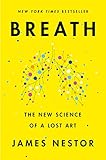
Editors Reads Verdict
Nestor's thorough investigation of breathing science is one of the more surprising and practically useful health books in years. The idea that most people breathe sub-optimally, with measurable health consequences, is well-documented and actionable.
What We Loved
- The nasal breathing vs. mouth breathing research is genuinely compelling and well-sourced
- Nestor's personal self-experimentation adds credibility and readable drama
- The historical and anthropological context is fascinating
- Practical techniques (Buteyko, coherent breathing, box breathing) are clearly explained
Minor Drawbacks
- Some claims extend further than the evidence strictly supports
- The folk and traditional material requires more critical treatment
- Some readers want more clinical evidence and less personal narrative
Key Takeaways
- → Mouth breathing causes measurable structural changes in the face and teeth — and health problems
- → Nasal breathing filters, humidifies, and nitric-oxide-enriches air in ways mouth breathing does not
- → Slow, diaphragmatic breathing at approximately 5-6 breaths per minute has significant cardiovascular benefits
- → Most people breathe too fast and with too little carbon dioxide tolerance
- → Ancient practices (pranayama, Wim Hof, Buteyko) have real physiological effects
| Author | James Nestor |
|---|---|
| Publisher | Riverhead Books |
| Pages | 304 |
| Published | May 26, 2020 |
| Language | English |
| Genre | Health, Science, Self-Help |
| Difficulty | Beginner |
| Best For | Anyone interested in improving their health through breathing practices, particularly those with sleep apnea, anxiety, asthma, or general wellness goals. |
How Breath Compares
Breath at a glance against 3 similar books readers weigh alongside it.
| Book | Author | Rating | Best for |
|---|---|---|---|
| Breath (this book) | James Nestor | ★ 4.5 | Anyone interested in improving their health through breathing practices, |
| Dopamine Nation | Anna Lembke | ★ 4.4 | Anyone dealing with compulsive behaviours — social media, food, substances, |
| Outlive | Peter Attia | ★ 4.7 | Adults of any age who want to approach their long-term health proactively |
| Why We Sleep | Matthew Walker | ★ 4.5 | Anyone who regularly gets less than 7 hours of sleep and rationalises it — |
The Overlooked Health Practice
James Nestor is a science journalist who became fascinated by breathing after attending a freediving class. The observation that changed his focus: trained freedivers could hold their breath for extraordinary periods, not primarily because of lung capacity, but because of how they breathed between dives. He began investigating the science of breathing and found a field with centuries of accumulated wisdom and decades of neglected scientific research.
Breath is the synthesis of that investigation: a well-reported, occasionally surprising examination of how breathing affects health and how most people in the modern world are doing it suboptimally.
The Nose vs. The Mouth
The book’s central finding is deceptively simple: nasal breathing is significantly healthier than mouth breathing, and a large proportion of the population habitually breathes through their mouths. Nestor documents the consequences: the nasal passages filter air, humidify it, and — crucially — produce nitric oxide (a vasodilator that improves oxygen delivery to tissues). None of these benefits are available to mouth breathers.
To demonstrate the point, Nestor took part in a Stanford experiment overseen by the rhinologist Dr. Jayakar Nayak, plugging his nose and breathing exclusively through his mouth for ten days while his health metrics were tracked, before switching to nasal breathing for a further ten. The mouth-breathing results were alarming: blood pressure rose, heart rate variability fell, stress hormones climbed, and snoring and sleep apnea appeared almost overnight. The reversal, once he returned to nasal breathing, was nearly as dramatic — a vivid, self-experimental demonstration of the book’s thesis.
How We Lost the Art
Some of the book’s most fascinating material is anthropological. Nestor argues, drawing on paleontology and the work of researchers studying ancient skulls, that humans were once superb breathers with wide, forward-set jaws and clear airways. The soft, processed diet of the industrial age, he contends, shrank our mouths and crowded our teeth over just a few generations, narrowing nasal passages and turning a large share of the modern population into chronic mouth breathers. This reframing — that crooked teeth, sleep apnea, and blocked noses are partly diseases of modern civilisation — gives the practical advice a deeper, more unsettling context, even if the historical reconstruction is necessarily speculative in places.
The Perfect Breath
Drawing on research from the Cleveland Clinic, the Framingham Heart Study, and independent researchers, Nestor identifies an optimal breathing pattern: approximately 5.5 seconds in, 5.5 seconds out — about 5.5 breaths per minute. This pattern, which appears in diverse traditions from pranayama to Catholic rosary prayer to mantra meditation, consistently produces measurable improvements in heart rate variability, blood pressure, and subjective wellbeing.
Carbon Dioxide and the Bohr Effect
One of the book’s most counterintuitive insights concerns CO2. We typically think of carbon dioxide as a waste product to be expelled as rapidly as possible. But CO2 triggers the Bohr effect — the mechanism that releases oxygen from haemoglobin into the tissues that need it. Chronically over-breathing, and so exhaling too much CO2, paradoxically reduces oxygen delivery to the brain and muscles. This is why so many of the book’s techniques aim at breathing less, not more, and why raising one’s tolerance to carbon dioxide turns out to be a marker of fitness and calm rather than a problem to be solved. It is the single idea most likely to change how a reader thinks about that next deep, gulping breath.
The Techniques
Beyond “breathe through your nose” and “breathe slowly,” Nestor surveys a toolkit of named methods, explaining the physiology behind each. The Buteyko method, developed by a Ukrainian doctor, trains people to breathe less — reducing volume to raise CO2 tolerance — and has shown real benefits for asthmatics. Coherent (resonant) breathing is the 5.5-in, 5.5-out pattern that optimises heart rate variability. At the more extreme end he explores Tummo and the Wim Hof Method, which use bouts of heavy breathing and breath-holds to deliberately stress and then regulate the nervous system. The practical, low-cost nature of these tools is much of the book’s appeal: most cost nothing and can be tried tonight.
Criticisms
Breath is not without its skeptics, and the cautions are worth heeding. Nestor is a journalist and self-experimenter rather than a clinician, and at times his enthusiasm carries individual claims further than the peer-reviewed evidence strictly supports. The folk traditions and anecdotal cures he relays deserve more critical scrutiny than they sometimes receive, and readers wanting hard clinical trials rather than compelling stories will find the balance tilted toward narrative. Taken as a well-sourced invitation to pay attention to something we do 25,000 times a day — rather than as settled medical doctrine — it earns its place.
Final Verdict
Breath is an accessible, well-reported, and practically valuable examination of a health practice we take entirely for granted. An international bestseller that has sold over two million copies, it makes a persuasive case that how we breathe is a genuine and neglected pillar of health, and its core recommendations are simple, free, and well-supported by evidence.
Few health books deliver advice this simple, this free, and this immediately testable. You can begin the most important experiment in the book — close your mouth and breathe slowly through your nose — before you have even finished reading this review, and that accessibility, more than any single study Nestor cites, is why Breath has stayed with so many readers.
Our rating: 4.5/5 — An eye-opening investigation into the most basic human action. The nasal breathing prescription alone is worth the cover price.
Frequently Asked Questions
What is "Breath" about?
A science journalist investigates the health implications of how we breathe — and finds that most people are doing it wrong, with significant consequences for their health.
Who should read "Breath"?
Anyone interested in improving their health through breathing practices, particularly those with sleep apnea, anxiety, asthma, or general wellness goals.
What are the key takeaways from "Breath"?
Mouth breathing causes measurable structural changes in the face and teeth — and health problems Nasal breathing filters, humidifies, and nitric-oxide-enriches air in ways mouth breathing does not Slow, diaphragmatic breathing at approximately 5-6 breaths per minute has significant cardiovascular benefits Most people breathe too fast and with too little carbon dioxide tolerance Ancient practices (pranayama, Wim Hof, Buteyko) have real physiological effects
Is "Breath" worth reading?
Nestor's thorough investigation of breathing science is one of the more surprising and practically useful health books in years. The idea that most people breathe sub-optimally, with measurable health consequences, is well-documented and actionable.
Ready to Read Breath?
Check the current price on Amazon.
Check Price on Amazon (paid link)Prices and availability are subject to change. See Amazon for current price.
Review last updated: