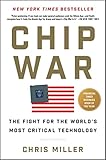
Editors Reads Verdict
Miller's account of the semiconductor industry is a masterwork of technology history — accessible, thoroughly researched, and written with genuine narrative urgency about a subject whose strategic importance most people have barely begun to grasp.
What We Loved
- Miller makes extraordinarily complex technology history accessible without simplifying it
- The geopolitical implications are explained with genuine strategic intelligence
- The characters — engineers, executives, military planners — are rendered vividly
- The stakes — who controls semiconductor manufacturing controls the global economy — are made visceral
Minor Drawbacks
- The technical depth can be demanding for readers with no semiconductor background
- The book's 2022 publication means the US-China chip war has evolved significantly since
- Some readers may want more policy prescription alongside the historical analysis
Key Takeaways
- → Semiconductor manufacturing is the most concentrated and strategically critical industry on Earth
- → Taiwan's TSMC produces chips at a sophistication no other company can match
- → The miniaturization of transistors has been the defining technological achievement of the twentieth and twenty-first centuries
- → Military power in the twenty-first century depends on semiconductors more than any other resource
- → The US-China technology competition is fundamentally a competition for control of semiconductor manufacturing
| Author | Chris Miller |
|---|---|
| Publisher | Scribner |
| Pages | 464 |
| Published | October 4, 2022 |
| Language | English |
| Genre | History, Technology, Business |
| Difficulty | Intermediate |
| Best For | Readers interested in technology history, geopolitics, and the economic competition between the US and China — anyone who wants to understand why semiconductor policy has become central to global power competition. |
How Chip War Compares
Chip War at a glance against 3 similar books readers weigh alongside it.
| Book | Author | Rating | Best for |
|---|---|---|---|
| Chip War (this book) | Chris Miller | ★ 4.5 | Readers interested in technology history, geopolitics, and the economic |
| Bad Blood | John Carreyrou | ★ 4.6 | Business readers, technology professionals, healthcare workers, and anyone |
| Sapiens | Yuval Noah Harari | ★ 4.6 | Curious readers of all backgrounds who want to understand how Homo sapiens came |
| The Smartest Guys in the Room | Bethany McLean | ★ 4.3 | Readers of business and financial journalism and anyone interested in corporate |
The Resource That Rules the World
Every smartphone, data center, advanced weapon system, electric vehicle, and modern appliance contains semiconductors. The most advanced chips — the ones that power artificial intelligence and cutting-edge military systems — are manufactured at a degree of precision that no other industry on Earth approaches, in factories that cost tens of billions of dollars to build, using equipment produced by a handful of companies in the Netherlands, Japan, and the United States.
Taiwan’s TSMC manufactures the majority of the world’s most advanced chips. This single fact — more than any other — explains why the Taiwan Strait has become the world’s most consequential potential flashpoint.
Chris Miller, an economic historian at Tufts, spent years researching the semiconductor industry to write Chip War, and his book arrived at exactly the right moment: as the US government implemented export controls designed to prevent China from acquiring the technology to manufacture advanced chips, and as the world began to understand, imperfectly and belatedly, that the semiconductor question was the central strategic competition of the era.
A History of Miniaturization
The book’s narrative arc spans seventy years: from the invention of the transistor at Bell Labs in 1947 through the development of the integrated circuit, the rise of Silicon Valley, the offshore manufacturing decisions that concentrated advanced chipmaking in Asia, and the current US-China competition. Miller traces the key figures — Jack Kilby, Robert Noyce, Andy Grove, Morris Chang — with the precision of someone who has done primary research and the accessibility of a natural writer.
The technical narrative — how transistors work, why miniaturization matters, what “nanometer” refers to in chip design — is handled with exactly the right level of detail: enough to make the stakes intelligible, not so much that non-engineers get lost.
The Geopolitical Argument
Miller’s most important contribution is explaining, clearly and systematically, why semiconductor control has become the defining geopolitical question of the twenty-first century. Advanced military systems — precision weapons, satellite networks, electronic warfare — require chips manufactured at the frontier of capability. Countries that cannot manufacture frontier chips cannot build frontier weapons. The logic is that simple and that consequential.
China’s semiconductor deficit — its current inability to manufacture at the leading edge — is the primary motivation for the Belt and Road Initiative’s technology components, for China’s massive investment in domestic chip capacity, and for the threat to Taiwan that a semiconductor-dependent China faces.
A Book That Landed at the Right Moment
Chip War won the Financial Times Business Book of the Year in 2022 and was cited by multiple US government officials as essential reading. The recognition reflects how far ahead of the broader policy conversation Miller’s research placed him.
Chris Miller and the Making of the Book
Chris Miller came to the semiconductor story by an unusual route. He is an academic historian whose earlier work focused on Russia and the Soviet economy — his first books examined Putin’s economic policy and the financial dimensions of the Soviet collapse — and he teaches international history at the Fletcher School at Tufts University. That background in economic statecraft, rather than in engineering, shapes Chip War’s distinctive angle: Miller is less interested in the physics of transistors for their own sake than in how the chip industry became an instrument of national power, how supply chains concentrated in a handful of countries, and how governments learned, slowly, to treat semiconductors as strategic assets. He spent roughly five years on the research, interviewing engineers, executives, and officials and digging through the histories of companies like Intel, Texas Instruments, TSMC, ASML, and Japan’s chip champions. The result reads less like a technology manual than like a Cold War history in which the decisive weapon turned out to be a sliver of patterned silicon.
The Argument and Its Reception
The central thesis of Chip War is that control over the design and manufacture of advanced semiconductors has become the foundation of both economic and military power, and that this control is dangerously concentrated — above all in Taiwan, whose TSMC fabricates the overwhelming majority of the world’s leading-edge chips. Miller traces how the United States built its early dominance, how Japan and then South Korea and Taiwan captured huge shares of manufacturing, and how China’s determined but lagging effort to catch up has turned chips into the central front of great-power rivalry. The book arrived precisely as the U.S. imposed sweeping export controls on advanced chips and chipmaking equipment to China, and its timing made it both prophetic and unusually influential; it was widely read inside governments and corporations and won the Financial Times and Schroders Business Book of the Year award. Critics noted that its 2022 vantage point means the fast-moving policy landscape has already shifted, and that Miller offers more diagnosis than prescription, but few dispute the clarity and authority of the underlying history.
Who Should Read It
Chip War is essential reading for anyone trying to understand the actual mechanics of twenty-first-century geopolitics — investors, policymakers, technologists, and general readers alike. It assumes no prior expertise, explaining concepts like lithography, fabrication, and the meaning of “nanometer” with enough care that a non-engineer can follow the stakes, while never dumbing the material down to the point of uselessness for more technical readers. Those who enjoyed the sweep of books like Sapiens or the corporate drama of Bad Blood will find a comparable narrative momentum here, applied to a subject of enormous and growing consequence. For readers who have wondered why a small island in the Western Pacific has become the most strategically important place on Earth, Miller provides the clearest available answer.
Our rating: 4.5/5 — A masterwork of technology history that makes the semiconductor industry’s strategic centrality viscerally clear — essential reading for anyone who wants to understand the actual architecture of twenty-first century power competition.
Frequently Asked Questions
What is "Chip War" about?
Economic historian Chris Miller traces the history of the semiconductor industry from the invention of the transistor to the US-China technology war, showing how computer chips became the defining resource of the twenty-first century.
Who should read "Chip War"?
Readers interested in technology history, geopolitics, and the economic competition between the US and China — anyone who wants to understand why semiconductor policy has become central to global power competition.
What are the key takeaways from "Chip War"?
Semiconductor manufacturing is the most concentrated and strategically critical industry on Earth Taiwan's TSMC produces chips at a sophistication no other company can match The miniaturization of transistors has been the defining technological achievement of the twentieth and twenty-first centuries Military power in the twenty-first century depends on semiconductors more than any other resource The US-China technology competition is fundamentally a competition for control of semiconductor manufacturing
Is "Chip War" worth reading?
Miller's account of the semiconductor industry is a masterwork of technology history — accessible, thoroughly researched, and written with genuine narrative urgency about a subject whose strategic importance most people have barely begun to grasp.
Ready to Read Chip War?
Check the current price on Amazon.
Check Price on Amazon (paid link)Prices and availability are subject to change. See Amazon for current price.
Review last updated: