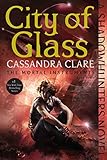
Editors Reads Verdict
City of Glass is the emotional culmination of the original Mortal Instruments trilogy, delivering long-deferred revelations with considerable dramatic skill while opening the Shadowhunter world into a scale it could not previously reach.
What We Loved
- The Idris setting dramatically expands the world's scope and visual imagination
- Long-built revelations about Clary and Jace's true relationship land with real impact
- The climax delivers genuine emotional stakes while honoring the trilogy's central relationships
- Alec and Magnus's storyline reaches a satisfying emotional maturity
Minor Drawbacks
- The middle section carries the weight of significant exposition and world-building
- Some plot developments rely on coincidences that strain credibility
- Valentine as a villain is more effective as a threat than as a characterized person
Key Takeaways
- → Identity is not determined by the parents who made you but by the choices you make with what you were given
- → The laws of an insular society often exist to protect the society's comfort rather than its values
- → Love is not diminished by revelation — it is tested and, if genuine, survives the test
- → Every world built on exclusion contains the seeds of its own crisis
- → Sacrifice means something only if the person making it had a real choice
| Author | Cassandra Clare |
|---|---|
| Publisher | Margaret K. McElderry Books |
| Pages | 541 |
| Published | March 24, 2009 |
| Language | English |
| Genre | Fantasy, Young Adult, Urban Fantasy, Fiction |
| Difficulty | Beginner |
| Best For | Readers who have followed Clary and Jace through City of Bones and City of Ashes; urban fantasy fans looking for the emotional payoff of a trilogy's conclusion. |
How City of Glass Compares
City of Glass at a glance against 3 similar books readers weigh alongside it.
| Book | Author | Rating | Best for |
|---|---|---|---|
| City of Glass (this book) | Cassandra Clare | ★ 4.5 | Readers who have followed Clary and Jace through City of Bones and City of Ashes |
| An Ember in the Ashes | Sabaa Tahir | ★ 4.3 | YA fantasy readers |
| City of Ashes | Cassandra Clare | ★ 4.2 | Readers who have completed City of Bones and are invested in the Shadowhunter |
| City of Bones | Cassandra Clare | ★ 4.2 | Young adult and adult fantasy readers — particularly those drawn to urban |
Into Idris
The first two Mortal Instruments books take place in New York City — a Manhattan where Shadowhunters operate in plain sight of mundanes who cannot see them, where Downworlders occupy the margins of society, and where the secret war between Valentine and the Clave plays out against the familiar backdrop of urban geography. City of Glass does something more audacious: it removes all of that.
Idris is the Shadowhunters’ hidden homeland, a walled country with a glass city at its center that mundanes cannot find and Downworlders are forbidden to enter. Arriving there, Clary — and the reader — encounters the full architecture of the society Clare has been building: its laws, its prejudices, its history, and the class of people who benefit from keeping all three intact. The setting change is more than cosmetic. It forces a confrontation with what Shadowhunter society actually is, separate from the romantic and action-driven momentum of the New York books.
The Weight of Revelation
City of Glass is built around a series of revelations, and Clare delivers most of them with genuine dramatic skill. The central mystery — what is the true nature of Clary and Jace’s relationship, and what has Valentine been doing with the information he has kept from both of them — has been developed across three books with enough care that the answer lands as earned truth rather than convenient plot device.
The revelation changes the emotional stakes of everything that precedes it. Rereading the series after City of Glass is a different experience, and Clare builds toward that retroactive recontextualization with structural competence that the first two books’ momentum sometimes obscures.
Valentine’s Endgame
Valentine’s plan in City of Glass is his most ambitious: using the Mortal Instruments to summon the Angel Raziel and command him to remake the world without Downworlders. It is a genocidal fantasy dressed in the language of purity and protection, and Clare draws the parallel to real-world exclusionary ideology with enough clarity to give it resonance beyond genre convention.
The climax — which involves Clary’s creative use of the runes she has always been able to invent — is satisfying precisely because it requires the protagonist’s unique capabilities rather than conventional heroism. The solution to Valentine is not strength or strategy but imagination.
An Opening Rather Than a Closing
Despite being conceived as the conclusion of a trilogy, City of Glass reads in retrospect as a beginning. The world it opens — Idris as a political entity, the Clave as an institution in crisis, the Downworlders as a community with claims on equality — is too large and too interesting to remain merely a backdrop. Clare spent the next decade exploring it across multiple series, and the decisions made in this book’s final pages shape all of them.
Our rating: 4.5/5 — The emotionally satisfying conclusion to the original Mortal Instruments trilogy, delivering its long-promised revelations with craft and expanding the Shadowhunter world into the full scale it always suggested.
Reading Guides
- Cassandra Clare Books in Order: Complete Shadowhunters Reading Guide (2026)
- Paul Auster Books in Order: The Complete Reading Guide (2026)
Idris as Culmination
The choice to set City of Glass’ major events in Idris — the Shadowhunters’ homeland that no mundane can find and no Downworlder may enter — is more than a setting change. It is a forcing function. In New York, the Shadowhunters operate as a hidden parallel society alongside the mundane world; their prejudices and power structures are partly invisible because their full social architecture is never on display. Idris strips away the context that has been moderating the reader’s view.
What Clare shows in the glass city of Alicante and the Shadowhunter society gathered around it is a community whose insularity is visible in its architecture, its laws, and its unexamined assumptions. The Shadowhunters who have never left Idris — who have always lived in a world where their supremacy is the natural order — are a different species from Clary’s New York acquaintances, and their instinctive hostility to Downworlders is not individual bigotry but cultural inheritance.
The Resolution of the Central Mystery
The core mystery of the Mortal Instruments trilogy — what Valentine actually did to Clary and Jace before and after their births, and what their true relationship is — is resolved in City of Glass with precision that rewards the patience Clare has asked of readers across two books. The answer is neither the simplest version the reader might have hoped for nor the most convenient; it is the answer that most fully honours the emotional investment the series has accumulated.
Clare handles the revelation with enough structural care that it recontextualises both previous books without making them feel misleading. The clues were always there; what changed was the framework for interpreting them.
The War for Idris
City of Glass’ third act is the series’ first full-scale war sequence — multiple factions, high casualties, the fate of the Shadowhunter world in explicit jeopardy. Clare stages it with enough chaos and enough individual focus that it reads as both epic and personal. The deaths that occur in the battle carry weight because Clare has built the characters carefully enough for the reader to feel their loss.
The battle’s resolution — the creative use Clary makes of her rune-inventing ability, which has been established across three books as her particular gift — is the kind of climax that pays off series-long setup with clean narrative logic. The protagonist’s unique capability solves the impossible problem. It is an old convention executed with real skill.
More Than a Trilogy
That City of Glass was conceived as a conclusion and functions as one — while simultaneously opening the world so thoroughly that three more trilogies followed — is a significant structural achievement. The resolution is genuine; the story is complete. Everything that follows is the continuation of a world rather than the resolution of a plot.
Frequently Asked Questions
What is "City of Glass" about?
Clary and Jace travel to Idris, the Shadowhunters' hidden homeland, where Valentine seeks the power to destroy all Downworlders — and a revelation about Clary's true identity changes everything she thought she knew.
Who should read "City of Glass"?
Readers who have followed Clary and Jace through City of Bones and City of Ashes; urban fantasy fans looking for the emotional payoff of a trilogy's conclusion.
What are the key takeaways from "City of Glass"?
Identity is not determined by the parents who made you but by the choices you make with what you were given The laws of an insular society often exist to protect the society's comfort rather than its values Love is not diminished by revelation — it is tested and, if genuine, survives the test Every world built on exclusion contains the seeds of its own crisis Sacrifice means something only if the person making it had a real choice
Is "City of Glass" worth reading?
City of Glass is the emotional culmination of the original Mortal Instruments trilogy, delivering long-deferred revelations with considerable dramatic skill while opening the Shadowhunter world into a scale it could not previously reach.
Ready to Read City of Glass?
Check the current price on Amazon.
Check Price on Amazon (paid link)Prices and availability are subject to change. See Amazon for current price.
Review last updated: