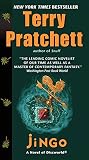
Editors Reads Verdict
The fourth City Watch novel turns Sam Vimes loose on war itself. As Ankh-Morpork and Klatch lurch toward a pointless conflict, Pratchett delivers a furious, funny anatomy of patriotism, prejudice, and the lies nations tell — with Vimes trying to arrest a war.
What We Loved
- Sam Vimes at his angry, principled best
- Sharp, still-relevant satire of war and jingoism
- Brings the whole City Watch ensemble into play
Minor Drawbacks
- An Antichamber-style detour subplot is divisive
- Heavier-handed than some earlier Watch books
Key Takeaways
- → Pratchett's sharpest satire of patriotism, war, and prejudice
- → Deepens Sam Vimes as one of fantasy's great moral protagonists
- → The fourth City Watch novel, building on Guards! Guards! and Men at Arms
- → Still uncomfortably topical decades after publication
| Author | Terry Pratchett |
|---|---|
| Publisher | Harper |
| Pages | 432 |
| Published | April 29, 2014 |
| Language | English |
| Genre | Fantasy, Comic Fantasy, Fiction |
| Difficulty | Beginner |
| Best For | Watch-series fans and readers who want comic fantasy with a hard satirical edge about war and nationalism. |
How Jingo Compares
Jingo at a glance against 3 similar books readers weigh alongside it.
| Book | Author | Rating | Best for |
|---|---|---|---|
| Jingo (this book) | Terry Pratchett | ★ 4.2 | Watch-series fans and readers who want comic fantasy with a hard satirical edge |
| Feet of Clay | Terry Pratchett | ★ 4.4 | Fantasy |
| Guards! Guards! | Terry Pratchett | ★ 4.5 | The ideal first Discworld book for adult readers — recommended for anyone who |
| Men at Arms | Terry Pratchett | ★ 4.5 | Fantasy |
An island rises and a war begins
In the middle of the Circle Sea, between Ankh-Morpork and the desert nation of Klatch, an island surfaces. It is Leshp — an ancient, sodden, largely useless lump of rock that has been underwater for centuries — and the instant it appears, both nations decide it is theirs, vital, and worth fighting for. With an attempted assassination of a Klatchian prince on Ankh-Morpork soil to light the fuse, the two cities slide, almost gratefully, toward war.
Jingo, the twenty-first Discworld novel and the fourth to centre on the City Watch, is Terry Pratchett’s war book, and it is one of his angriest. The title says it: this is a dissection of jingoism, of the giddy, dangerous patriotism that grips a population when someone waves a flag and names an enemy. Pratchett watches respectable, decent people of Ankh-Morpork transform overnight into chest-thumping warmongers, ready to despise neighbours they were friends with last week simply because those neighbours come from Klatch. The satire is broad, furious, and — decades on — uncomfortably undimmed.
Vimes versus the war
Standing against the tide is Commander Sam Vimes, head of the City Watch and Pratchett’s great study in earned, hard-won decency. Vimes is a working policeman to his bones, and he refuses to see a war as anything other than a very large crime in progress. His response to two armies meeting on a battlefield is to try to arrest both of them for breach of the peace. It is absurd, and it is also the moral centre of the entire book: Vimes insists that murder does not become acceptable because it is done at scale and called patriotism.
Pratchett uses Vimes to ask one of his recurring questions — what separates a policeman from a soldier, justice from vengeance, order from oppression — and the answer is uneasy. Vimes knows the darkness in himself; he carries an inner voice, the “Beast,” that he must constantly govern. His struggle to hold the line, to keep the law above the mob, gives Jingo a weight that lifts it well past comedy. The Watch ensemble backs him up: Carrot, the impossibly good dwarf-raised human; Angua, the werewolf; Detritus, the troll; Nobby and Colon providing the low farce; and Lord Vetinari, the Patrician, playing his own quietly devastating game on the side.
Satire with the gloves off
What makes Jingo land is how precisely Pratchett names the mechanics of manufactured hatred. The book skewers the way prejudice gets dressed up as common sense, the way “they’re not like us” justifies any cruelty, the way a war machine runs on slogans and the willingness of ordinary people to stop thinking. The Klatchians, far from the villains the Ankh-Morpork mob imagines, turn out to be a sophisticated, ancient civilisation, and the running joke is that each side’s caricature of the other is exactly, symmetrically wrong.
The novel does take risks. A subplot involving Vetinari, Nobby, and Colon on a strange experimental vessel veers off into a near-magical detour about roads not taken, which some readers find inventive and others find a distraction from the main thrust. And Jingo is undeniably more pointed, more openly polemical, than the lighter Watch books. But the anger is righteous, and Pratchett never lets the message smother the jokes — Nobby in disguise alone is worth the price of admission.
Where it sits in Discworld
Jingo is the fourth City Watch novel, following Guards! Guards!, Men at Arms, and Feet of Clay. It is best read in sequence, since Vimes’s character and the Watch’s growth are cumulative — Guards! Guards! introduces him as a drunk, and each book builds him into the formidable, principled figure he is here. Newcomers can follow Jingo alone, but the emotional payoff depends on having watched Vimes climb. The Watch thread continues into The Fifth Elephant, Night Watch, and Thud!.
Within the series, the Watch books are many readers’ favourites, and Jingo sits comfortably among them — perhaps not the very best, but one of the most thematically urgent.
The craft and the heart
Pratchett’s humanism burns hot in Jingo. Beneath the war satire is an insistence that the enemy is always, on closer inspection, just people — that nations are stories we tell to make killing easier, and that the only honest response to a war is to refuse to play your assigned part. Vimes embodies that refusal, and the book gives him some of his finest moments.
There is craft, too, in how Pratchett structures the slide into conflict. He shows the war building not from one grand decision but from a thousand small surrenders — a rumour believed, a slur left unchallenged, a politician seizing an opportunity, a crowd happy to be told whom to blame. By the time the armies face each other, the reader has watched exactly how an ordinary city talks itself into atrocity, and that accumulation is more damning than any speech. The supporting cast carries the load: 71-hour Ahmed, the Klatchian whose role keeps shifting, is one of Pratchett’s most intriguing one-book characters, and Vetinari’s manoeuvring runs like a cool current beneath the heat.
It is funny, furious, and far too relevant. Jingo is Discworld using comedy as a scalpel, and the wound it opens is the oldest one of all: how easily decent people can be talked into hating each other.
Our rating: 4.2/5 — A blistering, still-topical satire of patriotism and war, carrying Sam Vimes to some of his finest hours as he tries, magnificently, to arrest two armies at once.
Frequently Asked Questions
What is "Jingo" about?
A long-sunk island rises from the sea, and Ankh-Morpork and Klatch both claim it — and stumble toward war. Commander Sam Vimes drags the City Watch into the conflict, determined to police a battlefield and arrest two armies, in Pratchett's blistering satire of patriotism and jingoism.
Who should read "Jingo"?
Watch-series fans and readers who want comic fantasy with a hard satirical edge about war and nationalism.
What are the key takeaways from "Jingo"?
Pratchett's sharpest satire of patriotism, war, and prejudice Deepens Sam Vimes as one of fantasy's great moral protagonists The fourth City Watch novel, building on Guards! Guards! and Men at Arms Still uncomfortably topical decades after publication
Is "Jingo" worth reading?
The fourth City Watch novel turns Sam Vimes loose on war itself. As Ankh-Morpork and Klatch lurch toward a pointless conflict, Pratchett delivers a furious, funny anatomy of patriotism, prejudice, and the lies nations tell — with Vimes trying to arrest a war.
Ready to Read Jingo?
Check the current price on Amazon.
Check Price on Amazon (paid link)Prices and availability are subject to change. See Amazon for current price.
Review last updated: