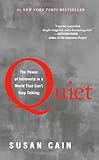
Editors Reads Verdict
Cain's meticulous, moving argument for the value of introversion is the most important psychology book for anyone who has felt marginalised by an extrovert-celebrating culture.
What We Loved
- Rigorous research synthesis with a deeply personal narrative voice
- The Extrovert Ideal historical analysis is original and eye-opening
- Practical guidance for introverts navigating extrovert-designed environments
- The chapter on introvert-extrovert relationships and children is exceptionally useful
Minor Drawbacks
- The introvert/extrovert dichotomy is more complex in real people than the book sometimes acknowledges
- Some prescriptions favour introverts at the potential cost of balanced group dynamics
Key Takeaways
- → One third to one half of the population is introverted — far more than the extrovert-centric culture acknowledges
- → The Extrovert Ideal: the cultural shift from Character to Personality in the 20th century created a bias toward loudness and assertiveness
- → Introverts are not shy; introversion is about stimulation preference, not social fear
- → Many of history's most significant creative and intellectual contributions came from introverts working alone
- → Free Trait Theory: introverts can act extroverted when their core values demand it — with appropriate recovery time
| Author | Susan Cain |
|---|---|
| Publisher | Crown |
| Pages | 368 |
| Published | January 24, 2012 |
| Language | English |
| Genre | Psychology, Self-Help, Science |
| Difficulty | Beginner |
| Best For | Introverts seeking validation and practical strategies, and the extroverts, managers, and parents who want to understand and work better with the introverts in their lives. |
How Quiet Compares
Quiet at a glance against 3 similar books readers weigh alongside it.
| Book | Author | Rating | Best for |
|---|---|---|---|
| Quiet (this book) | Susan Cain | ★ 4.5 | Introverts seeking validation and practical strategies, and the extroverts, |
| Emotional Intelligence | Daniel Goleman | ★ 4.4 | Parents, educators, managers, and anyone interested in understanding the |
| Grit | Angela Duckworth | ★ 4.5 | Students, athletes, educators, parents, and anyone seeking to understand what |
| The Power of Now | Eckhart Tolle | ★ 4.6 | Anyone struggling with anxiety, overthinking, or searching for a practical |
Reclaiming Introversion
When Susan Cain published Quiet in 2012, she gave a name and a rigorous analysis to something millions of people had felt but never articulated clearly: that the modern world — its schools, its offices, its social expectations — was designed by and for extroverts, and that introverts had been systematically undervalued, misunderstood, and pressured to become something they weren’t.
Her TED Talk (one of the most-watched of all time) and this book together sparked a cultural conversation that is still ongoing. But unlike many pop-psychology provocations, Quiet is grounded in serious research and makes its case with precision.
The Extrovert Ideal
Cain traces the cultural history of introversion’s marginalisation to the early twentieth century, when American culture shifted from what she calls a Culture of Character (valuing inner virtue, depth, and moral seriousness) to a Culture of Personality (valuing charm, energy, sociability, and visibility). The rise of self-help literature, advertising, and corporate culture accelerated this shift. The result: a culture that systematically rewards loudness over depth, speed over reflection, and visibility over contribution.
This historical analysis is one of the book’s most original contributions and explains phenomena — why open-plan offices feel oppressive to many workers, why group brainstorming produces worse results than individual ideation — that seem puzzling without this framework.
What Introversion Actually Is
Cain clarifies a persistent confusion: introversion is not shyness. Shyness is fear of social judgment. Introversion is a preference for less stimulating environments — a lower threshold for optimal arousal. Many introverts are perfectly comfortable socially; they simply need solitude to recharge in a way that extroverts don’t.
This distinction matters enormously for self-understanding. An introvert who has been told they are shy is being mislabelled in a way that compounds the problem. An introvert who understands their actual needs can design their environment and schedule accordingly.
Practical Strategies
The practical sections of the book are genuinely useful — for introverts designing their careers and relationships, for managers creating conditions where introverts can contribute at their actual level, and for parents and educators recognising and cultivating introvert children’s particular strengths.
Temperament, Biology, and Free Trait Theory
One of the book’s most fascinating threads digs into the biological roots of temperament. Cain draws on Jerome Kagan’s longitudinal studies of “high-reactive” infants — babies who respond intensely to novelty and tend to grow into careful, observant, often introverted adults — to argue that temperament is partly inborn, rooted in differences in how sensitive our nervous systems are to stimulation. She balances this, importantly, with Brian Little’s Free Trait Theory: the idea that we can each act “out of character” in service of projects and values we care deeply about, so a committed introvert can deliver a rousing lecture or lead a team — provided they build in “restorative niches” of solitude to recover. This nuance saves the book from biological determinism and gives introverted readers a genuinely actionable framework rather than mere consolation. Along the way Cain reclaims a gallery of quietly powerful figures — Rosa Parks, Gandhi, Steve Wozniak, Eleanor Roosevelt — as evidence that influence need not be loud.
Criticisms
The book is not beyond reproach, and its central strength shades into its central weakness. In so thoroughly dismantling the Extrovert Ideal, Cain at times tips into celebrating introversion as a near-moral virtue while painting extroversion in unflattering terms — a reversal of the very bias she set out to correct. Critics have also noted that she moves between the everyday, popular sense of “introvert” and narrower clinical definitions drawn from research, which lets her attach an attractive bundle of qualities to a fuzzy category. Real personalities, too, cluster around the middle of the spectrum (the so-called ambiverts) more than the book’s tidy dichotomy sometimes implies. None of this sinks the argument, but it warrants a reader’s healthy skepticism.
The Case Against Forced Collaboration
One of the book’s most provocative and practically useful arguments takes aim at the modern workplace’s obsession with collaboration. Cain marshals research suggesting that group brainstorming reliably produces fewer and worse ideas than the same people thinking alone and pooling results afterward, undone by social loafing, production blocking, and the fear of judgment. She extends the critique to the open-plan office and the relentlessly group-oriented classroom, environments that can drain and distract the very people most likely to do deep, original work. Her conclusion is not that teamwork is worthless but that solitude is an underrated and endangered condition for creativity — that “the new groupthink” has gone too far, and that organisations serious about innovation should protect quiet, privacy, and freedom from interruption. It is the part of the book most likely to change how a manager actually designs a workplace.
Final Verdict
Quiet is a landmark that has genuinely shifted how organisations, educators, and individuals think about personality and contribution. Paired with Cain’s TED talk — among the most-watched ever given — it sparked a cultural conversation that endures. It is meticulously researched, warmly written, and practically valuable, and for the third to half of the population that has felt out of step with a world that can’t stop talking, it is both clarifying and quietly empowering.
More than a decade on, it remains the definitive popular treatment of its subject and a quietly radical act of permission for everyone who has ever been told to speak up, network harder, or stop overthinking — when their real strength lay precisely in listening, focusing, and thinking things through.
Our rating: 4.5/5 — Essential reading for the significant proportion of the population that has felt out of step with extrovert culture. Clarifying and quietly empowering.
Frequently Asked Questions
What is "Quiet" about?
A compelling argument that our society dramatically undervalues introverts and the tremendous power of their deep thinking, focus, and quiet contributions.
Who should read "Quiet"?
Introverts seeking validation and practical strategies, and the extroverts, managers, and parents who want to understand and work better with the introverts in their lives.
What are the key takeaways from "Quiet"?
One third to one half of the population is introverted — far more than the extrovert-centric culture acknowledges The Extrovert Ideal: the cultural shift from Character to Personality in the 20th century created a bias toward loudness and assertiveness Introverts are not shy; introversion is about stimulation preference, not social fear Many of history's most significant creative and intellectual contributions came from introverts working alone Free Trait Theory: introverts can act extroverted when their core values demand it — with appropriate recovery time
Is "Quiet" worth reading?
Cain's meticulous, moving argument for the value of introversion is the most important psychology book for anyone who has felt marginalised by an extrovert-celebrating culture.
Ready to Read Quiet?
Check the current price on Amazon.
Check Price on Amazon (paid link)Prices and availability are subject to change. See Amazon for current price.
Review last updated: