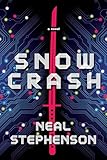
Editors Reads Verdict
Stephenson's wild, prescient, and enormously influential novel invented the word 'metaverse' and predicted the internet economy, corporate feudalism, and virtual reality with extraordinary accuracy.
What We Loved
- Invented or predicted the Metaverse, avatar-based virtual reality, and internet culture with remarkable accuracy
- The satire of late capitalism is savage and still relevant
- The protagonist Hiro Protagonist (yes, that's his name) is genuinely fun to follow
- The Sumerian linguistics subplot is one of science fiction's most original ideas
Minor Drawbacks
- The plot is deliberately chaotic — some readers want more narrative coherence
- The female characters are less developed than the male ones
- The info-dumps on linguistics and mythology can overwhelm the narrative
Key Takeaways
- → The Metaverse was imagined decades before Facebook renamed itself Meta
- → Information (including viruses) can affect both computer systems and human minds
- → Corporate feudalism — private entities replacing government functions — is a natural endpoint of certain political philosophies
- → Language is not just communication but a programming system for human minds
- → The future of identity may be as much digital as physical
| Author | Neal Stephenson |
|---|---|
| Publisher | Bantam Books |
| Pages | 440 |
| Published | June 1, 1992 |
| Language | English |
| Genre | Science Fiction, Cyberpunk, Satire |
| Difficulty | Intermediate |
| Best For | Science fiction readers, technologists, and anyone curious about the origins of ideas like the metaverse, avatar culture, and digital identity. |
How Snow Crash Compares
Snow Crash at a glance against 3 similar books readers weigh alongside it.
| Book | Author | Rating | Best for |
|---|---|---|---|
| Snow Crash (this book) | Neal Stephenson | ★ 4.4 | Science fiction readers, technologists, and anyone curious about the origins of |
| Foundation | Isaac Asimov | ★ 4.6 | Science fiction readers interested in big ideas, galactic-scale history, and |
| Neuromancer | William Gibson | ★ 4.3 | Science fiction readers interested in the foundational texts of cyberpunk and |
| Ready Player One | Ernest Cline | ★ 4.4 | Science fiction readers who enjoy page-turning adventure plots and 1980s pop |
The Novel That Invented the Metaverse
Neal Stephenson published Snow Crash in 1992, when the World Wide Web was brand new and most people had never heard of the internet. In the novel, he described a globally networked virtual reality called the Metaverse, accessed through avatars and goggles, where people could work, shop, socialise, and conduct business as digital representations of themselves. He called the protagonist’s virtual presence his “avatar.”
The word “avatar” in its digital sense and the concept of the “Metaverse” are Stephenson’s inventions. When Mark Zuckerberg renamed Facebook “Meta” in 2021 and announced his vision of an immersive virtual social platform, he was implementing something Stephenson had described thirty years earlier.
Hiro Protagonist
Stephenson’s protagonist — whose full name is Hiro Protagonist, announced without apology and generating its own comedy — is a pizza delivery driver for the Mafia (which runs the pizza industry in the novel’s near-future America) and former elite hacker. He lives in a storage unit and spends his spare time as one of the Metaverse’s premier swordfighters.
The novel’s satirical edge is established immediately: in a future where the federal government has been hollowed out, corporations and franchises provide all the services the state once did. The Mafia runs pizza. Private security companies have replaced police. Former suburbs are now independent corporate franchises with their own laws and flags.
The Linguistic Conspiracy
The novel’s plot involves a new drug called Snow Crash that works on both computers and human minds, exploiting a fundamental vulnerability in human consciousness related to the deep structure of language. The conspiracy traces back to ancient Sumerian culture and the nature of neurolinguistic programming — a genuinely original science fiction premise that Stephenson develops with considerable intellectual bravado.
Prescience and Influence
Snow Crash is one of the most influential science fiction novels of the past thirty years. Beyond the Metaverse, Stephenson anticipated the culture of startup companies, the privatisation of public services, the stratification of American society by income into walled communities, and the power of viral ideas in networked cultures.
Coining the Metaverse
The single most consequential thing about Snow Crash is a word. When Neal Stephenson published the novel in 1992, he needed a name for the three-dimensional virtual world his characters inhabit, and he coined “Metaverse” — combining the prefix “meta” with “universe” — to describe a persistent, shared, immersive digital space entered through avatars. He has said he chose the word precisely to avoid the existing jargon, which already felt clumsy and dated. The term lay relatively dormant for years before being adopted wholesale by the technology industry; when Facebook renamed itself Meta in 2021 and staked its future on building exactly the kind of immersive virtual world Stephenson had described, it was borrowing not just a concept but his actual vocabulary. Few novels can claim to have named a multibillion-dollar industry initiative three decades in advance. The novel’s use of “avatar” to mean a person’s graphical representation in a virtual space likewise helped fix that usage in the language.
The Sumerian Virus
The novel’s strangest and most original idea is the one that gives it its title. Snow Crash is a substance that functions simultaneously as a computer virus, a drug, and a religion — and the explanation Stephenson constructs for how a single thing can be all three is a tour de force of speculative linguistics. Drawing on the real Sumerian myths and the figure of the goddess Asherah, Stephenson proposes that human language once ran on a kind of biological machine code, a deep neurolinguistic layer that could be programmed directly, and that ancient Sumerian functioned as a “namshub” — a spoken incantation capable of reprogramming the human brain. The god Enki, in this reading, was a kind of hacker who introduced a counter-virus that fragmented humanity into many languages and protected the mind from direct programming. The Snow Crash drug is an attempt to reactivate the old vulnerability. It is an audacious, info-dense conceit, delivered largely through long conversations with a digital librarian, and it is unlike anything else in cyberpunk.
Pizza, Franchises, and a Hollowed-Out State
For all its metaphysical ambition, Snow Crash opens as a comedy, and its satirical vision of a privatised America remains its most enduringly funny and prophetic element. The federal government has shrivelled into one franchise among many, its sovereignty sold off to corporations and “Franchise-Operated Quasi-National Entities” that run their own gated enclaves with their own laws. The Mafia operates as a legitimate corporation whose core business is pizza delivery, governed by an obsessive guarantee of speed — which is how Hiro Protagonist, the novel’s hacker-swordsman hero, comes to be employed as a Deliverator racing through the suburbs of a fractured Los Angeles. The opening pizza-delivery set-piece, with its deadly-serious stakes attached to an absurd premise, is one of the most celebrated openings in modern science fiction, and it establishes the novel’s tone: breakneck, satirical, and deadpan about the collapse of the institutions readers take for granted.
Influence and Legacy
Snow Crash arrived early in the cyberpunk wave that William Gibson’s Neuromancer had launched in 1984, and it pushed the genre in a more anarchic, comic, and idea-saturated direction. Its influence has been enormous and concrete: it is a documented inspiration for the founders of virtual worlds such as Second Life and for engineers across the games and graphics industries, and Google Earth’s creators have cited the novel’s “Earth” software as a direct model. Beyond specific products, Stephenson’s image of a networked future — privatised, stratified by income into walled communities, dominated by viral information and corporate power — has proved an unusually durable forecast of the decades that followed. The novel predicted not only the technology but the social texture of the internet age, and it did so with a verve that has kept it continuously in print and continuously cited.
Final Verdict
Snow Crash is wild, smart, satirical, and prescient — one of the few science fiction novels that has genuinely shaped the technology it imagined. Embrace the chaos and enjoy the ride.
Our rating: 4.4/5 — The novel that invented the Metaverse. Essential science fiction for anyone in technology.
Frequently Asked Questions
What is "Snow Crash" about?
A pizza delivery driver who moonlights as a hacker navigates the Metaverse — Stephenson's invented virtual reality — to unravel a conspiracy involving a powerful new drug and ancient Sumerian linguistics.
Who should read "Snow Crash"?
Science fiction readers, technologists, and anyone curious about the origins of ideas like the metaverse, avatar culture, and digital identity.
What are the key takeaways from "Snow Crash"?
The Metaverse was imagined decades before Facebook renamed itself Meta Information (including viruses) can affect both computer systems and human minds Corporate feudalism — private entities replacing government functions — is a natural endpoint of certain political philosophies Language is not just communication but a programming system for human minds The future of identity may be as much digital as physical
Is "Snow Crash" worth reading?
Stephenson's wild, prescient, and enormously influential novel invented the word 'metaverse' and predicted the internet economy, corporate feudalism, and virtual reality with extraordinary accuracy.
Ready to Read Snow Crash?
Check the current price on Amazon.
Check Price on Amazon (paid link)Prices and availability are subject to change. See Amazon for current price.
Review last updated: