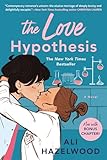
Editors Reads Verdict
The Love Hypothesis is the novel that broke the STEM romance subgenre into mainstream consciousness, combining a classic fake-dating premise with sharp academic satire and a protagonist whose neurodivergent social navigation feels authentically rendered. The formula is familiar but the execution is notably warm.
What We Loved
- The STEM academic setting is rendered with genuine insider knowledge and affection
- Olive's neurodivergence and social reasoning are portrayed with unusual specificity
- The academic power-imbalance problem is engaged with directly rather than glossed over
- Adam Carlsen is a convincingly grumpy-to-tender character arc
Minor Drawbacks
- The central conflict hinges on a misunderstanding that could be resolved in one honest conversation
- Secondary characters are underdeveloped compared to the central pair
- The fake-dating premise follows a well-worn track that rarely surprises
Key Takeaways
- → Academic environments create power structures that interact with romantic relationships in complicated ways
- → Imposter syndrome in STEM is disproportionately experienced by women and people from underrepresented groups
- → Emotional communication styles vary widely and do not map onto intelligence or competence
- → Fake relationships in fiction serve as a safe container for real feelings that feel too risky to express directly
- → Being liked for the wrong reasons can make you doubt whether anyone could like you for the right ones
| Author | Ali Hazelwood |
|---|---|
| Publisher | Berkley |
| Pages | 384 |
| Published | September 14, 2021 |
| Language | English |
| Genre | Romance, Contemporary Fiction, New Adult |
| Difficulty | Beginner |
| Best For | Romance readers who want academic setting and STEM protagonists; fans of slow-burn fake-dating dynamics with grumpy-sunshine pairings. |
How The Love Hypothesis Compares
The Love Hypothesis at a glance against 3 similar books readers weigh alongside it.
| Book | Author | Rating | Best for |
|---|---|---|---|
| The Love Hypothesis (this book) | Ali Hazelwood | ★ 4.1 | Romance readers who want academic setting and STEM protagonists |
| It Ends with Us | Colleen Hoover | ★ 4.2 | Readers of contemporary romance who want emotional depth |
| Normal People | Sally Rooney | ★ 4.1 | Literary fiction readers interested in contemporary Irish society, millennial |
| The Kiss Quotient | Helen Hoang | ★ 4.1 | Romance readers who want autistic representation and own-voices perspective |
The Accidental Experiment
Ali Hazelwood’s debut novel began its life as fan fiction, and carries the warmth of that tradition into its published form. The premise is economically constructed: Olive Smith, a PhD candidate in biology, is at a party when she needs her friend Anh to believe she has moved on from Jeremy, Anh’s new boyfriend. She turns to the nearest available man and kisses him. The nearest available man is Adam Carlsen — forbidding, famous, and the last person any graduate student would voluntarily interact with.
The fake-dating arrangement that follows is the novel’s scaffolding, but what Hazelwood does well is put genuine academic texture onto the scaffold. The research grant politics, the publication pressures, the conference culture, the specific anxieties of the pre-dissertation years — all of this is rendered with the kind of specific detail that comes from experience. Hazelwood herself is a neuroscientist, and it shows in the most charming possible way.
Olive and Adam
Olive Smith is a protagonist whose social reasoning is explicit and sometimes unusual in ways that feel consistent with a neurodivergent presentation, though the novel does not use clinical language. She processes social situations analytically, is frequently confused by unspoken rules, and is simultaneously deeply empathetic to others’ emotional needs. This combination makes her unusually compelling for the genre.
Adam Carlsen’s gruffness is quickly revealed to be a front for someone who is profoundly decent and somewhat overwhelmed by social expectation. The grumpy-to-tender arc is one of romance fiction’s oldest and most reliable patterns, and Hazelwood executes it with warmth.
The Academic Power Imbalance
To the novel’s credit, it does not pretend the power imbalance between professor and graduate student is irrelevant. Characters discuss it; the relationship is constructed with the power differential explicitly in view; the resolution addresses it directly. This is more than most academic romances manage.
The Genre at Work
The central misunderstanding on which the third-act conflict rests is the novel’s weakest element — the kind of conflict that exists primarily because the genre requires it and that a single direct conversation would dissolve. This is a structural limitation of the fake-dating subgenre more than a failure of craft, but it is notable in a novel otherwise characterized by directness.
From Fan Fiction to Phenomenon
Part of what makes The Love Hypothesis distinctive is its origin, and understanding it illuminates both the book’s strengths and its place in contemporary publishing. The novel began as a piece of Star Wars fan fiction centered on the characters Rey and Kylo Ren, and traces of that lineage remain in the dynamic between the small, brilliant heroine and the large, gruff, intimidating hero. Hazelwood reworked the story into an original contemporary romance, and it became one of the defining BookTok breakouts of the early 2020s, a runaway bestseller that helped legitimize fan fiction as a pipeline to mainstream publishing success. This heritage gives the book the particular warmth and trope-literacy of the fan-fiction tradition — an intimate understanding of exactly what its audience wants and a willingness to deliver it without apology. It also reflects a broader shift in how romance reaches readers, with online communities rather than traditional gatekeepers driving a title to phenomenon status.
STEM Romance and Representation
Beyond its romance, The Love Hypothesis helped popularize a distinct subgenre — the STEM romance — and its grounding in the real culture of academic science is a genuine contribution. Hazelwood, herself a neuroscience professor, renders the texture of graduate-student life with authority: the grant politics, the publication anxieties, the conference dynamics, the precariousness of a young woman’s position in a male-dominated field. Olive’s struggles are not merely backdrop but substance, and the book quietly foregrounds the obstacles women face in science, from condescension to harassment, without sacrificing its comic warmth. This specificity sets the novel apart from interchangeable contemporary romances and accounts for much of its appeal to readers who rarely see their professional worlds depicted with such accuracy. Hazelwood went on to build an entire career on STEM-set romances, and this debut established the template: smart, funny love stories that take their heroines’ scientific ambitions as seriously as their hearts.
The Power Imbalance Question
To its credit, The Love Hypothesis does not pretend that the relationship at its center is free of complication, and its handling of the professor–graduate-student power dynamic is more thoughtful than the genre usually manages. Adam Carlsen is not Olive’s supervisor, a distinction the novel is careful to establish, and the characters explicitly discuss the ethics of their situation rather than ignoring it. The resolution addresses the imbalance directly, acknowledging the real vulnerability of a graduate student’s position in a way that many academic romances elide entirely. This attentiveness reflects Hazelwood’s insider knowledge and her evident awareness of the genuine problems such relationships can pose in academic life. While the fantasy remains a fantasy — the gruff genius who turns out to be tender and respectful — the book’s willingness to name and navigate the power differential rather than romanticize it uncritically is a meaningful mark of care.
A Charming, Familiar Pleasure
For all its specificity, The Love Hypothesis succeeds first as a warm, funny, deeply readable romance, and its pleasures are those of a beloved formula executed with skill. The grumpy-sunshine pairing, the fake-dating premise, the slow thaw of a forbidding man revealed to be decent and overwhelmed — these are among romance’s most reliable patterns, and Hazelwood deploys them with affection and comic timing. Olive’s analytical, socially literal narration, which many readers find consistent with a neurodivergent presentation, gives the familiar material a fresh and endearing voice. The book is not without its flaws: the third-act conflict turns on a misunderstanding that a single honest conversation would dissolve, a structural weakness of the fake-dating subgenre rather than a failure unique to this book. But these are minor complaints against a novel whose authenticity of setting, genuine humor, and charming central couple have earned it a devoted following and a permanent place in the contemporary romance canon.
Our rating: 4.1/5 — A warm, specific, and genuinely funny academic romance that earns its large following through authenticity of setting and the particular charm of its central pairing.
Reading Guides
Frequently Asked Questions
What is "The Love Hypothesis" about?
A PhD student in biology impulsively kisses a notoriously intimidating professor to convince her friend she has moved on, and the resulting fake-dating arrangement becomes something neither of them expected.
Who should read "The Love Hypothesis"?
Romance readers who want academic setting and STEM protagonists; fans of slow-burn fake-dating dynamics with grumpy-sunshine pairings.
What are the key takeaways from "The Love Hypothesis"?
Academic environments create power structures that interact with romantic relationships in complicated ways Imposter syndrome in STEM is disproportionately experienced by women and people from underrepresented groups Emotional communication styles vary widely and do not map onto intelligence or competence Fake relationships in fiction serve as a safe container for real feelings that feel too risky to express directly Being liked for the wrong reasons can make you doubt whether anyone could like you for the right ones
Is "The Love Hypothesis" worth reading?
The Love Hypothesis is the novel that broke the STEM romance subgenre into mainstream consciousness, combining a classic fake-dating premise with sharp academic satire and a protagonist whose neurodivergent social navigation feels authentically rendered. The formula is familiar but the execution is notably warm.
Ready to Read The Love Hypothesis?
Check the current price on Amazon.
Check Price on Amazon (paid link)Prices and availability are subject to change. See Amazon for current price.
Review last updated: