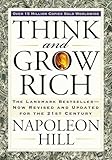
Editors Reads Verdict
The granddaddy of modern success literature. Its ideas on desire, belief, and persistence are genuinely powerful — if you can separate the timeless principles from the dated mysticism.
What We Loved
- Crystallises the mindset common to highly successful people
- The chapters on persistence and specialised knowledge remain essential
- Readable in a single sitting — direct and punchy
- Widely cited as foundational for entrepreneurs and executives
Minor Drawbacks
- The 'Master Mind' and metaphysical chapters have aged poorly
- No verifiable sources for many historical claims
- Gender and racial assumptions reflect its 1930s origins
Key Takeaways
- → Burning desire is the starting point of all achievement
- → Autosuggestion and self-belief shape reality through action
- → Specialised knowledge beats general knowledge in building wealth
- → Persistence in the face of adversity separates achievers from dreamers
- → The Master Mind principle: collaborative thinking multiplies individual capacity
| Author | Napoleon Hill |
|---|---|
| Publisher | Tarcher/Perigee |
| Pages | 238 |
| Published | March 1, 1937 |
| Language | English |
| Genre | Self-Help, Personal Development, Business |
| Difficulty | Beginner |
| Best For | Aspiring entrepreneurs and anyone studying the psychology of achievement and wealth creation. |
How Think and Grow Rich Compares
Think and Grow Rich at a glance against 3 similar books readers weigh alongside it.
| Book | Author | Rating | Best for |
|---|---|---|---|
| Think and Grow Rich (this book) | Napoleon Hill | ★ 4.5 | Aspiring entrepreneurs and anyone studying the psychology of achievement and |
| Start With Why | Simon Sinek | ★ 4.5 | Leaders, entrepreneurs, marketers, and anyone who wants to inspire action |
| The 7 Habits of Highly Effective People | Stephen R. Covey | ★ 4.7 | Anyone seeking lasting personal and professional effectiveness grounded in |
| The Power of Now | Eckhart Tolle | ★ 4.6 | Anyone struggling with anxiety, overthinking, or searching for a practical |
The Book That Launched a Genre
Published in 1937 after Napoleon Hill spent twenty years studying more than 500 wealthy Americans, Think and Grow Rich is arguably the book that invented the modern self-help genre. Every motivational speaker from Tony Robbins to Gary Vaynerchuk acknowledges its influence. Understanding it is almost a prerequisite for understanding self-improvement culture.
Hill’s central argument is provocative: wealth begins as a thought. Desire, faith, and persistence translate thoughts into material success. This is either profound or preposterous depending on your starting assumptions — but the principles have proven their staying power across nine decades.
The Thirteen Principles
Hill identifies thirteen steps to riches, from Desire (the first step) through Imagination, Organised Planning, Decision, Persistence, and the mysterious Sixth Sense (the last step). The most durable chapters are the early and middle ones.
The chapter on Desire opens with the story of Edwin Barnes, who wanted to work with Thomas Edison, not for him — and who burned all alternatives until he got his wish. Hill’s point is that desire must be a consuming obsession, not a casual preference. This distinction resonates deeply with anyone who has achieved something genuinely difficult.
Where the Book Holds Up
The chapters on Persistence and Specialised Knowledge are among the most useful pages in success literature. Hill observed that most great fortunes were built on the edge of a single breakthrough that almost didn’t happen — and that persistence is what separated those who crossed the threshold from those who quit three feet from gold. His practical advice on acquiring specialised knowledge through self-education also prefigures much of what modern learning researchers now confirm.
Where It Strains Credulity
The book’s weaknesses are real. The metaphysical framework — Hill claims thoughts literally vibrate at frequencies that attract circumstances — is untestable and occasionally distracts from the legitimate psychology. Many of Hill’s historical claims about his interviews with famous figures cannot be verified. And readers today will notice the conspicuous absence of women and people of colour from his examples of success.
The Mastermind Principle
Among the book’s more durable and practical concepts is the “Master Mind” — Hill’s term for a coordinated alliance of two or more people working toward a definite purpose in a spirit of harmony. Hill argued that no individual achieves great success alone, and that surrounding oneself with a deliberately chosen group of capable, supportive, like-minded people multiplies one’s knowledge, energy, and effectiveness far beyond what any person could muster in isolation. Stripped of Hill’s mystical claims about a third “mind” generated by the group’s combined energy, the underlying insight is sound and has been repeatedly validated: our ambitions and capabilities are powerfully shaped by the company we keep, and intentionally building a network of motivated peers and mentors is a genuine accelerant to achievement. The mastermind concept has been adopted across business and self-improvement culture, from formal mastermind groups to the broader recognition that environment and association shape outcomes, and it remains one of the book’s most actionable contributions.
A Product of the Depression
To read Think and Grow Rich well is to understand the circumstances that produced it, and they explain much of both its power and its distortions. Hill published the book in 1937, in the depths of the Great Depression, addressing an audience desperate for hope and a path out of economic ruin, and the book’s relentless optimism and insistence that anyone can think their way to wealth must be read against that backdrop of mass despair. The Depression context accounts for the book’s almost evangelical fervor about the power of individual mindset, a message that offered psychological refuge to readers stripped of material security. It also helps explain the book’s blind spots: its near-total focus on individual will obscures the structural and economic forces — the very forces then devastating millions — that shape who actually accumulates wealth. The book is a document of its moment as much as a manual, and recognizing this allows the reader to extract its genuine psychological insights while discounting its overstated promises.
Influence and Honest Caveats
The historical significance of Think and Grow Rich is difficult to overstate: it is plausibly the single most influential text in the entire self-help and personal-development tradition, and its DNA is visible in nearly every motivational book and speaker that followed, from Napoleon Hill’s direct descendants to the modern manifestation and mindset literature. But influence is not the same as reliability, and an honest reader must hold the book’s contributions alongside its serious problems. Hill’s most extravagant metaphysical claims — that thoughts literally vibrate at frequencies that attract corresponding circumstances — are untestable and have been weaponized by less scrupulous successors into the more dubious corners of “law of attraction” culture. Aspects of Hill’s own biography and his accounts of interviewing famous magnates have been questioned by researchers, and modern readers will note the conspicuous absence of women and people of color from his portraits of success. The book is best approached critically: as a foundational study in the psychology of desire, belief, and persistence, valuable for those themes and instructive about the genre it founded, rather than as a literal blueprint.
Final Verdict
Read Think and Grow Rich as a study in the psychology of achievement, not as a literal manual. Strip the mysticism, keep the mindset principles, and engage critically with its historical context. For its core insights on desire, belief, and persistence, it remains worth reading.
Our rating: 4.5/5 — Flawed but foundational. Read it once, think critically, and take what serves you.
Reading Guides
Frequently Asked Questions
What is "Think and Grow Rich" about?
Napoleon Hill's classic distillation of the success principles he observed in over 500 self-made millionaires, including Andrew Carnegie, Henry Ford, and Thomas Edison.
Who should read "Think and Grow Rich"?
Aspiring entrepreneurs and anyone studying the psychology of achievement and wealth creation.
What are the key takeaways from "Think and Grow Rich"?
Burning desire is the starting point of all achievement Autosuggestion and self-belief shape reality through action Specialised knowledge beats general knowledge in building wealth Persistence in the face of adversity separates achievers from dreamers The Master Mind principle: collaborative thinking multiplies individual capacity
Is "Think and Grow Rich" worth reading?
The granddaddy of modern success literature. Its ideas on desire, belief, and persistence are genuinely powerful — if you can separate the timeless principles from the dated mysticism.
Ready to Read Think and Grow Rich?
Check the current price on Amazon.
Check Price on Amazon (paid link)Prices and availability are subject to change. See Amazon for current price.
Review last updated: