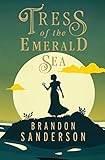
Editors Reads Verdict
Tress of the Emerald Sea is Sanderson doing something he had never done before: writing a fairy tale, with a fairy tale's particular relationship to moral simplicity, wonder, and the happiness that gets obscured by the genre conventions of epic fantasy. Narrated by Hoid, with his voice threading through every observation, it is Sanderson's most purely delightful book and arguably his most emotionally generous.
What We Loved
- Tress is Sanderson's most immediately likeable protagonist — ordinary, competent, observant, quietly brave
- Hoid's narration adds a layer of irony and warmth that transforms a simple story into something more
- The spore seas magic system is one of Sanderson's most visually original
- The fairy tale register is handled with genuine craft — it feels chosen, not imposed
Minor Drawbacks
- Readers expecting epic scale may be surprised by the story's deliberate smallness
- The villain's scheme is straightforward compared to Sanderson's usual complexity
- Cosmere connections may feel like rewards rather than plot content for those without prior knowledge
Key Takeaways
- → Ordinary competence and careful observation are forms of heroism — they don't require special powers
- → Happiness is often obscured by the assumption that adventure must be grand to be meaningful
- → Fairy tale logic — the world rewards genuine virtue — is emotionally true even when literally false
- → The most interesting narrators are ones who choose what to tell you and acknowledge that choice
- → Love that motivates action should be grounded in who the person actually is, not who you imagine them to be
| Author | Brandon Sanderson |
|---|---|
| Publisher | Dragonsteel Entertainment |
| Pages | 357 |
| Published | March 14, 2023 |
| Language | English |
| Genre | Fantasy, Epic Fantasy, Fiction |
| Difficulty | Intermediate |
| Best For | Cosmere readers wanting a lighter, shorter entry point; readers who love fairy tale retellings with emotional depth; fans of Hoid/Wit who want his full narration. |
How Tress of the Emerald Sea Compares
Tress of the Emerald Sea at a glance against 3 similar books readers weigh alongside it.
| Book | Author | Rating | Best for |
|---|---|---|---|
| Tress of the Emerald Sea (this book) | Brandon Sanderson | ★ 4.6 | Cosmere readers wanting a lighter, shorter entry point |
| The Final Empire | Brandon Sanderson | ★ 4.6 | Fantasy readers looking for innovative magic systems and tightly plotted epic |
| The Night Circus | Erin Morgenstern | ★ 4.4 | Fantasy readers who prioritise immersive atmosphere and beautiful prose over |
| The Sunlit Man | Brandon Sanderson | ★ 4.4 | Cosmere readers who want to see future developments in the universe |
The Ordinary Hero
Brandon Sanderson’s protagonists tend toward the exceptional. Vin is Mistborn; Kaladin becomes a Knight Radiant; Spensa is cytonic. The fundamental engine of most of his stories is the discovery and deployment of special abilities. Tress of the Emerald Sea begins with a deliberate and charming inversion: Tress is not special. She is a window washer who collects cups. She has never sailed, never fought, never done anything more dramatic than argue at the market. When the boy she loves is taken by the Dragon of Midnight Sea, she borrows a coin from every person on her island and sets out to rescue him.
The fairy tale logic this establishes — the good person deserves to get the good thing; competence and kindness are rewarded; the universe is, in some deep sense, just — is not typical Sanderson territory. He usually writes worlds where the universe is indifferent and human agency must struggle against entropy. Here he grants himself a different register, and the relief of inhabiting it is palpable on every page.
Hoid’s Voice
The most immediately distinctive quality of Tress is its narrator: Hoid, the cosmic wanderer who has appeared as a recurring side character throughout the Cosmere. Telling the story in first person — or rather in the storyteller’s third person, a voice that acknowledges it is constructing a narrative — gives the book a warmth and wit that distinguishes it from all Sanderson’s other novels. Hoid’s asides, his choices about what to include and exclude, his observations about the characters and what they fail to notice about themselves, are consistently the best prose Sanderson has published.
This is Sanderson writing through a character who is a better writer than he usually is, and the effect is striking.
The Spore Seas
The world of Tress is a planet covered not in water but in spores — twelve different types, each with different properties when wet. The Crimson Sea’s spores turn blood to crystal; the Midnight Sea’s spores, touched by water, grow tendrils in seconds. Navigation is genuinely dangerous in ways that are specific to the world’s physics, and the magic system that Tress eventually learns to use — Midnight Essence manipulation — is elegant and visually spectacular without requiring the reader to internalize a complex rule system.
The setting has the quality all great fantasy settings share: you understand immediately why stories happen there.
Our rating: 4.6/5 — Sanderson’s most purely delightful book, a fairy tale with heart, a narrator with wisdom, and a protagonist whose ordinariness is her most extraordinary quality.
Reading Guides
- Brandon Sanderson Cosmere Reading Order: The Complete Guide (2026)
- Brandon Sanderson Books in Order: The Complete Cosmere Reading Guide (2026)
The Fairy Tale as Serious Genre
Sanderson’s decision to write Tress of the Emerald Sea as a fairy tale — in the specific sense of a story that operates by fairy tale logic, where goodness is rewarded, where the universe is structured to support the genuine virtue of its protagonist — was a creative risk that paid off because he committed to it without irony.
Post-modernist fantasy has spent decades interrogating fairy tale conventions, examining the darkness beneath the comfortable surfaces, subverting the expectations of genre to reveal the grimmer realities the original stories were covering. This is valuable work, and Sanderson is aware of it. But Tress goes in the opposite direction: it reasserts that fairy tale logic is emotionally true even when literally false, that the experience of inhabiting a story that rewards competence and kindness is its own form of wisdom.
This is not naivety. It is a specific artistic choice with genuine insight behind it, and it distinguishes Tress from all of Sanderson’s other novels in ways that make it the most accessible entry point into the Cosmere while also being genuinely distinctive.
Hoid as Author
The decision to have Hoid narrate Tress in first-person-adjacent storyteller mode does more than add a distinctive voice. It positions the novel explicitly as a story — as a thing being constructed and told rather than simply unfolding — and this positioning allows Sanderson to do things with narrative self-awareness that would be awkward in a more conventional narrative mode.
Hoid’s asides about the nature of heroism, about ordinary people and what they are capable of, about the things stories are for — these are not interruptions to the story. They are the story’s philosophy, delivered in a voice with enough personality and enough darkness in its edges to make the philosophical content feel earned rather than imposed.
The Twelve Spore Seas
The world-building of Lumar — the planet covered in twelve distinct spore seas, each with its own properties, each requiring different navigation techniques and different safeguards — is Sanderson doing fantasy world-building at his most economical. Each spore type creates different practical problems; the practical problems create different cultures along the ships that navigate them; the cultures create different characters with different assumptions about what is normal and what is dangerous.
The Midnight Sea, which appears in the novel’s most dangerous sequences, is the one that earns the most development: spores that grow into grasping vines when wet, ships that must operate with absolute moisture discipline, a navigation problem that is also a horror-survival problem. The specific physics of this environment make the action sequences genuinely tense because the stakes of failure are specific and visible.
Tress as the Anti-Chosen-One
The particular pleasure of Tress as a protagonist is that her ordinariness is not a disguise for hidden chosen-one status. She does not discover that she has latent powers. She does not turn out to have been special all along. She is exactly what she appears to be — a resourceful, careful, observant person of genuine moral seriousness — and that is sufficient for the story the book wants to tell.
Sanderson has argued in interviews that ordinary-competence heroism is underrepresented in fantasy, and Tress is his most direct argument for it.
Frequently Asked Questions
What is "Tress of the Emerald Sea" about?
Tress has never left her small island. When the boy she loves is kidnapped and taken across the deadly spore seas, she sets out to rescue him — becoming a sailor, a pirate, and eventually a hero on a world she's never seen.
Who should read "Tress of the Emerald Sea"?
Cosmere readers wanting a lighter, shorter entry point; readers who love fairy tale retellings with emotional depth; fans of Hoid/Wit who want his full narration.
What are the key takeaways from "Tress of the Emerald Sea"?
Ordinary competence and careful observation are forms of heroism — they don't require special powers Happiness is often obscured by the assumption that adventure must be grand to be meaningful Fairy tale logic — the world rewards genuine virtue — is emotionally true even when literally false The most interesting narrators are ones who choose what to tell you and acknowledge that choice Love that motivates action should be grounded in who the person actually is, not who you imagine them to be
Is "Tress of the Emerald Sea" worth reading?
Tress of the Emerald Sea is Sanderson doing something he had never done before: writing a fairy tale, with a fairy tale's particular relationship to moral simplicity, wonder, and the happiness that gets obscured by the genre conventions of epic fantasy. Narrated by Hoid, with his voice threading through every observation, it is Sanderson's most purely delightful book and arguably his most emotionally generous.
Ready to Read Tress of the Emerald Sea?
Check the current price on Amazon.
Check Price on Amazon (paid link)Prices and availability are subject to change. See Amazon for current price.
Review last updated: