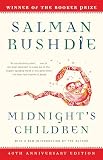
Salman Rushdie is a British-Indian novelist whose Midnight's Children and The Satanic Verses established him as one of the defining voices of postcolonial magical realism and among the most important novelists of the late twentieth century.
Salman Rushdie’s Midnight’s Children, published in 1981, announced one of the most distinctive voices in world literature: a maximalist, allusive, satirical storyteller working in the tradition of García Márquez but with his own unmistakably Indian-English cadence. The novel — narrated by Saleem Sinai, born at the exact moment of Indian independence — is not just a family saga but a palimpsest of Indian history, mythology, and politics, told with an exuberance that can only be called operatic. It won the Booker Prize and has twice been named the best Booker Prize winner ever awarded.
The fatwa issued against Rushdie by Ayatollah Khomeini following the publication of The Satanic Verses in 1989 changed the terms on which his work is discussed, making it impossible to read his subsequent career without reference to the decade he spent in hiding. What is remarkable is how consistently he continued to produce ambitious, risk-taking fiction throughout that period — including Haroun and the Sea of Stories, written for his son Zafar, and The Moor’s Last Sigh, a return to the multigenerational Bombay epic. The political circumstances of his life have sometimes overshadowed the formal accomplishment of the work itself.
Rushdie’s strengths are his density of reference, his comic energy, and his ability to construct mythological frameworks that make contemporary political life feel both grander and more absurd. His weaknesses are corresponding: the same maximalism can tip into excess, and some of his later novels have been received with less enthusiasm than his earlier masterpieces. At his best — in Midnight’s Children, The Satanic Verses, and The Moor’s Last Sigh — he produces fiction that is genuinely difficult to compare to anything else in the language.
A Giant of World Literature
Salman Rushdie is rightly counted among the most acclaimed and consequential writers of the past half-century, a novelist whose dazzling, exuberant fiction transformed the English-language novel and brought the techniques of magical realism to bear on the history and identity of the Indian subcontinent and its diaspora. Renowned for his linguistic inventiveness, his sweeping imaginative scope, and his fusion of myth, history, and politics, Rushdie has produced a body of work of remarkable richness and ambition. His influence on contemporary literature, and the extraordinary circumstances of his life, have made him a figure of global significance.
Midnight’s Children
Rushdie’s breakthrough and most celebrated novel, Midnight’s Children, is a landmark of postcolonial literature and one of the most honoured English-language novels of its era, having won the Booker Prize and later been named the best of all Booker winners. Telling the story of children born at the moment of India’s independence whose lives are magically intertwined with the fate of the nation, the novel fuses personal and national history in a riot of invention, language, and storytelling. It established Rushdie’s distinctive voice and remains the cornerstone of his reputation.
Magical Realism and History
A hallmark of Rushdie’s fiction is his use of magical realism to explore history, identity, and politics. In his hands, the fantastical and the historical intertwine, allowing him to capture the teeming complexity, the myth, and the chaos of the societies he writes about. He draws on the storytelling traditions of South Asia, the structures of myth and fable, and the techniques of modernist and postmodern fiction to create narratives of extraordinary density and energy. This blending of the marvellous and the real is central to his vision of how history is lived and remembered.
A Voice of the Diaspora
Rushdie is one of the great chroniclers of migration, displacement, and the hybrid identities of the postcolonial and diasporic world. His fiction explores what it means to live between cultures, to carry multiple inheritances, and to forge identity across borders, and he has celebrated the mongrel, impure, mixed nature of cultural identity as a source of vitality rather than loss. This concern with migration and belonging, drawn from his own experience between India, Pakistan, and Britain, gives his work a profound relevance to the global, interconnected age.
The Satanic Verses and Its Aftermath
Rushdie’s life was irrevocably altered by the publication of The Satanic Verses, which was condemned as blasphemous by some Muslims and led to a fatwa calling for his death, forcing him into years of hiding under police protection. The affair became a defining episode in the global debate over free expression, religious offence, and artistic freedom, and Rushdie became, against his will, a symbol of the writer’s right to speak. He has continued to write and to champion free expression with remarkable courage, even after surviving a violent attack decades later.
A Champion of Free Expression
Beyond his fiction, Rushdie has become one of the world’s most prominent defenders of freedom of expression, an eloquent advocate for the rights of writers and the value of open debate. His own experience placed him at the centre of these struggles, and he has spoken and written powerfully about the importance of resisting censorship and intimidation. This role as a public champion of intellectual and artistic liberty has made him a significant figure well beyond literature, admired for the courage with which he has defended principles at enormous personal cost.
The Salman Rushdie Legacy
Salman Rushdie’s contribution to literature is immense, both for the brilliance of his fiction and for his embodiment of the writer’s freedom in the face of grave danger. For newcomers, Midnight’s Children is the essential starting point, with Haroun and the Sea of Stories offering a more accessible, fable-like entry and The Moor’s Last Sigh showcasing his later mastery. For readers seeking fiction of dazzling imagination and serious engagement with history, identity, and the meeting of cultures, Rushdie remains one of the most rewarding and important writers of the modern age.
Where to Read Next
Keep going with Victory City and Shame, each a worthwhile addition to a Salman Rushdie reading list.
Reading Guides