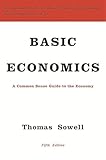
Thomas Sowell is an American economist and prolific author whose Basic Economics offers a rigorous, accessible introduction to economic thinking from a free-market perspective.
Thomas Sowell is a Senior Fellow at the Hoover Institution at Stanford and one of the most prolific economists writing for general audiences, with a career spanning six decades and more than thirty books. Basic Economics, first published in 2000 and now in its fifth edition, is his most widely read work: a comprehensive introduction to economic reasoning that deliberately avoids graphs, equations, and jargon in favour of plain English. The book argues that most economic mistakes stem from focusing on the immediate and visible effects of policies while ignoring their later and less obvious consequences, and it builds this case through examples drawn from rent control, trade policy, labour markets, and financial regulation.
Sowell is a conservative economist in the tradition of Milton Friedman, and Basic Economics is written from a broadly free-market perspective. This is worth noting clearly: the book is not politically neutral, and readers who come to it expecting a balanced survey of economic thought will find a consistent ideological orientation that is not always explicitly acknowledged. The analysis of markets is generally rigorous and instructive; the treatments of areas where market failures are most significant — externalities, public goods, inequality — receive less attention than the chapters on government failure.
That said, Sowell’s core argument about the importance of thinking through consequences rather than intentions is genuinely useful, and his prose is exceptionally clear. Basic Economics is worth reading for its analytical tools, provided readers supplement it with perspectives Sowell does not represent.
Sowell’s biography is inseparable from his thought, and it lends his work a distinctive authority. Born into poverty in North Carolina and raised in Harlem, he dropped out of high school, served in the Marine Corps during the Korean War, and came to higher education late, eventually earning degrees from Harvard, Columbia, and a doctorate in economics from the University of Chicago, where he studied in the orbit of Milton Friedman and George Stigler. He has often recounted that he was a Marxist into his thirties, and that his conversion to free-market views came not from ideology but from his experience working in government and observing the gap between the intentions of policies and their actual effects. This trajectory — from poverty to the academy, from the left to the right, by way of close attention to real-world outcomes — shapes the recurring themes of his vast output. It informs his deep suspicion of intellectuals and policymakers who, in his view, prescribe for others from a position of insulated theory, and it underlies his insistence that the test of any policy is its consequences rather than the nobility of its stated goals. Few public economists have travelled so far or drawn so directly on personal history.
Beyond Economics: A Wide-Ranging Thinker
Although Basic Economics is his best-known work, it represents only a fraction of an immense and varied body of writing that ranges across economics, social policy, intellectual history, and the study of race and culture. In works such as Knowledge and Decisions, he developed a sophisticated argument about how economic and social systems process dispersed information, building on the insights of Friedrich Hayek. In A Conflict of Visions, he advanced an influential framework distinguishing between the “constrained” and “unconstrained” visions of human nature that, he argues, underlie much of the political left-right divide — a genuinely original contribution to political philosophy. Across numerous books on race, ethnicity, and culture, including comparative international studies, he has challenged prevailing explanations of group disparities, attributing them more to cultural and historical factors than to discrimination, a stance that has made him both influential and intensely controversial. His writing on education, late-talking children, and the role of intellectuals further illustrates the breadth of his curiosity. Whatever one makes of his conclusions, the scope, productivity, and consistency of his intellectual project over six decades are extraordinary, marking him as a thinker far more wide-ranging than the label of free-market economist suggests.
A Polarizing Legacy
Sowell is among the most prominent conservative intellectuals of his era, and his legacy is correspondingly contested along the lines of the political divides his work addresses. To his many admirers, he is a model of clear thinking and intellectual courage, a writer who marshals data and logic to puncture comfortable assumptions and who has consistently been willing to defend unpopular positions, particularly as one of the most influential Black conservative voices in American life. To his critics, his free-market framework leads him to underweight the role of structural injustice, to treat market outcomes as more just and self-correcting than the evidence warrants, and to present a strongly ideological perspective in the guise of neutral analysis. Both responses contain truth, and a fair reading of Sowell requires engaging seriously with his arguments while recognising the consistent worldview that shapes them. What is not in dispute is his influence: his books have sold widely, his columns reached a large public, and his ideas have profoundly shaped conservative economic and social thought. For readers willing to think critically and to seek out the perspectives he omits, his work offers genuinely sharpening analytical tools and a bracing insistence on judging policies by their results rather than their intentions.
Where to Start with Sowell
The natural starting point is Basic Economics, his most widely read book, which lays out economic reasoning in plain English without graphs or jargon and is best approached as a clear, opinionated introduction to free-market analysis rather than a neutral survey. Readers drawn to his political philosophy should turn to A Conflict of Visions, arguably his most original and intellectually substantial work, which maps the competing assumptions about human nature underlying left and right. Those interested in how knowledge and decisions are coordinated across a society will find Knowledge and Decisions rewarding, if demanding. His writing on race, culture, and economic disparities — across several books and his long-running columns — represents another major and controversial strand worth engaging critically. For a quick sense of his style and range, his collections of columns offer accessible samples. Whichever the entry point, readers will benefit most by pairing Sowell with thinkers who hold different views, taking his analytical tools and his emphasis on consequences while supplying the structural perspectives his framework tends to leave out.
Reading Guides