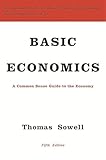
Editors Reads Verdict
Basic Economics is the rare textbook-scope work that reads like a conversation, using Sowell's singular ability to expose the hidden costs and unintended consequences lurking behind policies that sound appealing on the surface.
What We Loved
- Remarkably accessible — no graphs, equations, or jargon required
- Hundreds of real-world examples spanning countries, centuries, and industries
- Builds a durable mental framework for evaluating economic claims independently
Minor Drawbacks
- Sowell's market-oriented perspective is consistent, which some readers find ideologically skewed
- At 600+ pages the book can feel exhaustive; some chapters cover ground thoroughly covered earlier
Key Takeaways
- → The key question in economics is not whether a policy has good intentions but what its full consequences are
- → Prices are not just numbers — they are information signals that coordinate complex activity no central planner can replicate
- → Most economic fallacies stem from focusing on immediate, visible effects while ignoring longer-term, indirect ones
| Author | Thomas Sowell |
|---|---|
| Published | January 1, 2000 |
| Language | English |
| Genre | Economics, Non-Fiction, Education |
| Difficulty | Beginner |
| Best For | Anyone who wants to think more clearly about economic issues, from curious high schoolers to seasoned professionals outside economics. |
How Basic Economics Compares
Basic Economics at a glance against 3 similar books readers weigh alongside it.
| Book | Author | Rating | Best for |
|---|---|---|---|
| Basic Economics (this book) | Thomas Sowell | ★ 4.7 | Anyone who wants to think more clearly about economic issues, from curious high |
| $100M Offers | Alex Hormozi | ★ 4.6 | Entrepreneurs, small business owners, and sales professionals looking to |
| 1776 | David McCullough | ★ 4.5 | American history readers, students of leadership, and anyone who wants to |
| 21 Lessons for the 21st Century | Yuval Noah Harari | ★ 4.1 | Readers already familiar with Harari's work who want his take on contemporary |
Basic Economics Review
Thomas Sowell opens Basic Economics with a deceptively simple challenge: think through not just the immediate effects of an economic policy, but the effects of those effects. That single discipline — what economists call thinking past stage one — rigorously applied across hundreds of examples drawn from around the world and across history, is the engine of the entire book. Rent control sounds compassionate until you trace its incentive effects on housing supply and maintenance. Minimum-wage laws sound pro-worker until you map the hiring decisions of small businesses operating on thin margins. Sowell is less interested in scoring political points than in training a habit of mind: follow the logic, and the evidence, wherever they lead.
Economics Begins with Scarcity
The book is built on a foundational definition that Sowell returns to again and again: economics is the study of the use of scarce resources that have alternative uses. Because resources are finite and human wants effectively unlimited, every choice carries a trade-off — there is, in the famous phrase, no such thing as a free lunch. From this single premise Sowell derives a startling amount. Allocation is unavoidable; the only question is how a society chooses to do it, whether through prices and markets or through political and bureaucratic command, and what the real-world consequences of each method turn out to be.
Prices as Information
The book’s core insight concerns prices, and it deserves particular attention. Sowell argues at length that prices are fundamentally a communication system — the mechanism by which dispersed, local knowledge about supply and demand is aggregated into a single number that coordinates the decisions of millions of strangers who will never meet. A price rise tells producers to make more and consumers to economise, all without any central authority issuing an order. When governments override prices through ceilings, subsidies, or mandates, they do not abolish the underlying coordination problem; they simply disable the tool best equipped to solve it, and shortages, surpluses, or black markets predictably follow. This point, drawn from F. A. Hayek and developed with Sowell’s characteristic clarity, is worth the price of the book on its own.
Incentives, Profit, and Loss
Two further threads run throughout. The first is that incentives, not intentions, drive economic outcomes — a policy must be judged by the behaviour it actually rewards, not by the goals it proclaims. The second is the underrated role of profit and loss together. Profit lures resources toward their most valued uses, but losses are equally vital: they are the economy’s signal that resources are being wasted, forcing businesses to change or release them for better use. A system that suppresses losses — through bailouts, guarantees, or central planning — keeps resources trapped in unproductive hands, which is why Sowell devotes such attention to the contrast between market economies and the Soviet-style planning that tried to operate without these signals.
Accessibility and Breadth
What distinguishes this book from standard economics courses is the near-total absence of technical apparatus. There are no graphs, no equations, and no econometric models. Sowell trusts that economic reasoning can be conveyed entirely in plain prose, and he vindicates that trust across six hundred pages. The writing is clear, direct, and occasionally sharp, and the examples range from medieval European grain markets to modern California housing, from West African trade to Soviet industrial planning. The breadth is remarkable without ever feeling like a survey course.
What the Book Actually Covers
Despite its plain title, Basic Economics is genuinely comprehensive. Sowell moves methodically through the price system, business and labour, the role of time and risk, the national and international economy, and the special economics of money, banking, and government finance. Along the way he rehabilitates a series of misunderstood actors. Speculators and middlemen, often cast as parasites, are shown to perform real services — absorbing risk and moving goods across time and space. “Predatory” low prices and the relentless pressure of competition, far from harming consumers, are revealed as the very engine that drives quality up and costs down. And international trade is defended through the logic of comparative advantage, with Sowell patiently dismantling the protectionist intuition that imports are a loss and exports a win.
Why It Works as a First Economics Book
Part of what makes the book so effective for newcomers is Sowell’s refusal to assume any prior knowledge. He builds each concept from first principles and reinforces it with concrete cases before layering on the next, so that a reader with no background finishes with a genuine framework rather than a bag of disconnected facts. A long-time economist, columnist, and senior fellow at the Hoover Institution, Sowell writes with the confidence of someone who has taught this material for decades and the bluntness of someone uninterested in flattering fashionable opinion. The effect is less like a textbook than like an argument with an exceptionally well-prepared, slightly combative tutor — which is precisely why it sticks.
Criticisms
The book is not without its critics. Sowell’s market-oriented perspective is unwavering, and readers on the left often find it ideologically skewed — quick to detail the unintended costs of government intervention while treating market failures and inequalities more briskly. At 600-plus pages it can also feel exhaustive, with later chapters revisiting ground covered earlier. Read with those caveats in mind, however, the consistency is part of the value: Sowell is teaching a method, and applying it relentlessly is the lesson.
Verdict
Basic Economics has been updated across multiple editions, each revision adding fresh examples without losing the original’s coherence. Readers from across the political spectrum regularly report that it changed how they think, even when it challenged their priors. That is the mark of a genuinely educational book — not one that confirms what you already believe, but one that hands you better tools to evaluate whatever anyone, of any persuasion, happens to be claiming.
Frequently Asked Questions
What is "Basic Economics" about?
Thomas Sowell delivers a comprehensive, jargon-free introduction to economic thinking that trains readers to see beyond immediate effects to the full consequences of policies and actions.
Who should read "Basic Economics"?
Anyone who wants to think more clearly about economic issues, from curious high schoolers to seasoned professionals outside economics.
What are the key takeaways from "Basic Economics"?
The key question in economics is not whether a policy has good intentions but what its full consequences are Prices are not just numbers — they are information signals that coordinate complex activity no central planner can replicate Most economic fallacies stem from focusing on immediate, visible effects while ignoring longer-term, indirect ones
Is "Basic Economics" worth reading?
Basic Economics is the rare textbook-scope work that reads like a conversation, using Sowell's singular ability to expose the hidden costs and unintended consequences lurking behind policies that sound appealing on the surface.
Ready to Read Basic Economics?
Check the current price on Amazon.
Check Price on Amazon (paid link)Prices and availability are subject to change. See Amazon for current price.
Review last updated: