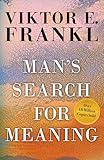
Viktor E. Frankl was an Austrian psychiatrist and Holocaust survivor whose Man's Search for Meaning describes his experiences in Nazi concentration camps and the philosophy of logotherapy he developed.
Viktor Frankl was a Viennese psychiatrist who had already developed the foundations of what he called logotherapy — a meaning-centred approach to psychotherapy — before he was deported to Auschwitz in 1944. Man’s Search for Meaning, published in German in 1946, has two parts: a harrowing first-person account of his years in concentration camps, and a compressed introduction to logotherapy and its central principle that the primary human motivation is not pleasure or power but the search for meaning. It has been called one of the most influential books of the twentieth century, and in terms of lives directly changed, that claim is difficult to dispute.
The first part of the book is devastating and written with the restraint of someone who has survived the worst and has no need to sensationalize it. Frankl describes not just the physical horror of the camps but the psychological strategies that helped some prisoners maintain their humanity and will to live — the importance of a “why” that could sustain any “how.” His observation that even in the most extreme circumstances, the last human freedom is the choice of one’s attitude, has resonated with readers across every culture and context.
Some contemporary psychologists have noted that logotherapy is not a fully developed therapeutic system and that Frankl’s post-war reconstruction of his pre-war theories requires some scrutiny. These are legitimate scholarly concerns that do not diminish the profound humanity and moral clarity of the book. Man’s Search for Meaning is essential reading.
Logotherapy: The Will to Meaning
Frankl’s enduring contribution to psychology is logotherapy, often described as the “third Viennese school” after Freud’s psychoanalysis and Adler’s individual psychology, and understanding it is essential to understanding the man. Where Freud located the primary human drive in the pursuit of pleasure and Adler in the striving for power, Frankl argued that the deepest motivation is what he called the will to meaning — the need to find purpose and significance in one’s existence. The frustration of this need, he held, produces a distinctive modern malaise he termed the “existential vacuum,” a pervasive sense of emptiness and boredom that no amount of pleasure or success can fill. Logotherapy, as a clinical practice, aims to help patients discover meaning in their particular lives, and Frankl identified three broad avenues toward it: through creative work or deeds, through the experience of love and beauty, and — most profoundly — through the attitude one takes toward unavoidable suffering. This last avenue is what gives his philosophy its terrible authority, because Frankl tested it not in the comfort of a consulting room but in the death camps, where he observed that prisoners who retained a sense of purpose, a task left undone or a loved one to live for, were better able to endure.
Forged in the Camps
The unique power of Frankl’s thought derives from the fact that his theory of meaning was not merely confirmed but forged in the most extreme conditions of human suffering imaginable. Already developing logotherapy as a young psychiatrist in Vienna, Frankl was deported with his family to the Nazi camps, where he lost his parents, his brother, and his pregnant wife. He himself survived Auschwitz and other camps, and the manuscript of his early theoretical work, which he had hidden in his coat, was destroyed — a loss that he later said he survived in part by reconstructing it from memory, an act of meaning-making in itself. What he witnessed and endured became the empirical ground of his philosophy. He observed firsthand that physical survival often depended less on strength than on the preservation of an inner life and a reason to go on, and that even in conditions designed to strip away every shred of human dignity, the freedom to choose one’s response remained. His insistence that this final freedom — the choice of one’s attitude in any given set of circumstances — can never be taken away is the moral center of his work, and it carries a weight that no purely academic theory could match, precisely because he earned the right to say it.
A Lasting Source of Hope
Man’s Search for Meaning has sold many millions of copies in dozens of languages and is regularly named among the most influential books of the twentieth century, a status that reflects its rare capacity to console and to challenge across every culture and circumstance. Its enduring appeal lies in the way it transforms the darkest material imaginable into a fundamentally affirming argument about human possibility — not by minimizing the horror, which Frankl describes with unflinching restraint, but by locating within it an unconquerable kernel of freedom and dignity. The book has guided countless readers through their own ordeals of grief, illness, and despair, offering not easy comfort but a demanding and dignifying proposition: that life can hold meaning even in suffering, and that we are responsible for finding it. Frankl went on to a long and distinguished postwar career, lecturing around the world, receiving numerous honors, and continuing to develop and defend his ideas. The scholarly debates about logotherapy’s rigor as a clinical system are real and worth acknowledging, but they touch little on the book’s essential achievement. As a testament to the resilience of the human spirit and the centrality of meaning to a life worth living, Man’s Search for Meaning remains without equal.
Where to Start with Frankl
The clear starting point is Man’s Search for Meaning, the short, profound book that contains both the harrowing memoir of his time in the camps and a compact introduction to logotherapy; it can be read in a single sitting and is among the most accessible and life-changing works of twentieth-century thought. Readers who find their interest in logotherapy deepened can turn to The Doctor and the Soul, his more systematic and clinically detailed exposition of the meaning-centred approach to psychotherapy, which predates the famous memoir and develops the theory at greater length. Yes to Life: In Spite of Everything, a series of lectures Frankl delivered shortly after the war and published in English decades later, offers a moving and concise companion to his best-known work. For the broadest overview, The Will to Meaning collects his lectures on the foundations and applications of logotherapy. But nearly everyone should begin with Man’s Search for Meaning; it is the gateway to everything else and, for countless readers, a book that genuinely changes how they understand their own lives.
Reading Guides