H.G. Wells Books in Order: Complete Bibliography & Best Starting Points
H.G. Wells's complete bibliography in order — from The Time Machine and The War of the Worlds to The Island of Doctor Moreau. Best starting points for new readers.

H.G. Wells (1866–1946) invented modern science fiction — The Time Machine, The War of the Worlds, The Island of Doctor Moreau, and The Invisible Man established the genre’s fundamental premises and methods. Every major science fiction writer from Jules Verne to Philip K. Dick to Arthur C. Clarke works in the tradition he created.
His scientific romances (written between 1895 and 1905) are distinguished by their combination of scientific extrapolation, social criticism, and narrative velocity. He was also a prolific novelist, journalist, and political thinker, though those later works are less widely read now.
Where to Start
The Time Machine (1895)
The essential starting point — at 90 pages, the most concentrated introduction to Wells’s method. The Time Traveller’s journey to the far future, the Eloi and the Morlocks, and the literalisation of Victorian class division as species divergence. The novel that established the time travel narrative as a science fiction form.
The War of the Worlds (1898)
The most immediately compelling of the scientific romances — the Martian invasion of Surrey, narrated from the perspective of a terrified ordinary person watching civilisation collapse around him. The most influentially structured of Wells’s novels: every alien invasion narrative (including Orson Welles’s radio broadcast) descends from it.
The Island of Doctor Moreau (1896)
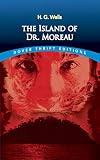
Wells’s most philosophically disturbing novel — Moreau’s vivisected human-animal hybrids and the collapse of the Law after his death. An investigation of what distinguishes the human from the animal, and of what science and religion have in common as technologies of social control.
Complete Bibliography (Scientific Romances)
| Title | Year | Note |
|---|---|---|
| The Time Machine | 1895 | Essential; time travel; class |
| The Island of Doctor Moreau | 1896 | Vivisection; horror |
| The Invisible Man | 1897 | Invisibility; power; madness |
| The War of the Worlds | 1898 | Martian invasion; most famous |
| The First Men in the Moon | 1901 | Selenites; lunar civilisation |
| The Food of the Gods | 1904 | Giant children; social satire |
| In the Days of the Comet | 1906 | Utopia through chemical change |
A Founding Father of Science Fiction
H.G. Wells stands as one of the founding fathers of science fiction, a writer whose pioneering scientific romances established many of the genre’s central themes, ideas, and possibilities and whose influence on all subsequent science fiction has been incalculable. Wells was among the originators of science fiction as we know it, and his early scientific romances, with their imaginative extrapolation from scientific ideas and their exploration of the possibilities and dangers of science and the future, established many of the foundational themes and forms of the genre. His pioneering works introduced ideas and scenarios that would become central to science fiction, time travel, alien invasion, the dangers of unchecked scientific experiment, future dystopias, and his imaginative extrapolation from scientific ideas established the characteristic method of the genre. The influence of Wells on subsequent science fiction has been immense, for his pioneering works established many of the genre’s central themes and possibilities and influenced virtually all the science fiction that followed. As one of the founding fathers of science fiction, Wells occupies a foundational place in the history of the genre, and his early scientific romances remain essential reading both for their own power and for their foundational significance. For readers, Wells offers the pioneering works of science fiction, the foundational scientific romances that established many of the genre’s central themes and possibilities. A founding father of science fiction, Wells established many of the genre’s central themes, ideas, and possibilities through his pioneering scientific romances, introducing time travel, alien invasion, and other foundational scenarios, and his influence on all subsequent science fiction has been incalculable.
Imagination in the Service of Ideas
H.G. Wells used the imaginative resources of science fiction not merely for entertainment but in the service of ideas, employing his fantastic scenarios to explore scientific, social, and philosophical questions and to comment on the human condition and the dangers and possibilities of the future. Wells’s scientific romances are not mere adventure stories but vehicles for the exploration of ideas, using their imaginative scenarios to examine scientific concepts, social questions, and philosophical problems, and to comment on the human condition and the prospects of humanity. His tale of time travel, for instance, extrapolates from scientific and social ideas to imagine the far future of humanity and to comment on the social divisions and evolutionary possibilities of his own time, while his tale of alien invasion uses its scenario to examine human complacency, the fragility of civilization, and the implications of scientific and evolutionary ideas. This use of imagination in the service of ideas is central to Wells’s achievement, for he employed the imaginative resources of science fiction to explore the deepest scientific, social, and philosophical questions and to comment on the human condition, establishing science fiction as a literature of ideas. His fiction combines imaginative power with intellectual seriousness, using its fantastic scenarios to engage serious questions about science, society, and the future of humanity. For readers, Wells offers imagination in the service of ideas, science fiction that uses its imaginative scenarios to explore serious scientific, social, and philosophical questions. Imagination in the service of ideas is central to Wells’s achievement, for he used the imaginative resources of science fiction to explore scientific, social, and philosophical questions and to comment on the human condition, establishing science fiction as a literature of ideas.
Prophet of the Modern Age
H.G. Wells was, in many ways, a prophet of the modern age, a writer whose imaginative explorations anticipated many of the developments, anxieties, and dangers that would come to define the modern world, and whose engagement with science, society, and the future gave his work a prophetic dimension. Wells possessed a remarkable prophetic imagination, and his fiction anticipated, with striking prescience, many of the scientific developments, social transformations, and dangers that would come to define the modern age, from technological warfare to social upheaval to the dangerous possibilities of science. His imaginative explorations of the future, of the possibilities and dangers of science, and of the transformations of modern society anticipated developments that would later come to pass, giving his work a prophetic dimension and a continuing relevance. Wells was deeply engaged with the science, society, and politics of his time, and his fiction reflected his serious concern with the direction of modern civilization, the dangers of unchecked science and technology, and the prospects and perils of the future, concerns that have proven prescient and that give his work its prophetic quality. As a prophet of the modern age, Wells anticipated many of the defining developments and anxieties of the twentieth century and beyond, and his fiction retains a continuing relevance as an early and prescient engagement with the possibilities and dangers of the modern world. For readers, Wells offers the prophetic imagination of a writer who anticipated many of the developments and anxieties of the modern age. A prophet of the modern age, Wells anticipated many of the developments, anxieties, and dangers that would come to define the modern world, and his prescient engagement with science, society, and the future gave his work a prophetic dimension and a continuing relevance.
Reading Order Recommendations
New to Wells: The Time Machine → The War of the Worlds → The Island of Doctor Moreau.
Scientific romances in order: The Time Machine → The Island of Doctor Moreau → The War of the Worlds.
Thematic: The Time Machine (class) → The Island of Doctor Moreau (science/ethics) → The War of the Worlds (empire/invasion).
Frequently Asked Questions
What is the best H.G. Wells book to start with?
The Time Machine (1895) is the best starting point — at 90 pages, the most concentrated of his scientific romances, and the one that most efficiently establishes his method: a scientific speculation (what would time travel show us about the future of humanity?) used to illuminate a social criticism (the class divisions of Victorian England are literalised as the speciation of humanity into the Eloi and the Morlocks). The War of the Worlds (1898) is the most immediately gripping — the Martian invasion of southern England, narrated by a terrified survivor.
What is The Time Machine about?
The Time Machine (1895) follows the Time Traveller, an inventor in Victorian England, who builds a machine capable of travelling forward in time. He travels to the year 802,701 and discovers that humanity has diverged into two species: the Eloi (beautiful, passive, childlike, who live above ground) and the Morlocks (pale, ape-like, who live underground and maintain the machines that sustain the Eloi — and who feed on them). Wells uses his science fiction premise to make a prediction about where Victorian class divisions lead: if the ruling class becomes entirely parasitic and the working class entirely subterranean, eventually the working class eats the ruling class.
What is The War of the Worlds about?
The War of the Worlds (1898) follows an unnamed narrator in Surrey as Martians begin landing in cylindrical projectiles on Horsell Common. The Martians, who are vastly more technologically advanced than humans, systematically destroy the towns and villages of southern England, using heat rays and toxic black smoke, as the human population flees in terror. Wells's novel is about the experience of invasion and helplessness — what the conquest of a supposedly inferior civilisation feels like from the conquered side. Completed in the year of the First Sino-Japanese War and anticipating the First World War's mechanised slaughter.
What is The Island of Doctor Moreau about?
The Island of Doctor Moreau (1896) follows Edward Prendick, a shipwrecked man rescued by a ship carrying animals to a remote island. On the island he discovers Doctor Moreau — a disgraced vivisectionist who has been creating human-animal hybrids through surgery. The Beast Folk, as they are called, are kept in order by the Law (a set of prohibitions that the animals repeat as a catechism); when Moreau is killed, the Law breaks down. Wells uses the horror premise to examine what distinguishes humans from animals, and what surgery and religion have in common as means of creating conformity.