Olga Tokarczuk Books in Order: Complete Reading Guide
Olga Tokarczuk's major novels in English — Flights, Drive Your Plow, The Books of Jacob. Reading guide for the Nobel Prize-winning Polish author.
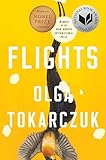
Olga Tokarczuk is a Polish author who won the Nobel Prize in Literature in 2019 (for 2018). Three of her major novels have been translated into English by Jennifer Croft, who won the International Booker Prize alongside Tokarczuk for Flights in 2018.
Olga Tokarczuk Major Works in English
1. Drive Your Plow Over the Bones of the Dead — 2009 Polish / 2018 English
Start here. Janina Duszejko, an elderly eccentric who lives alone in the mountains of southern Poland and translates Blake in her spare time, investigates a series of deaths she believes are the work of animals avenging their murdered kin. A philosophical mystery, a feminist novel, and a deeply funny book. The best starting point for new Tokarczuk readers.
➡ Full review → | Buy on Amazon →
2. Flights — 2007 Polish / 2017 English
A novel built from fragments — the narrator’s meditations on travel, historical vignettes about anatomists and the body, and a series of interconnected fictional stories — unified by the theme of movement, detachment, and the body as the one territory you can never leave. Won the International Booker Prize 2018.
➡ Full review → | Buy on Amazon →
3. The Books of Jacob — 2014 Polish / 2021 English
Tokarczuk’s magnum opus — 900 pages covering the life of Jacob Frank, an 18th-century Jewish mystic who founded a heretical movement, converted to Catholicism, and was imprisoned in a Polish fortress. One of the great historical novels of the century.
➡ Full review → | Buy on Amazon →
A Nobel Laureate’s Vision
Olga Tokarczuk stands among the most significant literary figures of her generation, a Polish writer whose distinctive and ambitious fiction earned her the Nobel Prize in Literature, the highest recognition the literary world can bestow. The Nobel honored a body of work of remarkable originality and depth, fiction that combines intellectual ambition with imaginative daring, formal experiment with deep human feeling, and a distinctly Central European sensibility with universal resonance. Tokarczuk’s vision is expansive and original, encompassing history and myth, the individual and the collective, the local and the universal, and her fiction is marked by a restless formal inventiveness, a willingness to break with conventional narrative structures in pursuit of new ways of capturing the complexity of human experience and the world. She is also a writer of strong moral and political engagement, whose work reflects a deep concern with history, with the marginalized and overlooked, with the relationship between humans and the natural world, and with the great questions of how we live and understand our existence. This combination of intellectual ambition, formal daring, and moral engagement, all rendered with imaginative richness and deep human feeling, is the distinctive achievement that the Nobel recognized, and it marks Tokarczuk as one of the most original and significant writers of her time. For readers approaching her work, the Nobel laureate’s vision offers a fiction of unusual ambition and originality, demanding but deeply rewarding, that combines intellectual depth with imaginative power and that engages the largest questions of history, existence, and the human relationship to the world. Tokarczuk’s vision, recognized by the Nobel, is among the most original and significant in contemporary literature.
The Constellation Novel
One of the most distinctive features of Olga Tokarczuk’s fiction is her development of what she has called the “constellation novel,” a fragmentary and non-linear form that abandons conventional continuous narrative in favor of an assemblage of fragments, stories, and reflections that the reader must connect into a larger pattern. This formal innovation is central to her achievement, most fully realized in Flights, a novel composed of dozens of fragments, stories, and meditations that together form a constellation of reflections on travel, the body, movement, and human restlessness. Rather than telling a single continuous story, the constellation novel assembles diverse fragments that resonate with one another, inviting the reader to perceive the connections and patterns among them and to construct meaning from their juxtaposition, much as one connects the stars of a constellation into a figure. This fragmentary form reflects Tokarczuk’s conviction that conventional linear narrative cannot adequately capture the complexity, multiplicity, and interconnection of human experience and the world, and that a more fragmentary, associative form is needed to render the patterns that connect disparate things. The constellation novel demands an active reader, one willing to perceive connections, hold multiple fragments in mind, and construct meaning from juxtaposition rather than receiving it from continuous narrative, but it rewards this effort with a distinctive richness and depth, a sense of the hidden patterns that connect the scattered fragments of experience. This formal innovation is among Tokarczuk’s most significant contributions, a genuinely original approach to the novel that expands the possibilities of the form. The constellation novel, fragmentary and associative, is the distinctive formal achievement of her fiction, demanding but deeply rewarding, and central to her original vision.
History, Myth, and the Polish Past
Much of Olga Tokarczuk’s most ambitious work engages deeply with history, particularly the complex and often troubled history of Poland and Central Europe, weaving together historical reality, myth, and imagination into rich and expansive fictions. Her monumental novel The Books of Jacob, widely regarded as her magnum opus, exemplifies this engagement, telling the story of Jacob Frank, an eighteenth-century Jewish religious figure who led a controversial messianic movement, and through his story illuminating a complex and largely forgotten chapter of Central European history. This vast novel reflects Tokarczuk’s deep engagement with the past, her ambition to recover and illuminate forgotten or marginalized histories, and her capacity to weave historical reality together with myth, religion, and imagination into an expansive and richly textured fiction. Her engagement with the Polish and Central European past is not merely antiquarian but morally and politically charged, for she is concerned with the marginalized and persecuted, with the complex and often painful realities of the region’s history, and with the ways that the past continues to shape and haunt the present. This historical engagement has sometimes made her a controversial figure in Poland, where her willingness to confront difficult aspects of the national past has provoked both admiration and hostility. For readers, her engagement with history, myth, and the Polish past offers fiction of remarkable depth and ambition, illuminating complex and forgotten chapters of Central European history and weaving historical reality together with myth and imagination into rich and expansive narratives. History, myth, and the Polish past are central to Tokarczuk’s most ambitious work, reflecting her deep engagement with the region’s complex history and her ambition to recover and illuminate its forgotten and marginalized chapters.
Reading Order Recommendation
| # | Title | Year |
|---|---|---|
| 1 | Drive Your Plow Over the Bones of the Dead | 2009 |
| 2 | Flights | 2007 |
| 3 | The Books of Jacob | 2014 |
Drive Your Plow → Flights → The Books of Jacob. This moves from most to least accessible, allowing you to establish your relationship with Tokarczuk’s sensibility before committing to her most demanding work.
Affiliate disclosure: Links to Amazon on this page are affiliate links. We earn a small commission at no extra cost to you.
Frequently Asked Questions
What Olga Tokarczuk book should I read first?
Start with Drive Your Plow Over the Bones of the Dead — it is her most accessible and immediately gripping novel, a philosophical mystery that introduces her concerns without the formal difficulty of Flights or The Books of Jacob.
What did Olga Tokarczuk win the Nobel Prize for?
Tokarczuk was awarded the 2018 Nobel Prize in Literature (announced in 2019 due to a delay at the Swedish Academy) for a narrative imagination that represents the crossing of boundaries as a form of life.
Is Flights a novel or a collection of stories?
Flights is described as a novel but is structured as a constellation of fragments — short chapters, essays, historical vignettes, and fictional narratives — loosely connected by the theme of travel and the body in transit. It won the International Booker Prize in 2018.