Where to Start with April Dunford: A Reading Guide
Where to start with April Dunford — how to approach Obviously Awesome, her definitive framework for product positioning. A complete reading guide.
By Marcus Webb
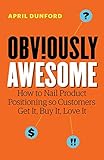
April Dunford is a Canadian product marketer and startup advisor who has positioned more than two dozen technology companies over a twenty-five-year career. Obviously Awesome: How to Nail Product Positioning So Customers Get It, Buy It, Love It (2019) was self-published and became the definitive book on product positioning for the startup and technology marketing world — turning a concept that most marketing books treat vaguely into a specific, repeatable process.
Where to Start: Obviously Awesome (2019)
The essential April Dunford — and the book that finally made product positioning concrete for the vast majority of founders and marketers who had struggled with the concept for years. Obviously Awesome begins with a correction: positioning is not a tagline, a mission statement, a marketing campaign, or a description of your product’s features. Positioning is the context you set for potential customers before they evaluate your product — the frame through which they understand what it is, who it’s for, and why it matters.
Most products are poorly positioned by default. The founders understand their product’s value but struggle to communicate it in terms that resonate with customers who don’t yet share their knowledge. Customers encounter the product, fail to understand where it fits in their mental map of available solutions, and either don’t buy or buy for the wrong reasons — creating friction in sales, confusion in marketing, and churn when reality doesn’t match expectation. Bad positioning is usually invisible precisely because the problem masquerades as something else: slow sales, low conversion rates, customer confusion.
Dunford’s framework builds positioning from five components that must all be explicitly defined:
Competitive alternatives — what would customers use if your product didn’t exist? This is not necessarily a direct competitor; it might be spreadsheets, email, or doing nothing. Understanding the real alternative defines the baseline against which your product must demonstrate value.
Unique attributes — what does your product have or do that the alternatives do not? This is where features belong in the framework: as the foundation for the value argument, not as the value argument itself.
Value — what is the specific benefit created by those unique attributes? Features are not value; value is the outcome the customer experiences as a result of the features. The distinction between feature and value is where most positioning fails.
Best-for customer profile — which specific customers experience the value most acutely? Narrow targeting feels counterintuitive but enables premium pricing, strong word of mouth, and marketing clarity. Being obviously perfect for a defined segment is more powerful than being adequate for everyone.
Market category — which context does your product sit in? This is the most powerful single positioning decision. The category you choose determines what expectations customers bring, what competitors you’re evaluated against, and what your price can legitimately be. The same product positioned as “a new kind of database” versus “an AI-powered analytics tool” reaches different buyers at different price points through different channels.
The book’s final section describes a positioning workshop process — involving sales, marketing, product, and customer success — that produces a positioning statement the entire organisation can align around. Dunford is precise about why cross-functional alignment matters: positioning only works if every customer touchpoint is consistent, and inconsistency is usually a sign that different functions have formed different views of what the product is and who it’s for.
Why Obviously Awesome Is the Ideal First Book
For a reader new to April Dunford, Obviously Awesome is the ideal and essential first book because it is her best-known work and the fullest expression of her distinctive expertise, the practical mastery of product positioning. Obviously Awesome presents Dunford’s clear, practical methodology for positioning products, helping companies define what their product is, who it is for, and why it matters, so that customers immediately understand its value. As an entry point it is essential, for it is her defining book and a concise, actionable guide to a subject many founders and marketers struggle with. It welcomes the newcomer with its clear framework, its practical guidance, and its accessible style, drawing the reader into the discipline of positioning. It is her most important work and the one that best represents her thinking, so the new reader encounters Dunford’s expertise directly. For the newcomer working on a product or its marketing, then, Obviously Awesome is the natural and ideal starting point.
What to Expect as a New Reader
As a new reader, you can expect Obviously Awesome to be a clear, practical, and genuinely useful guide to product positioning. You can expect a focus on positioning, the often-overlooked discipline of defining what your product is, who it is for, and why it matters. You can expect a clear methodology, for Dunford lays out a step-by-step process for finding and crafting effective positioning. You can expect practical guidance, for the book is concrete and actionable, grounded in her experience positioning many products. You can expect real-world examples that illustrate good and bad positioning. You can expect an emphasis on context, for Dunford shows how the right positioning makes a product’s value obvious to the right customers. You can expect a concise, accessible, and practical book. Expect, in short, a clear, practical, and genuinely useful guide to product positioning, the essential introduction to Dunford’s expertise.
Going Deeper After Your First Book
Once Obviously Awesome has given you a foundation in positioning, the reader who wishes to go deeper can explore Dunford’s other work and the wider literature of product marketing, go-to-market strategy, and sales to which positioning connects. Her later book extends her thinking into how to translate strong positioning into an effective sales pitch and go-to-market approach, building directly on the foundation of Obviously Awesome. The broad field of product-marketing and go-to-market writing offers many further perspectives the reader is well prepared to explore once they grasp positioning. Reading more widely deepens your engagement with Dunford’s distinctive expertise and with the broader discipline of bringing products to market. Her practical, methodical approach runs through her work. Building your reading journey from Obviously Awesome is a matter of following positioning into her later book and the wider product-marketing literature. The reader who begins here will have a genuinely useful foundation in positioning products.
Reading April Dunford
Obviously Awesome is Dunford’s essential book. It stands alone and requires no prior reading.
For the full April Dunford bibliography, reviews, and biography, visit the April Dunford author page on Editors Reads.
Affiliate disclosure: Links to Amazon on this page are affiliate links. We earn a small commission at no extra cost to you.
Frequently Asked Questions
Where should I start with April Dunford?
Obviously Awesome: How to Nail Product Positioning So Customers Get It, Buy It, Love It (2019) is Dunford's essential book — a practical, opinionated framework for product positioning drawn from twenty-five years of positioning technology companies. The most specific and actionable book on positioning available; it finally makes an abstract marketing concept concrete for founders and marketers who have struggled with it.
What is Obviously Awesome about?
Obviously Awesome argues that most products suffer from weak or absent positioning — the context that tells potential customers what a product is, who it's for, and why it matters before they even evaluate it. Dunford's five-component framework covers competitive alternatives, unique attributes, value, best-for customer profile, and market category. Of these, market category is the most powerful: it determines what your product is compared against and what your price can legitimately be.
Is Obviously Awesome only relevant for B2B tech companies?
Obviously Awesome is primarily oriented toward B2B technology products, where positioning problems are most acute and most expensive. The framework applies with some adaptation to consumer products and other sectors, but the examples and the workshop process are drawn from software and technology contexts. Founders and marketers in other sectors will find the principles broadly useful but will need to translate the specifics.
What should I read after Obviously Awesome?
After Obviously Awesome, Andrew Chen's The Cold Start Problem covers network effects and the distribution challenge that follows good positioning. The Mom Test by Rob Fitzpatrick covers customer research — how to talk to customers in ways that produce honest signal about positioning and value rather than polite encouragement. Donald Miller's Building a StoryBrand covers how to communicate your positioning in marketing messages and website copy.