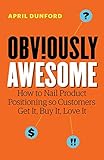
Editors Reads Verdict
April Dunford's Obviously Awesome is the book that finally made product positioning make sense for the vast majority of marketers and founders who had struggled with the concept for years. Practical, opinionated, and unusually specific for a marketing book.
What We Loved
- The five-component positioning framework is immediately applicable and comprehensive
- Dunford's twenty-five years of positioning practice give every principle concrete grounding
- The distinction between features, value, and best-for-customer is among the most clarifying in marketing
- The writing is direct and opinionated — no hedging, no both-sidesing
Minor Drawbacks
- Primarily oriented toward B2B technology products — some adaptation required for consumer or other sectors
- The workshop process described is difficult to implement without significant organizational buy-in
- Some examples are from companies readers may not be familiar with
Key Takeaways
- → Positioning is not a tagline or a mission statement — it is the context you set for customers before they evaluate your product
- → The five components of positioning: competitive alternatives, unique attributes, value, target market, and market category
- → The market category you choose frames everything — it sets customer expectations and determines what your product is compared against
- → Best-for is more powerful than better-than — narrow targeting enables premium pricing and strong word of mouth
- → Weak positioning happens when a product's best features are described as features rather than the value those features create
| Author | April Dunford |
|---|---|
| Publisher | Independently Published |
| Pages | 207 |
| Published | May 10, 2019 |
| Language | English |
| Genre | Business, Marketing, Startups |
| Difficulty | Beginner |
| Best For | Product marketers, founders, and product managers who need to position products; anyone who has struggled to explain what makes their product different and why that matters. |
How Obviously Awesome Compares
Obviously Awesome at a glance against 3 similar books readers weigh alongside it.
| Book | Author | Rating | Best for |
|---|---|---|---|
| Obviously Awesome (this book) | April Dunford | ★ 4.5 | Product marketers, founders, and product managers who need to position products |
| Inspired | Marty Cagan | ★ 4.4 | Product managers, product leaders, founders, and anyone who wants to understand |
| The Cold Start Problem | Andrew Chen | ★ 4.2 | Founders building marketplace or platform businesses |
| The Mom Test | Rob Fitzpatrick | ★ 4.6 | Startup founders, product managers, and anyone who needs to conduct customer |
What Positioning Actually Is
April Dunford has spent twenty-five years helping technology companies position their products, and the first thing Obviously Awesome does is correct a fundamental misunderstanding: positioning is not a tagline, a mission statement, or a marketing campaign. Positioning is the context you set for potential customers before they evaluate your product — the frame through which they understand what it is, who it’s for, and why it matters.
Bad positioning — the default condition of most products — is invisible. The product exists but customers cannot see themselves using it because they cannot place it in a coherent mental category. Good positioning makes the product obviously valuable to the right people for obvious reasons. Hence the title.
The Five Components
Dunford builds her framework around five components that must all be explicitly defined for positioning to work: competitive alternatives (what would customers use if your product didn’t exist), unique attributes (what your product has or does that alternatives don’t), value (the benefit created by those unique attributes), best-for customer profile (the specific customers for whom your value matters most), and market category (the context in which customers will evaluate and understand your product).
The most powerful of these is market category. The category you choose determines what your product is compared against, what customer expectations it must meet, and what your pricing can legitimately be. A product positioned as “a new kind of database” is evaluated against databases; the same product positioned as “an AI-powered analytics tool” is evaluated differently, priced differently, and bought by different people.
The Positioning Workshop
Dunford provides a detailed process for conducting a positioning workshop — involving sales, marketing, product, and customer success — that produces a positioning statement the whole organization can align around. This is important because positioning only works if everyone in the company communicates it consistently.
Why This Book is Different
The marketing section of any bookstore is full of books about positioning that are vague, theoretical, and full of frameworks that do not translate to actual products. Obviously Awesome is specific, process-driven, and full of examples from real technology companies. The specificity is its most valuable quality.
The Ten-Step Process and the Five Styles
What separates Obviously Awesome from the abstract treatments of positioning that preceded it is that Dunford reduces the work to a sequence a team can actually follow. She lays out a ten-step process that begins with setting aside your current positioning entirely, then moves through identifying your true competitive alternatives, isolating the unique attributes that those alternatives lack, mapping those attributes to the value they create, and finally choosing the market category that frames everything for the customer. The discipline of working in that order is the point: most companies start with the category they wish they were in and reverse-engineer a story to fit, whereas Dunford insists the category should be the last decision, derived from the value you have already proven you deliver.
She also introduces a useful taxonomy of positioning styles — whether to position your product within an existing, well-understood market category, to stake out a subsegment of one, or, most ambitiously, to create an entirely new category. Each carries different costs and risks, and Dunford is refreshingly honest that category creation, the strategy every founder romanticises, is also the most expensive and most likely to fail, because you must educate the market about a problem it does not yet know it has before you can sell the solution.
April Dunford’s Background and Authority
The book’s credibility rests heavily on Dunford’s track record, and she wears it openly. Before writing it she spent roughly twenty-five years in technology, leading marketing at a series of startups and large companies and personally positioning dozens of products across two decades. That practitioner’s perspective is audible on every page: the examples are not borrowed from business-school case studies but drawn from rooms she has actually sat in, and the failure modes she describes — the engineering team in love with features customers do not care about, the sales force describing the product five different ways — read like field notes rather than theory. She has since become one of the most sought-after positioning consultants in B2B technology and followed this book with Sales Pitch, which extends the same practical sensibility from positioning into the sales conversation itself.
Who Should Read It and Its Limits
Obviously Awesome is essential reading for founders, product marketers, and product managers in B2B technology, where its examples and assumptions land most cleanly. Anyone who has ever struggled to answer the deceptively simple question “what is your product?” will find the book clarifying, and its brevity — barely over two hundred pages — means the payoff arrives quickly. The chief caveat is scope: the framework is built around technology products sold to businesses, and readers in consumer goods, services, or other sectors will need to translate some of its assumptions, particularly around how customers discover and evaluate products. Implementing the workshop process also requires genuine organisational buy-in across sales, product, and marketing, which can be the hardest part of all. None of this undermines the book’s core value, which is to take a notoriously slippery concept and make it concrete enough to act on by Monday morning. For readers who want a single, opinionated, practitioner-tested account of how to make a product legible to the customers who should want it, it has become the default recommendation, and deservedly so.
Our rating: 4.5/5 — The definitive product positioning book — finally making an abstract marketing concept concrete, actionable, and useful for founders and marketers who have struggled with it for years.
Frequently Asked Questions
What is "Obviously Awesome" about?
A step-by-step process for positioning technology products that cuts through the confusion about what positioning is, why it matters, and how to do it well.
Who should read "Obviously Awesome"?
Product marketers, founders, and product managers who need to position products; anyone who has struggled to explain what makes their product different and why that matters.
What are the key takeaways from "Obviously Awesome"?
Positioning is not a tagline or a mission statement — it is the context you set for customers before they evaluate your product The five components of positioning: competitive alternatives, unique attributes, value, target market, and market category The market category you choose frames everything — it sets customer expectations and determines what your product is compared against Best-for is more powerful than better-than — narrow targeting enables premium pricing and strong word of mouth Weak positioning happens when a product's best features are described as features rather than the value those features create
Is "Obviously Awesome" worth reading?
April Dunford's Obviously Awesome is the book that finally made product positioning make sense for the vast majority of marketers and founders who had struggled with the concept for years. Practical, opinionated, and unusually specific for a marketing book.
Ready to Read Obviously Awesome?
Check the current price on Amazon.
Check Price on Amazon (paid link)Prices and availability are subject to change. See Amazon for current price.
Review last updated: