Where to Start with John Green: A Reading Guide
Where to start with John Green — whether to begin with The Fault in Our Stars, Looking for Alaska, or Turtles All the Way Down. A complete reading guide.

John Green (born 1977) is the American novelist and YouTuber who — with Looking for Alaska (2005) and The Fault in Our Stars (2012) — established himself as the most commercially successful and most critically engaged literary writer for young adults of his generation. His novels are characterised by highly intelligent teenage protagonists, literary references, philosophical ambition, and an unwillingness to protect his characters or his readers from emotional difficulty. He is one half of the VlogBrothers YouTube channel, host of the Crash Course educational YouTube series, and among the most influential cultural figures in contemporary YA publishing.
Where to Start: The Fault in Our Stars (2012)
The most widely read Green — and the book that brought him a global audience. Hazel Grace Lancaster is sixteen and has terminal lung cancer; an experimental drug is keeping her alive but is not a cure. She attends a cancer support group under protest, where she meets Augustus Waters, seventeen, who lost his right leg to cancer and is currently in remission. They share a book — Hazel’s favourite novel, An Imperial Affliction by the fictional Peter Van Houten — and plan to visit its reclusive author in Amsterdam.
Green writes Hazel with unusual intelligence and specificity. She is deeply aware of what she calls her ‘grenade’ — the damage her death will do to the people who love her — and she manages her relationships with the emotional caution this awareness demands. Augustus is more characteristically Green: articulate, philosophical, fond of grand gestures. The dynamic between them is precisely observed. The novel is moving because it earns its emotion through genuine characterisation rather than through manipulation; it is one of the very few terminal-illness YA novels that treats death as something other than ennobling.
Looking for Alaska (2005)
Green’s debut — and his most formally accomplished work. Miles Halter, fourteen, leaves home for Culver Creek Boarding School in Alabama; he is drawn to the Colonel (his roommate) and to Alaska Young, beautiful and self-destructive in ways Miles doesn’t fully understand. The novel is structured around a single event, divided into ‘Before’ and ‘After’, and the second half asks what it means to grieve someone you loved but didn’t fully know. The formal structure is precisely calibrated; the questions the novel asks about responsibility, guilt, and the unknowability of other people are genuinely difficult.
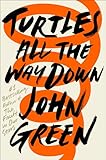
Turtles All the Way Down (2017)
Green’s most personal novel — a portrait of OCD rendered with clinical accuracy by a writer who has OCD himself. Aza Holmes’s intrusive thought spirals are described from the inside with a specificity that most mental health fiction does not achieve. The investigation plot (a missing billionaire) is the external frame; the actual subject is what it costs to maintain relationships and function in the world while managing a mind that doesn’t function conventionally. His most emotionally honest book.
Paper Towns (2008)
Green’s mystery novel — Quentin Jacobsen follows the evidence trail left by his neighbour Margo Roth Spiegelman, who has disappeared after a single extraordinary night they spent together. The novel’s argument — about the gap between the person we imagine someone to be and the person they actually are — is sharper than the thriller mechanics, which are looser than the other books. Best read after the first two novels.
Why The Fault in Our Stars Is the Ideal First Book
For a reader new to John Green, The Fault in Our Stars is the ideal first book because it is his most famous and beloved novel and the fullest expression of his distinctive gifts, the emotional honesty, the sharp wit, and the deeply felt portrayal of young people grappling with big questions. The Fault in Our Stars follows two teenagers who meet at a cancer support group and fall in love, in a funny, heartbreaking, and deeply moving story about love, illness, and meaning. As an entry point it is ideal, for it is his best-known work and a perfect example of his witty, emotional, and thoughtful young-adult fiction. It welcomes the newcomer with its endearing characters, its sharp wit, and its emotional power, drawing the reader into his distinctive voice. It is his most famous work and the one that best represents his gifts, so the new reader encounters Green at his most characteristic. For the newcomer, then, The Fault in Our Stars is the natural and ideal starting point.
What to Expect as a New Reader
As a new reader, you can expect The Fault in Our Stars to be a witty, emotional, and deeply moving young-adult novel. You can expect endearing characters, for the novel follows two intelligent, funny teenagers who meet at a cancer support group and fall in love. You can expect sharp wit, for Green’s characters are clever, articulate, and funny, and the dialogue sparkles. You can expect emotional honesty, for the novel deals with illness, love, and mortality with directness and feeling. You can expect heartbreak, for the story is genuinely moving and often makes readers cry. You can expect big questions, for the novel grapples thoughtfully with meaning, suffering, and what makes a life matter. You can expect a funny, sad, and resonant read. You should be prepared for emotional and difficult subject matter. Expect, in short, a witty, emotional, and deeply moving young-adult novel, a perfect introduction to Green’s gifts.
Going Deeper After Your First Book
Once The Fault in Our Stars has introduced you to Green’s gifts, the reader who wishes to go deeper can explore his other novels, which continue his emotional honesty, his sharp wit, and his deeply felt portrayal of young people grappling with big questions. His other beloved books follow intelligent, searching teenagers through stories of love, loss, identity, friendship, and the search for meaning, including his acclaimed novels of adventure, mystery, and mental health, each marked by his wit and emotional depth. Reading these after The Fault in Our Stars deepens your appreciation of Green’s distinctive gifts, the emotional honesty, the sharp wit, and the thoughtful engagement with big questions. His characteristic strengths run through his work, and the reader moved by The Fault in Our Stars will find them across his novels. Building your reading journey through Green is a matter of following his fiction from The Fault in Our Stars into his other novels. The reader who begins here and continues will find one of the most beloved and thoughtful authors in contemporary young-adult fiction.
Reading John Green
Green’s novels are united by his interest in intelligent teenagers who are aware of their own mortality, their own pretensions, and the gap between what they feel and what they can express. His books are not light; they are funny and warm but they refuse easy consolation. Begin with The Fault in Our Stars for the most emotionally immediate version of his gifts, or with Looking for Alaska for his most formally ambitious work.
Frequently Asked Questions
Where should I start with John Green?
The Fault in Our Stars (2012) is the most widely read starting point — Green's bestselling novel about two teenagers with cancer who fall in love at a support group. It is the most emotionally affecting of his books and the most accessible to readers who have not read him before. Looking for Alaska (2005), his debut, is the most critically regarded — a more complex and more morally challenging story about a boy who falls for a self-destructive girl at boarding school. Either makes a good starting point; The Fault in Our Stars is more immediately moving, Looking for Alaska is more ambitious.
What is The Fault in Our Stars about?
The Fault in Our Stars (2012) follows Hazel Grace Lancaster, sixteen, whose lung cancer is being controlled by an experimental drug that is not a cure. At her cancer support group, she meets Augustus Waters, who is in remission after losing his leg to osteosarcoma. They fall in love; they read and discuss books; they travel to Amsterdam to meet the reclusive author of Hazel's favourite novel. The book is about mortality and love and what it means to make a life that matters when the life is necessarily brief. Green writes Hazel and Augustus with unusual intelligence and specificity; the novel avoids sentimentality by taking its characters seriously.
What is Looking for Alaska about?
Looking for Alaska (2005) follows Miles 'Pudge' Halter, who leaves home for Culver Creek Boarding School in Alabama, where he befriends the Colonel (Chip Martin) and falls hard for Alaska Young — beautiful, self-destructive, funny, and consumed by a darkness she has been carrying since childhood. The novel is divided into two halves, 'Before' and 'After', structured around a single event; the second half asks what it means to grieve someone you didn't fully understand while they were alive. Green's most morally serious and most formally accomplished novel.
What is Turtles All the Way Down about?
Turtles All the Way Down (2017) is Green's most personally autobiographical novel, about a teenager with OCD whose thought spirals are rendered with unusual clinical accuracy. Aza Holmes and her best friend Daisy investigate the disappearance of a billionaire whose son Aza once knew, but the thriller plot is largely a frame for the interior experience of intrusive thought and the difficulty of maintaining relationships while managing a mental illness. Green has said it is the most honest thing he has written. The OCD depiction is considered one of the most accurate in YA fiction.