Where to Start with Orson Scott Card: A Reading Guide
Where to start with Orson Scott Card — whether to begin with Ender's Game, Speaker for the Dead, or the Ender's Shadow series. A complete reading guide.
Orson Scott Card (born 1951) is the American science fiction and fantasy novelist who — with Ender’s Game (1985) — produced one of the most widely read science fiction novels in the English language, one of the few books to win both the Hugo Award and the Nebula Award in the same year. The Ender series spans multiple novels and timelines across thousands of years; the original novel is the foundation for everything that follows, including a parallel series (Ender’s Shadow, told from Bean’s perspective) and two direct sequels (Speaker for the Dead, Xenocide) that are arguably more ambitious and more searching works. Card is a controversial public figure; his personal views on social issues have been widely criticised and have affected the reception of his work.
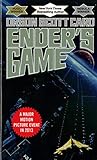
Where to Start: Ender’s Game (1985)
The essential Card — and one of the defining science fiction novels of the twentieth century. Six-year-old Andrew ‘Ender’ Wiggin is identified by the International Fleet as a military prodigy and selected for Battle School: a space station where children are trained through games and competitions for the command positions needed to defeat the Formics in a third invasion. Ender is the most gifted student in Battle School history; he is also being deliberately isolated, manipulated, and tested beyond any point his handlers consider safe.
Card constructs a novel in which the games — particularly the zero-gravity Battle Room — are the mechanism through which Ender’s genius develops and through which the reader understands both his capability and his psychological cost. The games are also literal cover for something else: Card uses the metaphor of play-as-preparation to tell a story about what is actually being prepared.
The novel’s final revelation — which should be encountered without prior knowledge — reframes everything that came before. Ender’s Game is one of the few science fiction novels whose final twist is not simply a narrative surprise but a moral reckoning.
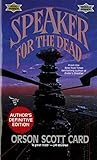
Speaker for the Dead (1986)
Card’s most philosophically searching novel — set 3,000 years after Ender’s Game (Ender has been travelling at near-light speeds and is in his thirties), on a colony planet called Lusitania where a second alien species has been discovered and where a scientist has been killed by them in a ceremony whose meaning cannot be decoded. Ender arrives as a Speaker for the Dead — a person who speaks the complete truth about a deceased person’s life, without mitigation — and begins to unpick the murder, the community’s dysfunction, and the question of whether the Pequeninos can be understood or only protected.
Speaker for the Dead is a completely different novel from Ender’s Game: slower, more patient, more focused on community and guilt than on individual genius and military command. Many readers consider it the better work; it requires Ender’s Game as foundation.
Xenocide (1991)
The third novel — continuing directly from Speaker for the Dead, introducing a third alien intelligence (the Descolada virus) and a new cast of characters on the distant planet of Path. The novel becomes increasingly concerned with consciousness, free will, and the morality of genocide when the survival of one species requires the extinction of another. More difficult and more abstract than the first two; best read as a continuation of Speaker for the Dead.
Why Ender’s Game Is the Ideal First Book
For a reader new to Orson Scott Card, Ender’s Game is the ideal first book because it is his most famous and beloved novel, a classic of science fiction, and the fullest expression of his distinctive gifts, the gripping storytelling, the compelling young protagonist, and the engagement with profound moral questions. Ender’s Game follows a brilliant child recruited and trained to lead humanity’s war against an alien threat, in a gripping, emotionally powerful, and morally complex novel. As an entry point it is ideal, for it is his best-known work and a perfect example of his propulsive, thoughtful science fiction. It welcomes the newcomer with its gripping premise, its compelling hero, and its moral depth, drawing the reader into his distinctive vision. It is his most celebrated work and the one that best represents his gifts, so the new reader encounters Card at his most characteristic. For the newcomer, then, Ender’s Game is the natural and ideal starting point.
What to Expect as a New Reader
As a new reader, you can expect Ender’s Game to be a gripping, emotionally powerful, and morally complex work of science fiction. You can expect a compelling young protagonist, for the novel follows a brilliant child recruited and trained at a battle school to lead humanity’s war against an alien threat. You can expect gripping storytelling, for the novel is propulsive, tense, and hard to put down. You can expect emotional power, for the pressures and isolation placed on the young hero give the story real weight. You can expect engagement with profound moral questions, about war, leadership, empathy, and the costs of victory. You can expect a famous and affecting ending. You can expect accessible, thoughtful science fiction. Expect, in short, a gripping, emotionally powerful, and morally complex work of science fiction, a superb introduction to Card’s gifts.
Going Deeper After Your First Book
Once Ender’s Game has introduced you to Card’s gifts, the natural next step is to continue its story, above all with its acclaimed direct sequel, which follows the hero into adulthood in a thoughtful, philosophical, and very different kind of novel, often considered as fine as the first. The Ender saga continues across further novels and a parallel series following another character, expanding the world and its moral questions. Beyond the Ender books, the reader who has enjoyed Card’s gifts can explore his other science fiction and fantasy, which display his gift for storytelling and his interest in moral and human questions. His characteristic strengths, the gripping storytelling, the compelling characters, and the moral depth, run through his work. Building your reading journey through Card is a matter of continuing the Ender saga and exploring his wider fiction. The reader who begins here will find one of the most beloved and thoughtful works of modern science fiction, and a saga to follow.
Reading Orson Scott Card
Begin with Ender’s Game — it is both the most accessible and the most emotionally powerful of his novels, and works as a complete standalone. Read Speaker for the Dead as the natural and more philosophically sophisticated second step. Xenocide is best read only if you want to continue Speaker for the Dead’s specific questions; it does not stand alone. The Ender’s Shadow parallel novel (Bean’s perspective on the events of Ender’s Game) is a worthwhile complement for readers who want to return to Battle School from a different angle.
Frequently Asked Questions
Where should I start with Orson Scott Card?
Ender's Game (1985) is the only starting point — the Hugo and Nebula Award-winning novel following Andrew 'Ender' Wiggin, a child prodigy selected to attend Battle School and trained to become humanity's strategic saviour against an alien species called the Formics. Ender's Game is one of the most widely read science fiction novels ever written and works as a complete standalone. The immediate sequel, Speaker for the Dead, is a completely different kind of novel — slower, more philosophical, set 3,000 years later — and some readers prefer to stop after Ender's Game.
What is Ender's Game about?
Ender's Game is set in a future where humanity has twice survived invasions by the Formics (called 'Buggers'), an insectoid alien species. Ender Wiggin is identified as a child of exceptional military genius and recruited into an elite training program — Battle School, a zero-gravity space station where children are trained for military command. The novel follows Ender's development through the school's games and psychological manipulations, toward a final command test whose nature he doesn't fully understand. The novel is simultaneously a study of childhood, manipulation, and genius, and a sustained meditation on what it means to destroy an enemy you don't fully understand.
What is Speaker for the Dead about?
Speaker for the Dead (1986) is set 3,000 years after Ender's Game (Ender has been travelling at relativistic speeds and aged only a few decades). He arrives on Lusitania, a colony planet where a second alien species — the Pequeninos, called piggies — has been discovered, and where a scientist has been killed by them in a ritualistic way. The novel is a slower, more philosophical work than Ender's Game — concerned with xenology, guilt, atonement, and the difficulty of truly understanding an alien species. Many readers consider it the better novel; it requires Ender's Game as context.
Is Ender's Game suitable for young readers?
Ender's Game is often read by readers as young as ten or eleven and is frequently assigned in schools; it is also widely read by adults who encounter it for the first time. The protagonist is a child, and the novel is concerned with childhood trauma and the ethics of child manipulation in ways that adult readers may find more disturbing than young ones. The violence is not graphic but is psychologically intense; the ethical questions about what was done to Ender are most fully understood by readers who can hold competing sympathies. It is genuinely suitable for a wide age range.