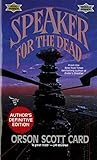
Editors Reads Verdict
Speaker for the Dead is one of science fiction's most extraordinary second novels — entirely different in tone and structure from Ender's Game, it won both Hugo and Nebula Awards and may be the more profound achievement.
What We Loved
- Won both Hugo and Nebula Awards — a rare achievement for a series second volume
- The anthropological puzzle at the novel's heart is brilliantly constructed
- Thematically ambitious in a way that Ender's Game's action-adventure structure didn't allow
- The alien Pequeninos are one of science fiction's most inventive non-human species
Minor Drawbacks
- The tonal shift from Ender's Game can disorient readers expecting a similar experience
- The family drama at Milagre is sometimes as frustrating as it's meant to be
- The novel rewards patience over speed — it's deliberately slow
Key Takeaways
- → Understanding the other — genuinely understanding, not merely tolerating — is the highest form of intelligence
- → The Hierarchy of Foreignness (utlannings, ramen, varelse, djur) is one of SF's most useful conceptual tools
- → Speaking for the dead means telling the truth about a life, including its failures
- → First contact is an ethical problem as much as a scientific one
- → Three thousand years of guilt have made Ender uniquely equipped for the task at hand
| Author | Orson Scott Card |
|---|---|
| Publisher | Tor Books |
| Pages | 382 |
| Published | March 1, 1986 |
| Language | English |
| Genre | Science Fiction |
| Difficulty | Intermediate |
| Best For | Readers who have completed Ender's Game and are ready for a more philosophically demanding second volume — and science fiction readers interested in anthropology, ethics, and first-contact narratives. |
How Speaker for the Dead Compares
Speaker for the Dead at a glance against 3 similar books readers weigh alongside it.
| Book | Author | Rating | Best for |
|---|---|---|---|
| Speaker for the Dead (this book) | Orson Scott Card | ★ 4.4 | Readers who have completed Ender's Game and are ready for a more |
| Childhood's End | Arthur C. Clarke | ★ 4.2 | Science fiction readers drawn to big ideas, cosmic perspective, and classic SF |
| Ender's Game | Orson Scott Card | ★ 4.7 | Science fiction readers from teenage years upward, fans of military fiction who |
| The Dispossessed | Ursula K. Le Guin | ★ 4.4 | Serious science fiction readers interested in political philosophy, utopian |
A Completely Different Book
The opening pages of Speaker for the Dead announce that Card has written something entirely unlike Ender’s Game. It is three thousand years later. Ender Wiggin, whose actions destroyed an alien civilisation, has spent millennia travelling at near-light speed, forever young while time passes around him, carrying a guilt he cannot expiate. He is also the author of The Hive Queen — the book that redefined human understanding of the Formics.
Now humanity has found a second alien species — the Pequeninos, or piggies, of the planet Lusitania. And the tiny human colony there is having its xenobiologists murdered by the aliens in ways that make no sense. A Speaker for the Dead has been called to speak for the colony’s founder, Pipo.
The Puzzle and the Method
The novel’s structure is essentially a mystery — an anthropological puzzle whose solution will determine whether humanity destroys a second alien species. Card constructs the problem with extraordinary care. The Pequeninos’ behaviour is genuinely baffling, and the solution is simultaneously surprising and, in retrospect, perfectly prepared for.
The Speaking itself — the practice of standing at a funeral and telling the complete truth about the life lived, without omission or euphemism — is one of Card’s most compelling inventions. It is a form of radical honesty that the novel presents as a genuine ethical achievement.
Ender After Guilt
Wiggin himself is a different character from the child soldier of the first book: older in spirit than any human should be, carrying the weight of genocide, seeking a form of atonement. His relationship with the Ribeira family of Lusitania — and what he uncovers about their history — gives the novel its emotional architecture.
Our rating: 4.4/5 — Card’s most philosophically ambitious achievement: a Hugo and Nebula winner that rewards the patience it demands.
Hugo and Nebula Awards
Speaker for the Dead won both the Hugo Award for Best Novel (1987) and the Nebula Award for Best Novel (1986), making Card one of only a handful of authors to win both awards for the same book in consecutive years. Its predecessor Ender’s Game had won both awards the year before (Hugo 1986, Nebula 1985) — a back-to-back achievement that remains without parallel in the history of the two major science fiction awards.
Card had conceived Speaker for the Dead first, before Ender’s Game, and wrote the longer, philosophical novel imagined as the fuller statement of the work. Ender’s Game began as a novella designed to introduce the character of Ender Wiggin and make him comprehensible to readers before they encountered him three thousand years later, transformed by relativistic travel into the figure who gives the dead their true voice.
The Pequeninos
The alien species called piggies — officially the Pequeninos — are among the more carefully constructed first-contact aliens in science fiction. Their apparent violence, which puzzles the colony of Lusitania, is eventually revealed to be a form of honour, a biological and cultural practice whose logic is entirely coherent within their own framework. The misunderstanding that accumulates across the novel reflects Card’s argument that genuine alien contact would require not just translation of language but translation of framework — an understanding of what the other’s actions mean within their own logic rather than ours.
The Hive Queen
The novel introduces the Hive Queen, one of the Formics who survived the Third Invasion, carried in the Ansible by Ender for three thousand years as he searches for a world where she can rebuild her people. The moral weight of Ender’s entire life — his guilt, his vocation as Speaker, his search for a home for the Hive Queen — gives the novel its emotional architecture. Speaker for the Dead is a quieter book than Ender’s Game, more interested in anthropology and moral philosophy than military strategy, and it rewards readers willing to accept the change of register.
Philosophical Context
Card’s “Speaking for the Dead” — the practice of delivering a full and honest account of a dead person’s life, without softening or sentimentality — is drawn in part from his Mormon background, in which truthful accounting of life is a theological concept. The novel uses science fiction’s speculative freedom to ask what genuine moral honesty would look like as an institution, and what it would cost the person practising it.
Ender’s Transformation
Andrew Wiggin becomes “The Speaker for the Dead” — a cultural institution across three thousand years — after publishing the Hive Queen and the Hegemon, two accounts of the beings most directly hurt by humanity’s expansion: the destroyed Formics and his brother Peter, who controlled Earth after the war. The practice of Speaking — delivering a full and honest account of a person’s life without evasion — is presented as both vocation and penance: Ender carries the guilt of the Formic genocide and the responsibility of the Speaker’s role. Card’s creation of a secular quasi-religious institution around the practice of honest witness is one of science fiction’s more original social inventions.
The Ansible Network
The Ansible — the instantaneous communication device connecting human colonies across three thousand years — is borrowed from Ursula K. Le Guin’s Hainish Cycle, with her permission. Card’s use of the device allows the Speaker institution to function: the same individual can travel between stars at relativistic speeds, ageing decades while centuries pass outside, and receive instant communication from any colony. The combination of relativistic aging (Ender is ancient in experience but young in body) and instantaneous communication creates the specific time-displacement that makes the novel’s emotional architecture possible — the same man, speaking across millennia, carrying a guilt that the universe has long since moved past.
Frequently Asked Questions
What is "Speaker for the Dead" about?
Three thousand years after Ender's Game, the now-ancient Ender Wiggin becomes a Speaker for the Dead on a world where a second contact with aliens threatens to become the second genocide.
Who should read "Speaker for the Dead"?
Readers who have completed Ender's Game and are ready for a more philosophically demanding second volume — and science fiction readers interested in anthropology, ethics, and first-contact narratives.
What are the key takeaways from "Speaker for the Dead"?
Understanding the other — genuinely understanding, not merely tolerating — is the highest form of intelligence The Hierarchy of Foreignness (utlannings, ramen, varelse, djur) is one of SF's most useful conceptual tools Speaking for the dead means telling the truth about a life, including its failures First contact is an ethical problem as much as a scientific one Three thousand years of guilt have made Ender uniquely equipped for the task at hand
Is "Speaker for the Dead" worth reading?
Speaker for the Dead is one of science fiction's most extraordinary second novels — entirely different in tone and structure from Ender's Game, it won both Hugo and Nebula Awards and may be the more profound achievement.
Ready to Read Speaker for the Dead?
Check the current price on Amazon.
Check Price on Amazon (paid link)Prices and availability are subject to change. See Amazon for current price.
Review last updated: