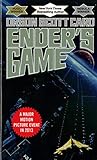
Editors Reads Verdict
One of the most influential science fiction novels ever written — and still one of the most readable. Card's insight that the most brilliant military minds are children, shaped before they understand the moral weight of what they're being trained for, gives the book an ethical dimension that transcends its genre. The Battle Room sequences are pure kinetic genius.
What We Loved
- The Battle Room zero-gravity combat sequences are among the most original action writing in science fiction
- The ethical twist in the final act reframes everything that came before — one of the best reveals in genre fiction
- Ender is one of the most compelling child protagonists in literature — brilliant, isolated, deeply sympathetic
- Short and fast — 352 pages that read like 200
- The themes of manipulation, child soldiers, and pre-emptive war are philosophically serious
Minor Drawbacks
- The sequels (*Speaker for the Dead*, *Xenocide*) are radically different in tone — many readers prefer to stop here
- Some of the dialogue is slightly wooden, a legacy of the 1977 short story version
- The military setting can feel dated to readers who encounter it post-*Hunger Games*
Key Takeaways
- → The most dangerous soldiers are those who don't know they're soldiers — ignorance is a military asset
- → Empathy and military genius can coexist — Ender understands his enemies so completely he can destroy them
- → Pre-emptive war raises the deepest moral questions: how certain must you be before you strike first?
- → Children can be trained to kill if you make the killing a game — and this is an indictment, not an endorsement
- → The enemy's gate is down — reframing problems spatially (and cognitively) is the key to solving them
| Author | Orson Scott Card |
|---|---|
| Publisher | Tor Books |
| Pages | 352 |
| Published | January 15, 1985 |
| Language | English |
| Genre | Science Fiction, Classic Literature, Young Adult |
| Difficulty | Beginner |
| Best For | Science fiction readers from teenage years upward, fans of military fiction who want ethical complexity, anyone who liked *The Hunger Games* or *Divergent* and wants the serious adult equivalent, and teachers looking for a gateway text into serious science fiction. |
How Ender's Game Compares
Ender's Game at a glance against 2 similar books readers weigh alongside it.
| Book | Author | Rating | Best for |
|---|---|---|---|
| Ender's Game (this book) | Orson Scott Card | ★ 4.7 | Science fiction readers from teenage years upward, fans of military fiction who |
| Dune | Frank Herbert | ★ 4.7 | Readers of ambitious fiction, fans of the films who want the deeper version, |
| Project Hail Mary | Andy Weir | ★ 4.8 | Science fiction readers who want accurate science without sacrificing story, |
The Game Within the War Within the Novel
Ender’s Game began as a short story published in Analog Science Fiction in 1977. Orson Scott Card expanded it into a novel in 1985, winning both the Hugo and Nebula Awards — the two highest honours in science fiction — in the same year. It is one of only a handful of novels to achieve this double.
Forty years later, it is still on school reading lists, still widely assigned in military academies, and still the novel more readers cite as their introduction to science fiction than almost any other.
The Premise
In the near future, humanity has survived two invasions by an alien species known as the Formics — insect-like beings who nearly destroyed human civilisation. Believing a third invasion is inevitable, Earth’s military establishment — the International Fleet — has built a programme to identify and train child prodigies as military commanders.
Andrew “Ender” Wiggin is six years old when he is identified as the most gifted candidate the programme has ever found. He is removed from his family and transported to Battle School — a space station where children train in zero-gravity combat games designed to develop tactical genius.
The Battle Room
The novel’s central set pieces take place in the Battle Room: a zero-gravity sphere where two armies of children fight in suits and helmets, scoring points by freezing enemies with a light gun and getting soldiers through the enemy’s “gate.” Card describes these battles with extraordinary spatial clarity — you always know where everyone is, how the zero-gravity physics work, and why Ender’s solutions are brilliant.
The famous rule of the Battle Room: The enemy’s gate is down. Ender reorients the entire spatial frame of the game, treating the enemy’s gate (the goal) as the floor and attacking from “above” relative to the enemy’s perspective. This cognitive flip — redefining orientation to change strategy — is the novel’s central intellectual move, applied at every level of the story.
The Ethical Ambush
Ender’s Game is a novel about manipulation. From the first page, Ender is being shaped, tested, and used by adults who believe the stakes are high enough to justify anything. Colonel Graff — the school’s commandant — treats Ender not as a child to be educated but as a weapon to be forged.
The final act contains one of the great moral reveals in genre fiction: a twist that reframes everything the reader understood about the novel’s training structure and asks, with sudden urgency, whether brilliant military effectiveness can ever be separated from moral responsibility for what that effectiveness produces.
Card does not answer the question — he just makes it unavoidable.
Why It Holds Up
Ender’s Game is short, propulsive, and built around ideas that become more urgent rather than less as you grow older. The child-soldier critique was ahead of its time in 1985; the questions about pre-emptive warfare have only deepened since 2001. The Battle Room sequences are technically extraordinary. And Ender himself — isolated, brilliant, desperately wanting connection and consistently denied it — is one of the most human protagonists in science fiction.
Our rating: 4.7/5 — The novel that defined military science fiction. Essential, and far more ethically serious than its YA reputation suggests.
Reading Guides
- Books Like Ender
- Books Like Jurassic Park: 12 Techno-Thrillers Where Science Goes Wrong
- Books Like The Martian: Problem-Solving, Survival, and Optimistic Science Fiction
- Books Like The Hitchhiker
- Books Like Divergent: 13 YA Dystopian Reads for Faction-War Fans
- Books Like Red Rising: 12 Brutal, Epic Reads for Fans of Pierce Brown
- Books Like Project Hail Mary: 11 Science Fiction Novels for Problem-Solvers
Awards
Ender’s Game won both the Hugo Award for Best Novel (1986) and the Nebula Award for Best Novel (1985), making Card one of only a handful of authors to win both major awards for the same book. The following year, Speaker for the Dead repeated the achievement — making Card the only author to have won both the Hugo and Nebula in consecutive years for consecutive novels. The two-year sweep established Card as the preeminent science fiction writer of the mid-1980s.
The Film Adaptation
A feature film adaptation, directed by Gavin Hood, was released in November 2013 with Asa Butterfield as Ender, Harrison Ford as Colonel Graff, and Ben Kingsley as Mazer Rackham. Card was a producer. The film grossed $125 million worldwide against a production budget of $110 million — a modest performance for a major studio release — and was criticised for compressing the novel’s years of training into what appeared to be weeks. A planned sequel was not produced.
Card’s Controversy
Orson Scott Card’s public statements against same-sex marriage, made throughout the 2000s and 2010s, generated significant controversy and led to calls for boycotts of the 2013 film. Card has been a board member of the National Organisation for Marriage since 2009. The controversy split readers between those who believe the author’s political views should affect engagement with the work and those who argue for their separation. The novel remains one of the most-read in American middle schools and high schools, where its themes of outsider identity and moral isolation under institutional pressure give it a readership that transcends the controversy around its author.
The Formics — the alien species Ender destroys — are depicted with enough interiority to make the genocide morally ambiguous; the follow-up novel Speaker for the Dead takes that ambiguity as its starting point.
Frequently Asked Questions
What is "Ender's Game" about?
Andrew 'Ender' Wiggin is humanity's most gifted military mind, trained from childhood in the zero-gravity Battle Room of a space station to fight the alien Formics. But the game and the war may not be as separate as Ender believes.
Who should read "Ender's Game"?
Science fiction readers from teenage years upward, fans of military fiction who want ethical complexity, anyone who liked *The Hunger Games* or *Divergent* and wants the serious adult equivalent, and teachers looking for a gateway text into serious science fiction.
What are the key takeaways from "Ender's Game"?
The most dangerous soldiers are those who don't know they're soldiers — ignorance is a military asset Empathy and military genius can coexist — Ender understands his enemies so completely he can destroy them Pre-emptive war raises the deepest moral questions: how certain must you be before you strike first? Children can be trained to kill if you make the killing a game — and this is an indictment, not an endorsement The enemy's gate is down — reframing problems spatially (and cognitively) is the key to solving them
Is "Ender's Game" worth reading?
One of the most influential science fiction novels ever written — and still one of the most readable. Card's insight that the most brilliant military minds are children, shaped before they understand the moral weight of what they're being trained for, gives the book an ethical dimension that transcends its genre. The Battle Room sequences are pure kinetic genius.
Ready to Read Ender's Game?
Check the current price on Amazon.
Check Price on Amazon (paid link)Prices and availability are subject to change. See Amazon for current price.
Review last updated: