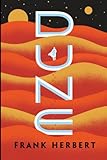
Editors Reads Verdict
The most ambitious science fiction novel ever written. Herbert built not just a plot but an entire civilisation — ecology, religion, politics, economics — with a depth that rewards re-reading indefinitely. The Villeneuve films are stunning; the book is on another level entirely.
What We Loved
- Unmatched world-building depth — ecology, politics, religion, and economics all interlocking
- The best-selling sci-fi novel of all time for good reason
- Themes of imperialism, environmentalism, and messianic religion are more relevant than ever
- The Villeneuve films have introduced millions of new readers — the book delivers far more
Minor Drawbacks
- Dense — requires patience in the first 100 pages before the world clicks into place
- The philosophical asides and epigraphs can slow momentum
- The sequels vary wildly in quality — the first book is the pinnacle
Key Takeaways
- → Whoever controls the spice controls the universe — resource control is the foundation of power
- → The messiah myth is dangerous even when (especially when) the messiah is real
- → Ecology shapes culture, politics, and religion more profoundly than any ideology
- → Prescience (seeing possible futures) is a burden, not a superpower
- → The greatest fear is the fear that paralyses — face it and it disappears
| Author | Frank Herbert |
|---|---|
| Publisher | Ace |
| Pages | 896 |
| Published | August 1, 1965 |
| Language | English |
| Genre | Science Fiction, Fantasy, Classic Literature |
| Difficulty | Intermediate |
| Best For | Readers of ambitious fiction, fans of the films who want the deeper version, political science and ecology enthusiasts, and anyone who wants to read the book that defined modern science fiction. |
How Dune Compares
Dune at a glance against 3 similar books readers weigh alongside it.
| Book | Author | Rating | Best for |
|---|---|---|---|
| Dune (this book) | Frank Herbert | ★ 4.7 | Readers of ambitious fiction, fans of the films who want the deeper version, |
| 1984 | George Orwell | ★ 4.7 | Every adult in a democracy |
| Man's Search for Meaning | Viktor E. Frankl | ★ 4.8 | Anyone confronting meaninglessness, loss, suffering, or existential questions |
| Sapiens | Yuval Noah Harari | ★ 4.6 | Curious readers of all backgrounds who want to understand how Homo sapiens came |
The Book That Defined Science Fiction
Frank Herbert began researching Dune in 1959. He spent six years writing it. It was rejected by twenty publishers before Chilton Books — then primarily known as an automotive manual publisher — agreed to publish it in 1965.
It won the Hugo Award, the inaugural Nebula Award, and went on to become the best-selling science fiction novel of all time. Denis Villeneuve’s 2021 and 2024 film adaptations introduced it to a new generation. The book is better than the films.
The World
Arrakis — Dune — is a desert planet with no native surface water. It is also the only source in the known universe of Melange, a spice that extends life, enhances cognition, enables space navigation, and is addictive after first use. Whoever controls Arrakis controls interstellar civilisation.
Herbert built this world with a specificity that remains unmatched in science fiction. The ecology of the desert — how the sandworms relate to the spice cycle, how the Fremen have adapted their bodies and culture to zero water loss, how the planet’s entire biology interlocks — is not decoration but the structural foundation of everything that happens.
This ecological depth was deliberate. Herbert was inspired by a 1959 trip to Oregon where the U.S. Department of Agriculture was attempting to stabilise shifting sand dunes. He began to think about how an ecosystem shapes a civilisation, and Dune is the result.
The Politics
The galactic empire of Dune is feudal, not technocratic. Great Houses control planets under an Emperor who balances power between them. The Bene Gesserit sisterhood runs a multi-millennial breeding programme. The Spacing Guild maintains monopoly control of space travel. The financial empire CHOAM controls trade.
Herbert was writing about the Oil Age with spice standing in for oil — the resource that an industrialised civilisation cannot function without, controlled by a region whose native people are considered primitive by those who depend on their resource. The parallels to 20th-century Middle East politics were intentional and remain urgently relevant.
Paul Atreides
The protagonist — young Paul, heir to House Atreides — is a fascinating hero precisely because Herbert resisted making him straightforwardly admirable. Paul’s journey toward becoming Muad’Dib, the Fremen messiah, is presented with deliberate ambivalence.
The Bene Gesserit have seeded messianic legends throughout the galaxy for generations, preparing convenient myths that a trained operative could inhabit in times of need. Paul knows this. He knows the prophecy he is fulfilling may be manufactured. He becomes the messiah anyway — partly because he has no choice, partly because he discovers it’s true in ways the Bene Gesserit didn’t intend.
Herbert was writing a warning, not a celebration: the messiah myth is dangerous even when the messiah is real. Dune Messiah (the sequel) makes this explicit.
The Fremen
The native people of Arrakis are Dune’s most remarkable creation. The Fremen are fanatically disciplined, ecologically sophisticated, and spiritually fierce — shaped by millennia of desert survival into something the Empire fundamentally cannot understand or control.
Their relationship with the sandworms — massive, ancient, worshipped as embodiments of the planet’s deity — is one of the great invented mythologies of 20th-century literature. Equally vital is the planetary ecologist Liet-Kynes, whose secret, generations-long dream of terraforming Arrakis from desert into green abundance gives the Fremen a future to fight for. Herbert makes ecology not a subplot but the hidden engine of the entire political order: water is wealth, the spice cycle is bound to the worms, and any attempt to remake the planet threatens the substance the galaxy depends on. It is no accident that Dune became a touchstone for the environmental movement of the late 1960s.
Prescience and the Cost of Power
One of Herbert’s most sophisticated ideas is his treatment of Paul’s prescience — the spice-induced ability to see branching futures. Far from a triumphant superpower, foresight becomes a trap: the more clearly Paul sees the paths ahead, the more he feels himself locked onto a single terrible one, the jihad his followers will wage across the galaxy in his name. Herbert dramatizes the burden of the visionary leader who can perceive catastrophe and still find himself unable to prevent it. Coupled with the Bene Gesserit’s cynical Missionaria Protectiva — the deliberate seeding of religious myths to be exploited later — the novel mounts a sustained critique of charismatic authority and the machinery of belief that sustains it.
Why Read It in 2026?
The themes of Dune — resource imperialism, ecological collapse, the weaponisation of religion, the danger of charismatic leadership — are if anything more urgent now than in 1965. Herbert was thinking about what happens when a civilisation becomes dependent on a resource it cannot produce and must obtain from people it considers inferior.
Winner of the inaugural Nebula Award and a joint Hugo Award, Dune did not merely succeed; it redrew the boundaries of what science fiction could attempt, proving that the genre could carry the weight of serious ideas about politics, faith, and the planet. Nearly every ambitious work of imaginative fiction since — from Star Wars to The Expanse — owes it a debt. The films are worth watching. The book is worth studying.
Our rating: 4.7/5 — The most fully realised imagined world in science fiction. Requires patience and rewards it extravagantly.
Reading Guides
- Dune vs The Lord of the Rings
- Books Like Dune: 14 Epic Sci-Fi Novels for Herbert Fans
- Books Like Ender
- Books Like The Martian: Problem-Solving, Survival, and Optimistic Science Fiction
- Dune Books in Order: What to Read After Dune Part Two (2026)
- Best Fantasy Books of All Time — The Definitive Reading List
- Best Science Fiction Books of All Time — The Essential Reading List
- Dune vs A Game of Thrones: Which Epic to Read First?
Frequently Asked Questions
What is "Dune" about?
On the desert planet Arrakis, young Paul Atreides must navigate political intrigue, ecological disaster, and prophetic destiny to avenge his family and fulfil a legend centuries in the making. The best-selling science fiction novel of all time.
Who should read "Dune"?
Readers of ambitious fiction, fans of the films who want the deeper version, political science and ecology enthusiasts, and anyone who wants to read the book that defined modern science fiction.
What are the key takeaways from "Dune"?
Whoever controls the spice controls the universe — resource control is the foundation of power The messiah myth is dangerous even when (especially when) the messiah is real Ecology shapes culture, politics, and religion more profoundly than any ideology Prescience (seeing possible futures) is a burden, not a superpower The greatest fear is the fear that paralyses — face it and it disappears
Is "Dune" worth reading?
The most ambitious science fiction novel ever written. Herbert built not just a plot but an entire civilisation — ecology, religion, politics, economics — with a depth that rewards re-reading indefinitely. The Villeneuve films are stunning; the book is on another level entirely.
Ready to Read Dune?
Check the current price on Amazon.
Check Price on Amazon (paid link)Prices and availability are subject to change. See Amazon for current price.
Review last updated: