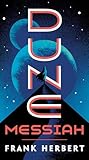
Frank Herbert was an American science fiction author whose epic novel Dune is one of the best-selling and most influential works in the history of the genre.
Frank Herbert spent years writing Dune, publishing it in 1965 after it was rejected by dozens of publishers. The novel went on to become the best-selling science fiction book in history — a sweeping epic set on the desert planet Arrakis, the sole source of the most valuable substance in the universe, a spice called melange that enables interstellar travel. The novel operates simultaneously as adventure story, political allegory, ecological meditation, and examination of how charismatic leaders can be made and then weaponised by the systems that create them.
Herbert’s world-building is extraordinary in its depth and consistency. The ecology of Arrakis — the way water scarcity has shaped every aspect of Fremen culture and biology — is rendered with the rigour of speculative science, and the political and religious structures Herbert creates feel genuinely foreign rather than thinly veiled Earth analogues. The prose is dense and expects intellectual engagement from its readers; the appendices and glossary at the novel’s end are not ornamental but functional.
Dune is not an easy read. Its opening sections require patience as Herbert establishes the world and its many competing factions, and some readers find the protagonist Paul Atreides’ arc toward messianic power more troubling than triumphant — which is precisely the point Herbert was making, though it is sometimes misread as straightforward hero myth. For readers willing to meet it on its own terms, however, Dune is simply one of the most richly conceived novels in any genre.
The Creator of Dune
Frank Herbert was one of the most important and influential science fiction writers of the twentieth century, the creator of Dune, widely regarded as one of the greatest science fiction novels ever written. Renowned for his ambitious world-building, his integration of complex themes including ecology, politics, religion, and human evolution, and his creation of one of the most richly imagined fictional universes in literature, Herbert transformed the genre. Dune and its sequels became a landmark of science fiction, beloved by millions and enormously influential, and Herbert’s sophisticated, idea-rich approach helped elevate the genre’s ambitions and secure his place as one of its true masters.
Dune
Herbert’s masterpiece, Dune, is one of the best-selling and most acclaimed science fiction novels of all time, a vast and intricate epic set on the desert planet Arrakis, the only source of a substance essential to galactic civilization. Combining political intrigue, religious prophecy, ecological vision, and a coming-of-age story in its tale of the young Paul Atreides, the novel created an extraordinarily detailed and immersive universe. Its richness, ambition, and thematic depth made it a landmark of the genre, inspiring numerous sequels, adaptations, and a vast devoted following, and it remains the cornerstone of Herbert’s reputation and one of science fiction’s defining works.
Ecological Vision
A defining and pioneering feature of Herbert’s work is its profound engagement with ecology. Dune is, at its heart, deeply concerned with the environment, depicting the intricate ecology of its desert world and the relationship between a people, their planet, and its resources with remarkable sophistication. Herbert’s ecological vision, his understanding of environments as complex interconnected systems and his concern with humanity’s relationship to nature and resources, was ahead of its time and gives his work lasting relevance. This pioneering ecological consciousness is central to Dune and to Herbert’s distinctive contribution to science fiction.
Politics, Power, and Religion
Herbert’s fiction is notable for its sophisticated engagement with politics, power, and religion. Dune explores the dynamics of imperial politics, the manipulation of religion and prophecy, the dangers of charismatic leadership, and the corrupting nature of power with genuine complexity and insight. Herbert was deeply skeptical of heroes and messianic figures, and his work examines the perils of placing too much faith in leaders, a theme he developed across the series. This serious engagement with political and religious themes, treated with nuance and skepticism, gives his work an intellectual depth that distinguishes it within the genre.
Masterful World-Building
Herbert is celebrated as one of the greatest world-builders in science fiction. The universe of Dune is extraordinarily detailed and fully realized, encompassing complex political systems, religions, ecologies, cultures, histories, and technologies, all woven together into a coherent and immersive whole. This depth and richness of world-building, creating a universe that feels vast, ancient, and real, is central to the appeal and the achievement of his work, and it set a standard for the genre. The immersive completeness of his imagined universe rewards readers’ investment and is one of the great pleasures of his fiction.
A Lasting Influence
Herbert’s influence on science fiction and popular culture is immense. Dune helped elevate the ambitions of the genre, demonstrating that science fiction could engage serious themes with literary depth and sophistication, and it inspired countless writers and creators. Its influence extends across literature, film, and other media, and its concepts and imagery have permeated popular culture. The continued popularity of Dune, renewed by major film adaptations, testifies to its enduring power and relevance. Herbert’s pioneering integration of ecology, politics, and religion into epic science fiction makes him a foundational and lastingly influential figure in the genre.
Why Frank Herbert Endures
Frank Herbert’s influence on science fiction is profound, and Dune remains one of the most beloved and important works in the genre, its reputation continually renewed for new generations. For newcomers, Dune is the essential starting point and the gateway to its many sequels, which continue and complicate its themes. For readers seeking ambitious, intelligent, and richly imagined science fiction that engages seriously with ecology, politics, religion, and the human future within an immersive and unforgettable universe, Frank Herbert is one of the foundational and most rewarding masters of the genre.
Reading Guides