Books Like Dune: 14 Epic Sci-Fi Novels for Herbert Fans
If Dune's political intrigue, world-building, and philosophy hooked you, these science fiction epics — from Asimov to Le Guin — deliver the same depth.

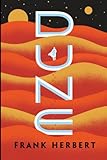
Frank Herbert’s Dune is a singular achievement. Published in 1965, it remains the best-selling science fiction novel of all time — and not because it has space battles and laser guns (though there are those). Dune is a book about ecology, religion, power, and the danger of following charismatic leaders. It builds a world with the depth of a real civilization: the spice economy, the Fremen culture, the political interplay of Great Houses, the Bene Gesserit sisterhood, all interlocking with genuine internal logic.
Finding something that scratches the same itch is not easy. But these 14 novels come closest — each one offering epic scope, serious ideas, and the sense that the universe the author has built exists beyond the edges of the page.
Political Intrigue and Civilizational Scale
#1 — Foundation by Isaac Asimov
Hari Seldon has developed psychohistory — the mathematical science of predicting the behavior of large populations — and has foreseen the fall of the Galactic Empire. His solution is a Foundation designed to preserve knowledge and shorten the coming dark age from thirty thousand years to one thousand. Asimov’s trilogy (later expanded) is the definitive science fiction exploration of how empires fall and how civilization might be steered through collapse. The political maneuvering of the early books, where the Foundation must survive among larger powers without military force, is pure Dune energy.
#2 — Hyperion by Dan Simmons
A group of pilgrims travel to the world of Hyperion, each telling the story of how they came to be there — a structure borrowed from Chaucer, to magnificent effect. Simmons builds a far-future civilization with Hebert-level complexity: the Catholic Church has survived into space, time works differently near certain technologies, and at the center of everything is the Shrike, an indestructible creature from the future that may be a god or a weapon. Hyperion rewards patience and pays off in full.
#3 — Ancillary Justice by Ann Leckie
The former starship Justice of Toren — now reduced to a single human body — is hunting the most powerful person in the galaxy for reasons of justice and revenge. Leckie’s novel rethinks the mechanics of empire through the lens of a civilization that values certain forms of loyalty and expansion above individual identity. The political intrigue, the exploration of colonialism and cultural assimilation, and the slow revelation of what actually happened make this one of the most celebrated debut SF novels of the past twenty years.
#4 — A Fire Upon the Deep by Vernor Vinge
Vinge’s premise: the galaxy is divided into Zones of Thought, and the further from the galactic core you travel, the more sophisticated thought and technology become possible. Humans near the core are limited; near the Transcend, godlike entities exist. A human ship accidentally releases something terrible from the Transcend, and the fate of civilization depends on a rescue mission to a medieval alien world. The scope and the seriousness of the ideas are Herbet-worthy.
Ecology, Culture, and Deep World-Building
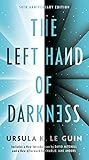
#5 — The Left Hand of Darkness by Ursula K. Le Guin
Le Guin’s Ekumen universe is the closest thing science fiction has to Herbert’s Dune in terms of anthropological depth. The Left Hand of Darkness sends an envoy to a world whose inhabitants have no fixed gender — they are sexually neutral for most of the month and become either male or female briefly during the reproductive cycle. Le Guin uses this premise to examine how gender shapes every aspect of politics, war, loyalty, and love. The world of Winter is built with the same care Herbert gave to Arrakis.
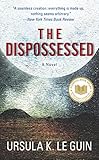
#6 — The Dispossessed by Ursula K. Le Guin
The second Le Guin on this list because she more than anyone else operated at Herbert’s intellectual level. The Dispossessed cuts between two worlds: a capitalist planet and its anarchist moon colony, tracing the physicist Shevek as he tries to bridge them. It is a genuine philosophical novel in the form of science fiction, asking what freedom means, what ownership means, and what sacrifice civilization requires. Herbert fans who engage with Dune as a political text will find their match here.
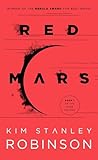
#7 — Red Mars by Kim Stanley Robinson
Robinson’s Mars trilogy begins with Red Mars — the story of the first hundred colonists to permanently settle Mars, told across decades as they terraform the planet and fracture into ideological factions over whether doing so is even right. The ecological themes are as central here as they are in Dune: what does it mean to reshape a world? What is lost when a wilderness is made habitable? Robinson writes with scientific rigor and political sophistication that Herbert would have respected.
Characters Under Pressure in Brutal Universes
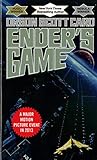
#8 — Ender’s Game by Orson Scott Card
Andrew “Ender” Wiggin is selected at age six for Battle School, an orbital military academy that trains children to fight an alien species that has already twice nearly destroyed humanity. Card’s novel is a masterclass in showing a child prodigy navigate systems of power — manipulated by adults who see him as a weapon, trying to maintain his humanity in a machine designed to crush it. The ending is one of the most devastating in science fiction. Like Paul Atreides, Ender is shaped into something he didn’t choose.
#9 — The Forever War by Joe Haldeman
Haldeman’s Vietnam allegory: soldiers fighting an alien war are subject to time dilation, so each tour of duty ages them years while centuries pass on Earth. The soldier returning home to a civilization that has moved beyond him is one of science fiction’s most powerful metaphors, and Haldeman executes it with aching precision. The military culture, the bureaucratic indifference to soldiers as individuals, and the ultimate revelation about the war itself will resonate deeply with Dune readers.
#10 — Use of Weapons by Iain M. Banks
Banks’ Culture novels are set in a post-scarcity civilization run by hyper-intelligent AI Minds, who occasionally use human agents for interventions in less advanced civilizations. Use of Weapons follows Cheradenine Zakalwe, one of those agents — a man with a fractured past that is revealed in chapters running backwards while the main narrative runs forward. The moral complexity of using violence in service of allegedly benevolent ends is pure Herbert territory.
Philosophical Science Fiction
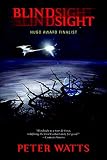
#11 — Blindsight by Peter Watts
Blindsight is the most intellectually demanding novel on this list, and possibly the most disturbing. A first-contact mission reaches an alien object near the edge of the solar system — and what the crew finds challenges the assumption that consciousness is evolutionarily advantageous. Watts draws on neuroscience, evolutionary biology, and information theory to build a genuinely alien encounter. It is Herbert-level in its willingness to subordinate comfort to ideas.
#12 — The Book of the New Sun by Gene Wolfe
Severian is a torturer’s apprentice in the far future — so far that the sun is dimming and the Earth (called Urth) is almost unrecognizable. Wolfe’s four-volume novel is narrated by Severian, who claims to remember everything perfectly — a claim the careful reader will find systematically undermined. The Book of the New Sun rewards rereading in the way Dune does: the second reading reveals a completely different story beneath the surface of the first.
#13 — Tau Zero by Poul Anderson
A small crew aboard an experimental starship is caught in an accelerating malfunction: their ship cannot decelerate, and so they continue accelerating, time-dilation compressing billions of years of cosmic history into their subjective experience. Anderson uses this framework to explore human response to absolute helplessness and the heat death of the universe. It is a short, devastating novel of ideas.
Classic World-Building at Scale
#14 — Rendezvous with Rama by Arthur C. Clarke
A massive alien object enters the solar system and a crew is sent to explore it before it departs. Clarke’s novel is a pure exercise in world-building from first principles: what would a self-contained alien civilization look like from the inside? The object — a rotating cylinder fifty kilometers long, with its own internal sea and artificial sun — is one of the great constructions in science fiction. Clarke asks no more and no less than what it would feel like to walk inside something built by minds utterly unlike ours.
How to Choose Your Next Read
If you want political complexity: Foundation or Ancillary Justice.
If you want ecological and philosophical depth: The Left Hand of Darkness or Red Mars.
If you want a character shaped by forces beyond their control: Ender’s Game or Use of Weapons.
If you want the most ambitious ideas: Blindsight or Hyperion.
Dune Reading Order: The Complete Sequence
For Herbert’s full Dune series and what to read after Villeneuve’s films, see our Dune Books Reading Order guide.
For the Best Fantasy Books
For the definitive guide to fantasy fiction — from Tolkien and Le Guin to Brandon Sanderson and George R.R. Martin — see our Best Fantasy Books of All Time list.
Affiliate disclosure: Links to Amazon on this page are affiliate links. We earn a small commission at no extra cost to you. This does not influence our editorial recommendations.
Frequently Asked Questions
What books are most similar to Dune?
The most similar books to Dune are The Left Hand of Darkness by Ursula K. Le Guin, Foundation by Isaac Asimov, and A Fire Upon the Deep by Vernor Vinge. All feature complex world-building, political intrigue, and ideas-driven science fiction at an epic scale.
What should I read after Dune?
After Dune, most readers either continue with Dune Messiah (Book 2 of Herbert's series) or try something tonally similar like Ursula Le Guin's The Dispossessed. If you want the same political epic scope, try The Book of the New Sun by Gene Wolfe or A Fire Upon the Deep by Vernor Vinge.
Is Foundation similar to Dune?
Foundation by Isaac Asimov shares Dune's interest in civilisation-scale forces, the fall of empires, and the role of individuals in shaping history. It is less focused on a single protagonist and more on the sweep of centuries, but it is one of the closest matches in tone and ambition.
Are there any Dune sequels worth reading?
Frank Herbert's Dune Messiah and Children of Dune are both considered essential follow-ups that deepen the original. God Emperor of Dune is a fascinating philosophical experiment but less accessible. The Brian Herbert and Kevin J. Anderson prequels are generally considered lesser works by fans of the original.