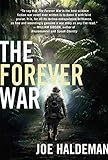
Editors Reads Verdict
The Forever War is one of science fiction's most intelligent anti-war novels — a Hugo and Nebula Award winner that uses relativistic time dilation not just as a plot device but as a devastating metaphor for the Vietnam veteran's experience of alienation.
What We Loved
- The time dilation conceit is both scientifically rigorous and metaphorically perfect
- Haldeman's Vietnam experience gives the combat sequences authentic, unglamorous texture
- The satirical picture of a changing Earth is mordantly funny
- The love story across time provides genuine emotional stakes
Minor Drawbacks
- Some sections of the changing Earth feel dated in their extrapolation
- The military sequences are detailed in ways that not all readers will find engaging
- The ending is happy in ways that feel somewhat earned but also somewhat abrupt
Key Takeaways
- → Time dilation as a metaphor for the veteran's alienation from a changed home society is perfectly conceived
- → Haldeman wrote the novel as a direct response to his Vietnam service
- → The novel is partly a rebuttal to Heinlein's Starship Troopers
- → War is made senseless not just by its violence but by its disconnection from comprehensible purpose
- → The human cost of an incomprehensible war falls on those who fight it while the world moves on
| Author | Joe Haldeman |
|---|---|
| Publisher | St. Martin's Press |
| Pages | 258 |
| Published | December 1, 1974 |
| Language | English |
| Genre | Science Fiction |
| Difficulty | Intermediate |
| Best For | Science fiction readers interested in military SF, anti-war fiction, and classic Hugo/Nebula winners — particularly those interested in Vietnam-era literature in SF form. |
How The Forever War Compares
The Forever War at a glance against 3 similar books readers weigh alongside it.
| Book | Author | Rating | Best for |
|---|---|---|---|
| The Forever War (this book) | Joe Haldeman | ★ 4.3 | Science fiction readers interested in military SF, anti-war fiction, and |
| Old Man's War | John Scalzi | ★ 4.3 | Science fiction readers looking for smart, accessible, and entertaining |
| Starship Troopers | Robert A. Heinlein | ★ 4.1 | Science Fiction |
| Stranger in a Strange Land | Robert A. Heinlein | ★ 4.1 | Classic science fiction readers and anyone interested in the history of |
Time Is the Weapon
Joe Haldeman fought in Vietnam and came home to find that the world had moved on. His novel makes that experience literal and cosmic. In The Forever War, soldiers fighting humanity’s first interstellar war travel at near-light speed between battlefields and Earth, and the relativistic time dilation means that what takes months for them takes decades or centuries at home. William Mandella enlists in 1997 and, by the end of his military service, returns to an Earth that is centuries in his future.
The metaphor is almost too perfect — which is why it works. The veteran’s experience of returning to a society that has become incomprehensible, that has changed in ways that exclude and bewilder, is rendered here with scientific rigour that makes it feel not like allegory but like extrapolation.
The Anti-Heinlein
Haldeman wrote The Forever War partly in response to Heinlein’s Starship Troopers, a novel that presented military service as morally clarifying and war as essentially heroic. Haldeman’s war is neither. The enemy is an alien species humanity barely understands, fighting for reasons that are never made clear, and the combat sequences are written with the unglamorous specificity of someone who has experienced organised violence firsthand.
The Love Across Time
Mandella’s relationship with Marygay Potter — a fellow soldier — provides the novel’s emotional core. The logistics of maintaining a relationship when each tour takes you further into the future are handled with both wit and genuine pathos. Their eventual fate is one of science fiction’s more satisfying romantic resolutions, though it takes extraordinary patience to reach.
A Deserved Classic
Winner of both Hugo and Nebula Awards, The Forever War has dated less than most of its contemporaries because its essential insights are about human experience rather than technology.
Our rating: 4.3/5 — A masterwork of military science fiction: Haldeman’s Vietnam transmuted into one of the genre’s most intelligent anti-war novels.
Service and Its Aftermath
What makes The Forever War more than a clever extrapolation is the specificity of its emotional knowledge. Haldeman served in Vietnam, was wounded, and earned a Purple Heart, and the novel’s authority comes from the way it transmutes that experience rather than reports it. The combat in the novel is not the heroic clarity of much military science fiction; it is confusion, equipment failure, orders that make no sense, and death that arrives without meaning or warning. The enemy — the alien Taurans — remains incomprehensible for almost the entire conflict, and the war itself, it eventually emerges, may have been founded on a misunderstanding that neither side was willing to examine. This is the Vietnam veteran’s hard-won knowledge rendered as cosmic structure: that the war you are asked to die in may have no purpose anyone can articulate, and that the home you are dying to protect will not recognise you when you return.
The novel’s structure reinforces this. Each section of William Mandella’s service is separated from the last by a relativistic jump that costs him decades or centuries of Earth time. He returns from his first campaign to a planet whose economy, language, and sexual customs have transformed beyond recognition. The society that sent him to war has moved on so completely that re-enlistment becomes, for Mandella, less a choice than the only remaining option — the army is the one institution that still makes sense to him, precisely because it is the thing that has alienated him from everything else. Haldeman captures the terrible circularity of the veteran’s predicament: the war damages your capacity to live anywhere but the war.
A Novel That Has Outlasted Its Moment
It would have been easy for The Forever War to date into a period piece — a Vietnam allegory for readers who remember Vietnam. Instead it has survived, because its insights are about the permanent structure of the soldier’s experience rather than any particular conflict. Readers who have never heard a shot fired in anger recognise the alienation Mandella feels, the sense that the world’s priorities have rearranged themselves while you were occupied elsewhere. The novel’s mordant satire of a changing Earth — overpopulation, engineered social arrangements, an economy that no longer has a place for a returning soldier — occasionally shows the marks of 1970s extrapolation, but the emotional spine is timeless.
The relationship between Mandella and Marygay Potter is what keeps the novel from despair. Across the gulfs of time that separate them, their attachment becomes the one fixed point in a universe that keeps rearranging itself, and Haldeman’s resolution of their story — engineered, improbable, and quietly moving — offers the only kind of hope the novel’s logic permits: not the restoration of a lost world, but the preservation of one human bond against the entropy of everything else. It is a hard-won, modest, and entirely earned conclusion to one of the genre’s essential novels.
The Combat the Novel Refuses to Glamorise
A final measure of the novel’s integrity is the texture of its violence. Haldeman, who saw combat himself, writes the fighting with a specificity that withholds every consolation military fiction usually offers. Equipment malfunctions, accelerations crush bodies, and the soldiers die in ways that have nothing of heroism about them. The Tauran enemy stays opaque for almost the whole war, and the conflict’s eventual explanation — that it may have rested on a misunderstanding neither side troubled to examine — confirms the senselessness the combat scenes have been registering all along. This is the hard knowledge of the returning soldier converted into structure: that the war you are asked to die in may serve no purpose anyone can state, and that the proof of this is buried not in any speech but in the dumb particulars of how men actually die in it.
Reading Guides
Frequently Asked Questions
What is "The Forever War" about?
A soldier fighting an interstellar war discovers that time dilation means each tour of duty lasts years, while centuries pass at home — making Earth progressively unrecognisable.
Who should read "The Forever War"?
Science fiction readers interested in military SF, anti-war fiction, and classic Hugo/Nebula winners — particularly those interested in Vietnam-era literature in SF form.
What are the key takeaways from "The Forever War"?
Time dilation as a metaphor for the veteran's alienation from a changed home society is perfectly conceived Haldeman wrote the novel as a direct response to his Vietnam service The novel is partly a rebuttal to Heinlein's Starship Troopers War is made senseless not just by its violence but by its disconnection from comprehensible purpose The human cost of an incomprehensible war falls on those who fight it while the world moves on
Is "The Forever War" worth reading?
The Forever War is one of science fiction's most intelligent anti-war novels — a Hugo and Nebula Award winner that uses relativistic time dilation not just as a plot device but as a devastating metaphor for the Vietnam veteran's experience of alienation.
Ready to Read The Forever War?
Check the current price on Amazon.
Check Price on Amazon (paid link)Prices and availability are subject to change. See Amazon for current price.
Review last updated: