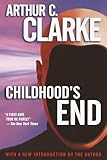
Editors Reads Verdict
Childhood's End is Clarke's most ambitious novel and one of the genre's most profound meditations on humanity's place in the cosmos — a genuinely moving story about transcendence, loss, and what it means to be the end of a line.
What We Loved
- The central premise is one of science fiction's most striking and original
- Clarke's sense of cosmic scale is unmatched — the final section is genuinely awe-inspiring
- The Overlords' secret is handled with real narrative skill
- The novel raises questions about human purpose that it refuses to answer cheaply
Minor Drawbacks
- The middle section is slower and less driven than the opening and closing
- Character development is subordinated to ideas — the humans are largely vehicles for the argument
- The 1950s social assumptions feel dated in places
Key Takeaways
- → Clarke imagines a benevolent alien intervention that is simultaneously gift and ending
- → The Overlords' paradox — they are humanity's midwife but cannot follow where humanity goes — is deeply moving
- → Transcendence in Clarke is not religious but evolutionary — and not obviously good
- → The novel asks whether human art, culture, and individual identity matter at cosmic scales
- → Clarke's sense of deep time and cosmic perspective is his defining literary gift
| Author | Arthur C. Clarke |
|---|---|
| Publisher | Del Rey |
| Pages | 224 |
| Published | August 27, 1953 |
| Language | English |
| Genre | Science Fiction |
| Difficulty | Intermediate |
| Best For | Science fiction readers drawn to big ideas, cosmic perspective, and classic SF — particularly those interested in first-contact narratives and questions of human destiny. |
How Childhood's End Compares
Childhood's End at a glance against 3 similar books readers weigh alongside it.
| Book | Author | Rating | Best for |
|---|---|---|---|
| Childhood's End (this book) | Arthur C. Clarke | ★ 4.2 | Science fiction readers drawn to big ideas, cosmic perspective, and classic SF |
| 2001: A Space Odyssey | Arthur C. Clarke | ★ 4.3 | Science fiction readers interested in hard SF, AI, space exploration, and the |
| Foundation | Isaac Asimov | ★ 4.6 | Science fiction readers interested in big ideas, galactic-scale history, and |
| The Dispossessed | Ursula K. Le Guin | ★ 4.4 | Serious science fiction readers interested in political philosophy, utopian |
The Aliens Are Already Here
Childhood’s End opens with one of the most dramatic scenes in classic science fiction: enormous alien spaceships appear simultaneously over every city on Earth. The Cold War race to reach the Moon is immediately rendered irrelevant. The Overlords have arrived.
They do not invade. They do not communicate at first. They simply appear. And then, through their representative Karellen — who speaks to Earth’s Supervisor but will not be seen — they begin to end war, end poverty, and establish a global golden age. Clarke asks: what would you give up for utopia?
The Price of Paradise
The answer, as the novel gradually reveals, is more significant than it initially appears. Human creativity wanes. Art and science lose their urgency when all the pressing problems are solved. And the Overlords refuse, for decades, to show their faces — a mystery with a revelation that is one of the genre’s most striking and carefully prepared surprises.
Clarke’s handling of the Overlords’ appearance is a masterclass in dramatic withholding. When we finally see them, the revelation recontextualises the entire novel.
The Final Section
The novel’s closing section — dealing with the children of the golden age and what they become — is Clarke at his most cosmically ambitious. It is an image of transcendence so vast and so indifferent to human individuality that it produces a kind of awe-tinged grief. Clarke refuses comfortable resolution: the ending of humanity’s childhood is not presented as either triumph or tragedy, but as something more strange and more real than either.
A Novel About Endings
Childhood’s End is ultimately a meditation on what it means to be the last of something — the last humans, the last artists, the last members of a species with individual purposes. Clarke asks whether that matters and refuses to answer simply.
The Devils’ Revelation
The novel’s most famous stroke is the reason the Overlords hide their bodies for fifty years. When Karellen finally permits himself to be seen, humanity beholds a creature out of its deepest nightmares: leathery wings, cloven hooves, horns, a barbed tail — the literal image of the Devil. Clarke’s twist is to invert the meaning of that terror. The Overlords are not demons but benefactors, and their satanic appearance is, the novel suggests, a kind of premonition running backward through human history: a racial memory not of a past encounter but of this future one, when these winged beings would preside over the end of the species. It is one of science fiction’s great conceptual reversals, turning the oldest religious iconography into a fragment of prophecy, and it recontextualizes everything that came before.
Individuality and the Overmind
Beneath the spectacle, Childhood’s End is wrestling with one of the deepest tensions of its Cold War moment: the value of the individual against the claims of the collective. The Overlords, for all their godlike technology, are revealed to be a kind of evolutionary dead end — a servant race, forever barred from the transcendent leap they exist to midwife. That leap belongs to humanity’s children, who merge into a single group consciousness and ultimately join the Overmind, a vast cosmic intelligence of pure thought. Clarke presents this fusion as the genuine destiny and meaning of human development, yet he refuses to make it comforting: the price of joining something infinite is the annihilation of the individual self, of art, of personality, of everything that made humanity human. Whether this is humanity’s apotheosis or its erasure, the novel deliberately leaves unresolved. Clarke, an avowed rationalist who professed no religious belief, nonetheless reaches here for something genuinely transcendent — a secular vision of evolution toward the divine that owes as much to mysticism as to science, and that has unsettled and moved readers for seventy years precisely because it cannot be filed comfortably under either hope or despair.
Jan Rodricks, the Last Man
The cosmic abstractions are given a human anchor in Jan Rodricks, a young Black astrophysicist who, frustrated by the Overlords’ ban on space travel, stows away aboard an Overlord ship to see their homeworld. Through the strange physics of relativistic travel, he returns to an Earth transformed — the children already merging, the adults dwindling — and becomes the literal last human being, choosing to remain and broadcast a report of the planet’s final moments. His eyewitness account of the end — the Earth turning transparent, glowing from its core, then dissolving as the ascended children siphon its energy into the heavens — gives the novel’s vast finale an intimate, mortal point of view. He is the last set of human eyes, and Clarke lets us share them.
Transcendence Without Comfort
What makes Childhood’s End endure is Clarke’s refusal of easy feeling. The ending is neither the triumphant ascension of a hopeful space opera nor the bleak apocalypse of a cautionary tale; it is something stranger and more honest — an event of such scale that human categories of victory and loss simply fail to contain it. Clarke’s defining gift, his sense of deep time and cosmic perspective, here produces not detachment but a peculiar awe-tinged grief: we are invited to mourn the extinction of everything we are while simultaneously glimpsing the unimaginable thing we might become. The novel’s characters are admittedly thin, vehicles for ideas more than people, and its 1950s social texture has dated. But for sheer conceptual ambition and the emotional power of its final pages, it remains one of science fiction’s high-water marks.
Our rating: 4.2/5 — Clarke’s finest novel: a cosmically scaled meditation on transcendence and loss that earns its devastating final section.
Reading Guides
Frequently Asked Questions
What is "Childhood's End" about?
Alien Overlords arrive over Earth and usher in an unprecedented era of peace and prosperity — but the price is humanity's future.
Who should read "Childhood's End"?
Science fiction readers drawn to big ideas, cosmic perspective, and classic SF — particularly those interested in first-contact narratives and questions of human destiny.
What are the key takeaways from "Childhood's End"?
Clarke imagines a benevolent alien intervention that is simultaneously gift and ending The Overlords' paradox — they are humanity's midwife but cannot follow where humanity goes — is deeply moving Transcendence in Clarke is not religious but evolutionary — and not obviously good The novel asks whether human art, culture, and individual identity matter at cosmic scales Clarke's sense of deep time and cosmic perspective is his defining literary gift
Is "Childhood's End" worth reading?
Childhood's End is Clarke's most ambitious novel and one of the genre's most profound meditations on humanity's place in the cosmos — a genuinely moving story about transcendence, loss, and what it means to be the end of a line.
Ready to Read Childhood's End?
Check the current price on Amazon.
Check Price on Amazon (paid link)Prices and availability are subject to change. See Amazon for current price.
Review last updated: