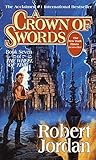
Editors Reads Verdict
A Crown of Swords is the novel in which the Wheel of Time's expansion begins to show its costs. The world is now so vast, and the cast so large, that no single volume can give every thread its due. What it does deliver — Rand's campaign against Sammael, Mat's increasingly central role in Ebou Dar, and the atmospheric tension of a city where assassination is a formal institution — is executed with Jordan's customary precision. The mid-series pacing challenges begin here, but the individual sequences remain compelling.
What We Loved
- The Ebou Dar sequences introduce one of the series' most distinctive city cultures
- Mat's growing prominence as a military and strategic mind is consistently entertaining
- Rand's hunt for Sammael delivers a genuinely surprising conclusion
- The political aftermath of Dumai's Wells is handled with care and consequence
Minor Drawbacks
- The novel marks the beginning of the series' middle-volume pacing issues
- Some storylines feel as though they are treading water relative to the urgency of the first six books
- The Bowl of the Winds quest, though important, takes considerable time to reach its destination
Key Takeaways
- → Ebou Dar's dueling culture — where women enforce social contracts with knives — shows Jordan's world-building at its most inventive
- → Mat Cauthon's transformation from reluctant hero to genuine military genius is one of the series' most satisfying arcs
- → The resolution of the Sammael thread demonstrates Jordan's willingness to subvert reader expectations about villain confrontations
- → Power gained through trauma — Rand's hardening after Dumai's Wells — does not make characters stronger in the ways they hope
| Author | Robert Jordan |
|---|---|
| Publisher | Tor Books |
| Pages | 856 |
| Published | May 15, 1996 |
| Language | English |
| Genre | Fantasy, Epic Fantasy, Fiction |
| Difficulty | Intermediate |
| Best For | Readers continuing the Wheel of Time through its middle volumes; fans invested in Mat Cauthon's development; epic fantasy readers who enjoy richly realized city-settings as much as open-world campaigns. |
How A Crown of Swords Compares
A Crown of Swords at a glance against 3 similar books readers weigh alongside it.
| Book | Author | Rating | Best for |
|---|---|---|---|
| A Crown of Swords (this book) | Robert Jordan | ★ 4.3 | Readers continuing the Wheel of Time through its middle volumes |
| A Memory of Light | Robert Jordan and Brandon Sanderson | ★ 4.6 | Every reader who has travelled from The Eye of the World to this point |
| Crossroads of Twilight | Robert Jordan | ★ 3.9 | Committed Wheel of Time readers who understand they are in the midst of a |
| Knife of Dreams | Robert Jordan | ★ 4.4 | Wheel of Time readers who persisted through the slower middle volumes and are |
After the Wells
A Crown of Swords opens in the immediate aftermath of Dumai’s Wells, with the Wheel of Time’s world fundamentally changed. Rand al’Thor has demonstrated, before witnesses from every major faction, that he will use overwhelming force when pushed to the edge. The Aes Sedai who captured him have been made to swear oaths to him. The Asha’man have revealed what male channellers, properly trained, can do in combat. Nothing in the series will be the same.
Jordan’s challenge in the novel’s opening sections is managing the political fallout of an event that no party — not the Aes Sedai, not Rand’s allies, not Rand himself — was prepared for. The result is a novel that opens in a state of deliberate imbalance and spends much of its length examining what that imbalance means for everyone who lives in Rand’s world.
Ebou Dar
The novel’s most memorable setting is Ebou Dar, the capital of Altara — a city where dueling is a formal social institution, women enforce their honour with knives worn ostentatiously at the waist, and the architecture reflects a culture of elaborate formality governing what is essentially constant low-level violence. Mat Cauthon arrives in Ebou Dar with Nynaeve and Elayne, who are seeking the Bowl of the Winds, an ancient ter’angreal that may be able to fix the world’s weather — which has been wrong since the Dark One began touching the Pattern.
Mat’s sequences in Ebou Dar are among the novel’s pleasures. He has become, without quite intending to, one of the most capable military minds in the world — a consequence of the memories of dead generals that the doorway ter’angreal implanted in him in earlier books. His instinct for tactical thinking coexists with his instinct to avoid responsibility, creating a character who is perpetually doing more than he claims to be doing.
Sammael and Illian
Rand’s campaign against the Forsaken Sammael — who holds Illian, one of the continent’s great city-states — drives the novel’s main military narrative. Sammael is among the more interesting of the Forsaken: a general of real ability who chose the Shadow not from ideology but from wounded pride, having been judged the lesser of the Age of Legends’ great generals. His confrontation with Rand does not resolve as the reader expects, which is exactly the point.
A Series Finding Its Middle Distance
A Crown of Swords is the first of the Wheel of Time novels that feels consciously mid-series — aware that it must keep threads alive for future resolution while still delivering enough forward movement to justify its length. Jordan manages this balance better than its reputation suggests. The individual sequences are consistently strong; it is the connective tissue that occasionally tests patience.
Our rating: 4.3/5 — A strong mid-series entry that excels in setting and character while beginning to show the structural challenges of managing an epic of this scope; the Ebou Dar sequences alone reward the investment.
Reading Guides
The Middle Series and Its Reputation
A Crown of Swords marks the beginning of what longtime readers sometimes call the “slog” — the middle volumes in which the series’ expansion begins to work against its momentum. The characterization is not entirely fair: the individual sequences in this novel are consistently strong, and Jordan’s world-building continues to reward attention. But it is true that the confident acceleration of The Shadow Rising and The Fires of Heaven has given way to something more complex and, for some readers, more demanding.
Understanding the middle volumes requires understanding Jordan’s intentions, which were not simply to advance the plot but to show what it actually looks like when a world is being remade. Rand’s campaign across the Westlands is not a triumphant march; it is a grinding, politically complicated, morally compromising process of fighting one crisis while two more develop elsewhere. The frustration readers feel at the pace is part of what Jordan is depicting: the gap between prophesied destiny and practical reality.
Published in 1996, A Crown of Swords arrived when the Wheel of Time’s readership had grown to the point where it was one of the most commercially significant fantasy series in the world. Jordan was writing under conditions that most fantasy authors never experience: guaranteed enormous readership, dedicated fan analysis, and the knowledge that every choice he made would be scrutinized by readers who had invested years in the series.
The Forsaken as Antagonists
The Forsaken — the thirteen of the Age of Legends’ most powerful channellers who chose to serve the Dark One in exchange for immortality — are at their most interesting in the middle volumes, where Jordan has space to differentiate them as individuals rather than simply as dark powers. Sammael, whom Rand hunts in this novel, is among the most humanly comprehensible: a man who served the Light as one of its greatest generals and chose the Shadow because he could not bear to be second. His pride is intelligible even though his choices are not defensible.
Jordan’s treatment of the Forsaken throughout the series reflects his general commitment to antagonists with internal consistency. They do not simply want to destroy the world; they want power, immortality, and recognition — desires that are entirely human in their origin, even when their methods exceed any human category of evil. This humanization makes them more threatening rather than less: an enemy you cannot understand can be dismissed, but an enemy whose motivations are legible cannot.
Frequently Asked Questions
What is "A Crown of Swords" about?
In the aftermath of Dumai's Wells, Rand hunts the Forsaken Sammael in Illian while Mat and Elayne seek the Bowl of the Winds in Ebou Dar. The series' political complexity deepens as the Dragon Reborn's actions reshape nations.
Who should read "A Crown of Swords"?
Readers continuing the Wheel of Time through its middle volumes; fans invested in Mat Cauthon's development; epic fantasy readers who enjoy richly realized city-settings as much as open-world campaigns.
What are the key takeaways from "A Crown of Swords"?
Ebou Dar's dueling culture — where women enforce social contracts with knives — shows Jordan's world-building at its most inventive Mat Cauthon's transformation from reluctant hero to genuine military genius is one of the series' most satisfying arcs The resolution of the Sammael thread demonstrates Jordan's willingness to subvert reader expectations about villain confrontations Power gained through trauma — Rand's hardening after Dumai's Wells — does not make characters stronger in the ways they hope
Is "A Crown of Swords" worth reading?
A Crown of Swords is the novel in which the Wheel of Time's expansion begins to show its costs. The world is now so vast, and the cast so large, that no single volume can give every thread its due. What it does deliver — Rand's campaign against Sammael, Mat's increasingly central role in Ebou Dar, and the atmospheric tension of a city where assassination is a formal institution — is executed with Jordan's customary precision. The mid-series pacing challenges begin here, but the individual sequences remain compelling.
Ready to Read A Crown of Swords?
Check the current price on Amazon.
Check Price on Amazon (paid link)Prices and availability are subject to change. See Amazon for current price.
Review last updated: