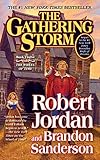
Editors Reads Verdict
The Gathering Storm is, by any measure, one of the most impressive achievements in the history of the fantasy genre: Brandon Sanderson, working from Robert Jordan's notes, scenes, and the voices of fourteen years of worldbuilding, produced a novel that captures the series' spirit while bringing something of his own — a tighter, more urgent narrative pace that the story needed after the slower middle volumes. Rand's arc in this novel, culminating on Dragonmount, is as powerful as anything Jordan wrote. Egwene's arc, equally, is a masterpiece of political and personal storytelling.
What We Loved
- Rand's psychological arc — his near-breaking and his redemption on Dragonmount — is the series' most powerful emotional sequence
- Egwene's final campaign within the White Tower delivers everything her long arc promised
- Sanderson's tighter pacing, relative to the middle volumes, gives the final phase of the series necessary momentum
- The novel honours Jordan's vision while demonstrating that the story could move faster without losing depth
Minor Drawbacks
- Some longtime readers detect a subtle shift in voice from Jordan's Wheel of Time — Sanderson's style is more direct
- Mat's characterisation in this volume is the least successful of the three Sanderson books
- The transition between authors is occasionally visible in minor tonal inconsistencies
Key Takeaways
- → Rand's moment on Dragonmount — where he chooses to live rather than destroy — is the series' emotional and thematic heart
- → Brandon Sanderson demonstrated that a work of creative inheritance can honour its source while contributing something new
- → Egwene's arc shows that institutional reform requires patience, courage, and a willingness to suffer for principle
- → The series' acceleration in this volume proves that Jordan's careful setup across the middle books was deliberate and purposeful
| Author | Robert Jordan and Brandon Sanderson |
|---|---|
| Publisher | Tor Books |
| Pages | 766 |
| Published | October 27, 2009 |
| Language | English |
| Genre | Fantasy, Epic Fantasy, Fiction |
| Difficulty | Intermediate |
| Best For | Wheel of Time readers who have reached this point in the arc; readers curious about how Brandon Sanderson's completion of the series differs from Jordan's original voice; epic fantasy fans ready to experience the series' final phase. |
How The Gathering Storm Compares
The Gathering Storm at a glance against 3 similar books readers weigh alongside it.
| Book | Author | Rating | Best for |
|---|---|---|---|
| The Gathering Storm (this book) | Robert Jordan and Brandon Sanderson | ★ 4.5 | Wheel of Time readers who have reached this point in the arc |
| A Crown of Swords | Robert Jordan | ★ 4.3 | Readers continuing the Wheel of Time through its middle volumes |
| A Memory of Light | Robert Jordan and Brandon Sanderson | ★ 4.6 | Every reader who has travelled from The Eye of the World to this point |
| Crossroads of Twilight | Robert Jordan | ★ 3.9 | Committed Wheel of Time readers who understand they are in the midst of a |
The Completion Begins
When Robert Jordan died in September 2007, he left behind a partially finished final volume, extensive notes, recorded dictation, and — in the estimation of everyone who worked with him — a clear sense of where the story was going and how it would end. His widow and editor, Harriet McDougal, chose Brandon Sanderson to complete the work. Sanderson, the author of the Mistborn series and a lifelong Wheel of Time reader, accepted the task knowing it was both an honour and an almost impossible responsibility.
The result was originally intended to be one novel. It became three. The Gathering Storm, published in October 2009, is the first of those three volumes — and one of the finest novels the series produced.
Rand at the Edge
The novel is structured around two parallel arcs, each of which would anchor a lesser book on its own. Rand al’Thor has been hardening since The Shadow Rising, the warmth of his character slowly eroded by trauma, isolation, and the burden of his prophesied role. By the time of The Gathering Storm, that hardening has become something genuinely frightening. He is destroying the nations he is supposed to save. He is killing people — innocent people — because the calculation of the Last Battle makes individual lives legible only as costs.
The arc culminates on Dragonmount, the volcanic peak created by the Dragon Lews Therin’s death at the end of the Age of Legends. What Rand experiences there — and the choice he makes — constitutes the series’ emotional and thematic climax, even though the Last Battle itself is still two volumes away. Sanderson, working from Jordan’s notes, executes this sequence with precision and genuine emotional power.
Egwene’s Triumph
In parallel, Egwene al’Vere — captured by Elaida’s forces at the end of Knife of Dreams — pursues her campaign to heal the White Tower from within. Rather than trying to escape, she uses her position as prisoner to expose Elaida’s incompetence and cruelty to the Aes Sedai who have remained loyal to the old Amyrlin. Her conduct is a sustained demonstration of what it looks like to fight with conviction and without self-pity.
The resolution of Egwene’s arc — and of Elaida’s — is one of the cleanest narrative payoffs the series delivers, and it lands with the full weight of several novels of careful preparation.
A New Voice, The Same Story
Sanderson’s prose is more direct than Jordan’s — less ruminative, more action-oriented, faster to its points. Long-term readers will detect the difference, particularly in passages involving Mat, whose voice Sanderson himself acknowledged was the most difficult to capture. But the differences are less significant than the achievements. The Gathering Storm is not a diminishment of the Wheel of Time; it is a continuation that honours Jordan’s vision while recognising what the story needed to reach its ending.
Our rating: 4.5/5 — A remarkable act of creative inheritance: Sanderson delivers Rand’s most important moment and Egwene’s long-promised triumph in a novel that restores the series’ momentum and emotional power.
The Wheel of Time Regains Its Momentum
The Gathering Storm is the twelfth volume of the Wheel of Time and the first to be completed by Brandon Sanderson following the death of the saga’s creator, Robert Jordan. Working from Jordan’s extensive notes and outline, Sanderson took up one of the most daunting tasks in modern fantasy — finishing another author’s beloved epic — and the result was widely welcomed by readers as a return to momentum after the series’ sprawling middle volumes. The book drives several long-developing storylines forward decisively, and for many fans it reignited their investment in a saga they had followed for years.
Two Storylines, Powerfully Told
Much of the novel concentrates on two of the series’ central characters and their parallel reckonings, and these threads are handled with a focus and intensity that the series had sometimes lacked. The culmination of one character’s long, harrowing arc in particular is regarded by many readers as one of the most powerful sequences in the entire saga. By narrowing its focus and driving toward genuine climaxes, The Gathering Storm delivers the kind of payoff that long-running epics often defer, and it does so while setting the stage for the saga’s final movement.
A New Hand on the Wheel
The book is inevitably read in light of its unusual creation, and readers can detect the shift between Jordan’s voice and Sanderson’s. Sanderson writes with greater pace and directness, and while some longtime readers note the change in style, the consensus is that he honoured Jordan’s world, characters, and intentions faithfully while bringing renewed energy to the storytelling. That the transition worked as well as it did is a significant achievement, and it gave the saga the conclusion its readers deserved.
Not a Starting Point
This is firmly a late volume in a vast saga, and it assumes deep familiarity with the dozens of characters and storylines that precede it; it cannot be appreciated on its own. For readers already invested in the Wheel of Time, however, it is a crucial and reinvigorating entry — the book where the long story begins its final, accelerating drive toward resolution.
Why It Matters to the Saga
The Gathering Storm matters because it rescued and revitalised one of epic fantasy’s defining works at the moment it most needed it, proving that the transition to a new author could succeed and setting the saga on course for a satisfying conclusion. For the millions of readers committed to the Wheel of Time, it stands as a turning point — the volume where the gathering storm of the title finally breaks, and the end at last comes into view.
Reading Guides
Frequently Asked Questions
What is "The Gathering Storm" about?
The first volume completed by Brandon Sanderson from Robert Jordan's notes: Rand al'Thor approaches psychological breaking point as the Last Battle nears, while Egwene fights to reunite the fractured White Tower from within its walls.
Who should read "The Gathering Storm"?
Wheel of Time readers who have reached this point in the arc; readers curious about how Brandon Sanderson's completion of the series differs from Jordan's original voice; epic fantasy fans ready to experience the series' final phase.
What are the key takeaways from "The Gathering Storm"?
Rand's moment on Dragonmount — where he chooses to live rather than destroy — is the series' emotional and thematic heart Brandon Sanderson demonstrated that a work of creative inheritance can honour its source while contributing something new Egwene's arc shows that institutional reform requires patience, courage, and a willingness to suffer for principle The series' acceleration in this volume proves that Jordan's careful setup across the middle books was deliberate and purposeful
Is "The Gathering Storm" worth reading?
The Gathering Storm is, by any measure, one of the most impressive achievements in the history of the fantasy genre: Brandon Sanderson, working from Robert Jordan's notes, scenes, and the voices of fourteen years of worldbuilding, produced a novel that captures the series' spirit while bringing something of his own — a tighter, more urgent narrative pace that the story needed after the slower middle volumes. Rand's arc in this novel, culminating on Dragonmount, is as powerful as anything Jordan wrote. Egwene's arc, equally, is a masterpiece of political and personal storytelling.
Ready to Read The Gathering Storm?
Check the current price on Amazon.
Check Price on Amazon (paid link)Prices and availability are subject to change. See Amazon for current price.
Review last updated: