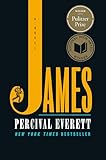
Editors Reads Verdict
Everett's Pulitzer Prize-winning masterwork transforms one of American literature's most contested texts by giving Jim — renamed James — interiority, intelligence, and moral authority. It is both a literary act of reclamation and a devastating meditation on the performance of selfhood under bondage.
What We Loved
- A profound literary reimagining that stands completely on its own
- James's secret literacy is one of the most powerful conceits in recent fiction
- Everett's prose is precise, often funny, and quietly furious
- Deepens rather than cancels the original Twain — a genuine dialogue across time
Minor Drawbacks
- Readers unfamiliar with Huckleberry Finn will lose some resonance
- The final section shifts registers in ways some readers find jarring
- Everett's restraint occasionally withholds emotion the scene has earned
Key Takeaways
- → Enslaved people were required to perform ignorance as a survival strategy
- → The same story looks completely different from a silenced perspective
- → Intelligence and literacy were themselves acts of resistance
- → Freedom means different things to those for whom it has never been assumed
- → American literature's most beloved texts carry buried violence worth excavating
| Author | Percival Everett |
|---|---|
| Publisher | Doubleday |
| Pages | 320 |
| Published | March 19, 2024 |
| Language | English |
| Genre | Literary Fiction, Historical Fiction |
| Difficulty | Intermediate |
| Best For | Literary fiction readers; anyone interested in American history, race, and the power of perspective. |
How James Compares
James at a glance against 3 similar books readers weigh alongside it.
| Book | Author | Rating | Best for |
|---|---|---|---|
| James (this book) | Percival Everett | ★ 4.5 | Literary fiction readers |
| Beloved | Toni Morrison | ★ 4.5 | Serious readers of literary fiction with the patience for challenging, |
| The Color Purple | Alice Walker | ★ 4.7 | Readers who want powerful, voice-driven fiction about female experience and |
| The Warmth of Other Suns | Isabel Wilkerson | ★ 4.8 | Anyone seeking to understand the full scope of African American history and the |
Giving Jim a Voice
Mark Twain’s Jim is one of American literature’s most famous silences — a man we travel with for hundreds of pages whose inner life remains largely opaque, filtered through Huck’s affectionate but limited perspective. Percival Everett’s “James” corrects this omission with surgical precision. His Jim — James — is literate, philosophical, and bitterly aware of the performance his survival requires. Among enslaved people, James reveals early in the novel, there is a whole secret language, a parallel dialect deployed to keep white people comfortable while the real conversation happens elsewhere.
The Performance of Subjugation
The novel’s central conceit is its most devastating: enslaved people like James have learned to speak badly on purpose, to mangle grammar and truncate sentences, because intelligence in an enslaved person is perceived as dangerous. James must constantly perform his own diminishment. When he is alone, or among trusted others, he reads Voltaire and discusses philosophy. When white characters approach, the performance snaps back into place. Everett renders this code-switching with such precision that it becomes almost unbearable — a daily performance of erasure.
Running Alongside Huck
The novel follows the bones of Twain’s plot — the raft, the river, the Duke and King — but everything looks different from James’s vantage. Huck’s innocence reads as privilege here; his good intentions are genuinely kind but also naive in ways that put James at risk repeatedly. The comedy Twain wrings from the Duke and King’s schemes is considerably darker when viewed from the perspective of a man who cannot simply escape by declaring himself free.
The Voice That Carries It
The novel’s most remarkable technical achievement is its voice. Everett writes James’s interior narration in clear, precise, often wryly funny standard English — the language of a sharp, well-read mind — and then forces that mind to translate itself, in real time, into the broken “slave dialect” white listeners expect. In one early scene, James actually drills enslaved children in this performance, teaching them to “speak correctly” by speaking incorrectly, as a survival skill. The effect is to expose dialect itself as a kind of mask, and to make the reader feel the exhausting, ceaseless labour of code-switching under threat of violence. It is a quietly devastating literary device, because it means every line of dialogue James speaks aloud is a small act of self-erasure that the reader, alone with his thoughts, can see through. Everett’s restraint — his refusal to over-explain or to milk the obvious emotion — only sharpens the effect.
The Pencil and the Mind
The novel’s most charged object is a pencil. To write — to set down his own words in his own hand — James must steal a pencil and a scrap of paper, and the theft is an act of such danger that men die over it. Literacy, in the world of James, is not a quiet private skill but contraband, the single most subversive thing an enslaved person can possess, because the written word is the instrument of the very freedom the system exists to deny. Everett deepens this with extraordinary dream sequences in which James debates Enlightenment philosophers — Voltaire, John Locke, Rousseau — interrogating the men whose lofty pronouncements about liberty and natural rights coexisted with the slavery that surrounded them. These passages are the intellectual engine of the book: a brilliant, enslaved mind turning the West’s own ideas back on the civilisation that enslaved him, exposing the chasm between its philosophy and its practice.
A Twist That Rewrites Everything
Everett does not merely re-narrate Twain; in the final third he breaks decisively from the source. Where the original drifts toward Tom Sawyer’s farcical “rescue,” James turns toward violence, agency, and self-emancipation, as its protagonist sheds the survival-performance entirely and claims his full name — no longer the diminutive “Jim” that white society assigned him, but James, a man who authors himself. The novel’s great structural bombshell — the revelation, drawn from the logic of Twain’s own world, that Huck is in fact James’s biological son — recasts the entire river journey as a story about a father unable to claim his child under a system that forbids it. It is a stroke that some readers find tonally jarring and others consider the book’s masterstroke; either way, it transforms a literary homage into something far more radical.
A Major Literary Event
James was one of the most decorated novels in recent memory, winning the National Book Award for Fiction, the Kirkus Prize, and the 2025 Pulitzer Prize, and earning a place on the Booker shortlist. It confirmed Percival Everett — long admired as one of America’s most prolific and inventive novelists, and newly famous after his novel Erasure became the Oscar-winning film American Fiction — as a writer at the absolute height of his powers. The Pulitzer board praised it as a reconsideration of Huckleberry Finn that “gives agency to Jim to illustrate the absurdity of racial supremacy” while telling “a new take on the search for family and freedom.”
Verdict
Everett has written a book that is in conversation with the entire tradition of American literature — not to destroy it but to demand that it be read more honestly. It stands completely on its own, but its power is amplified enormously by Twain’s shadow, and readers who know Huckleberry Finn will find every chapter electric with revision. Precise, mordantly funny, and quietly furious, James is at once a thrilling adventure, a philosophical inquiry, and an act of reclamation — and one of the finest American novels of the decade.
Our rating: 4.5/5 — A masterwork of reclamation and reimagination that ranks among the finest American novels of this decade.
Reading Guides
Frequently Asked Questions
What is "James" about?
A retelling of Adventures of Huckleberry Finn from the perspective of Jim, the enslaved man, revealing what Twain's classic looks like when its silent center finally speaks.
Who should read "James"?
Literary fiction readers; anyone interested in American history, race, and the power of perspective.
What are the key takeaways from "James"?
Enslaved people were required to perform ignorance as a survival strategy The same story looks completely different from a silenced perspective Intelligence and literacy were themselves acts of resistance Freedom means different things to those for whom it has never been assumed American literature's most beloved texts carry buried violence worth excavating
Is "James" worth reading?
Everett's Pulitzer Prize-winning masterwork transforms one of American literature's most contested texts by giving Jim — renamed James — interiority, intelligence, and moral authority. It is both a literary act of reclamation and a devastating meditation on the performance of selfhood under bondage.
Ready to Read James?
Check the current price on Amazon.
Check Price on Amazon (paid link)Prices and availability are subject to change. See Amazon for current price.
Review last updated: