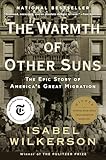
Editors Reads Verdict
One of the great works of American history. Wilkerson spent fifteen years reporting this story and tells it through three unforgettable individuals. The result is narrative history at its finest — precise, moving, and essential.
What We Loved
- Fifteen years of reporting and 1,200 interviews condensed into a masterwork of narrative history
- The three protagonists make an abstract historical event deeply personal
- Comprehensive statistical context without ever losing the human story
- National Book Critics Circle Award winner and universally acclaimed
Minor Drawbacks
- At 600 pages, it demands sustained commitment
- The narrative structure alternating between three protagonists requires patient tracking
Key Takeaways
- → Six million Black Americans left the South between 1915 and 1970 — the largest domestic migration in American history
- → The migrants were driven by violence, economic exclusion, and the basic human desire for dignity
- → The Great Migration fundamentally reshaped American culture, politics, and cities
- → The North offered more freedom but not equality — migrants faced housing discrimination, job exclusion, and violence
- → Individual choices to leave, at enormous personal risk, collectively transformed America
| Author | Isabel Wilkerson |
|---|---|
| Publisher | Vintage |
| Pages | 624 |
| Published | September 7, 2010 |
| Language | English |
| Genre | History, Journalism, African American Studies |
| Difficulty | Intermediate |
| Best For | Anyone seeking to understand the full scope of African American history and the forces that shaped modern American cities, culture, and politics. |
How The Warmth of Other Suns Compares
The Warmth of Other Suns at a glance against 3 similar books readers weigh alongside it.
| Book | Author | Rating | Best for |
|---|---|---|---|
| The Warmth of Other Suns (this book) | Isabel Wilkerson | ★ 4.8 | Anyone seeking to understand the full scope of African American history and the |
| Born a Crime | Trevor Noah | ★ 4.8 | Anyone interested in apartheid South Africa, memoir as a form, questions of |
| Caste | Isabel Wilkerson | ★ 4.7 | Anyone seeking to understand the structural foundations of racial inequality in |
| Say Nothing | Patrick Radden Keefe | ★ 4.8 | Anyone interested in the Troubles, political violence, narrative nonfiction |
The Story America Forgot to Tell Itself
Isabel Wilkerson spent fifteen years researching and reporting The Warmth of Other Suns — interviewing more than 1,200 people, including survivors of the Great Migration and their descendants. What she produced is one of the great works of American historical journalism: a comprehensive account of one of the most significant but least-discussed events in American history, told through the stories of three extraordinary individuals.
The Great Migration was the exodus of six million Black Americans from the Jim Crow South to the cities of the North and West between 1915 and 1970. It was the largest domestic migration in American history. It transformed Chicago, New York, Los Angeles, and Detroit. It seeded the Harlem Renaissance, the blues, jazz, and soul music. It laid the demographic foundations of modern urban America. And for most of the century following it, it was barely taught in schools.
Three Lives, One Migration
Wilkerson structures the book around three individuals whose stories collectively represent the migration’s different chapters and geographies. Ida Mae Brandon Gladney, a sharecropper’s wife from Mississippi who moves to Chicago in the late 1930s. George Starling, a citrus picker from Florida who moves to New York. Robert Joseph Pershing Foster, an army doctor from Louisiana who drives to California. Each is driven by different forces — violence, economic necessity, ambition — and each finds a different version of the North.
The choice to tell this history through individuals rather than statistics is the book’s masterstroke. By the time Wilkerson gives you the numbers — a million migrants in the first wave, five million more over the following decades — you understand what those numbers actually meant in terms of human lives and choices.
What They Were Running From
The sections on Jim Crow are among the most important in American historical writing. Wilkerson documents the systematic terror of the caste system with specificity: the lynchings, the enforced deference, the economic exclusion, the prohibition on voting, the daily humiliations that defined Black life in the post-Reconstruction South. Understanding what people were fleeing is essential to understanding why they went.
What They Found
The North was not the Promised Land, though it was genuinely better. Housing discrimination, enforced by violent covenants and real estate redlining, concentrated Black migrants in specific neighbourhoods. Economic discrimination limited job access. Northern racism was less formalised but no less real. Wilkerson documents these realities without diminishing the genuine improvements in safety and dignity that migration provided.
Final Verdict
The Warmth of Other Suns is a masterwork. Every American should read it; it is essential for understanding where the country has been and why it is the way it is.
Our rating: 4.8/5 — One of the most important books about American history ever written. Essential, moving, and unforgettable.
History Through Individual Lives
Isabel Wilkerson’s monumental account of the Great Migration — the movement of some six million African Americans out of the South to the cities of the North and West across much of the twentieth century — could have been a dry demographic study. Instead Wilkerson tells it through three individuals, following their journeys in intimate, novelistic detail so that the vast historical movement becomes comprehensible and deeply moving on a human scale. By embedding the sweep of history in the specific hopes, fears, and decisions of three real people, she lets the reader feel a migration that reshaped America rather than merely learn about it.
A Migration Reframed as a Search for Freedom
Wilkerson’s central argument is that the Great Migration should be understood not as a passive drift but as a deliberate, courageous bid for freedom — millions of individual decisions to leave the violence and oppression of the Jim Crow South in search of dignity and opportunity, much like immigrants crossing an ocean. This reframing, treating internal migrants as people fleeing a kind of caste system, gives the book its moral weight and its larger thesis about how this movement transformed the demographics, culture, and politics of the entire nation.
Reporting and Research as Craft
The book rests on fifteen years of work and more than a thousand interviews, and that depth shows on every page. Wilkerson combines the rigour of a historian with the narrative gifts of a novelist, weaving statistics and historical context seamlessly into the personal stories so that the reader never loses either the individual or the epic scale. The result is a model of how serious history can be made both authoritative and irresistibly readable.
Why It Matters
The Warmth of Other Suns won the praise it did, and a permanent place on lists of essential nonfiction, because it filled a vast gap in the American story and did so with extraordinary humanity. It illuminates a movement central to understanding modern America — its cities, its culture, its racial landscape — that had been strangely under-told, and it does so in a way that honours the courage of the people who lived it. Substantial but never dry, it is among the most important and beautifully written works of American history of its century, and a book that has reshaped how a generation of readers understands the making of modern America. Few works of nonfiction so completely combine scholarly authority with the emotional reach of great storytelling.
Reading Guides
Frequently Asked Questions
What is "The Warmth of Other Suns" about?
The epic story of the Great Migration — the decades-long exodus of six million Black Americans from the Jim Crow South to the cities of the North and West.
Who should read "The Warmth of Other Suns"?
Anyone seeking to understand the full scope of African American history and the forces that shaped modern American cities, culture, and politics.
What are the key takeaways from "The Warmth of Other Suns"?
Six million Black Americans left the South between 1915 and 1970 — the largest domestic migration in American history The migrants were driven by violence, economic exclusion, and the basic human desire for dignity The Great Migration fundamentally reshaped American culture, politics, and cities The North offered more freedom but not equality — migrants faced housing discrimination, job exclusion, and violence Individual choices to leave, at enormous personal risk, collectively transformed America
Is "The Warmth of Other Suns" worth reading?
One of the great works of American history. Wilkerson spent fifteen years reporting this story and tells it through three unforgettable individuals. The result is narrative history at its finest — precise, moving, and essential.
Ready to Read The Warmth of Other Suns?
Check the current price on Amazon.
Check Price on Amazon (paid link)Prices and availability are subject to change. See Amazon for current price.
Review last updated: