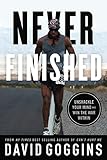
Editors Reads Verdict
Goggins's follow-up to his breakout memoir is angrier, more extreme, and more philosophically rigorous about the nature of suffering as a teacher — it will alienate readers who found Can't Hurt Me excessive and electrify those who found it transformative.
What We Loved
- Goggins's willingness to go further psychologically than almost any other writer
- The philosophical underpinning of the 'Savage' identity is more developed than the first book
- Specific physical and mental challenges documented in verifiable detail
- The honesty about continuing self-doubt is unusual in motivational memoir
Minor Drawbacks
- The intensity is relentless in a way that can desensitize rather than inspire
- Benefits significantly from having read Can't Hurt Me first
- Goggins's path is genuinely unusual and may not model well to average lives
Key Takeaways
- → The mind gives up long before the body is actually exhausted
- → Comfort is the enemy of growth — seek discomfort deliberately
- → The most important conversations you will ever have are the ones with yourself
- → Being finished is a choice, not a fact
- → Suffering endured with purpose builds a different kind of person than suffering avoided
| Author | David Goggins |
|---|---|
| Publisher | Lioncrest Publishing |
| Pages | 352 |
| Published | December 6, 2022 |
| Language | English |
| Genre | Memoir, Self-Help, Motivation |
| Difficulty | Intermediate |
| Best For | Readers who want extreme motivation and are willing to engage with a philosophy of deliberate discomfort and relentless self-examination. |
How Never Finished Compares
Never Finished at a glance against 3 similar books readers weigh alongside it.
| Book | Author | Rating | Best for |
|---|---|---|---|
| Never Finished (this book) | David Goggins | ★ 4.5 | Readers who want extreme motivation and are willing to engage with a philosophy |
| Can't Hurt Me | David Goggins | ★ 4.7 | Anyone seeking extreme motivation to push past comfort zones, with the caveat |
| Grit | Angela Duckworth | ★ 4.5 | Students, athletes, educators, parents, and anyone seeking to understand what |
| Unbroken | Laura Hillenbrand | ★ 4.6 | Readers of narrative nonfiction and World War II history who want a true story |
Past the Breaking Point Again
David Goggins finished Can’t Hurt Me at the top of the world: a Navy SEAL who had transformed himself from an abused, obese child into one of the most accomplished endurance athletes alive. Never Finished begins with the acknowledgment that arriving at the top was its own problem. The external challenges had been conquered. What remained was the internal war — the part of him that, even having done everything he’d done, still found reasons for doubt, self-criticism, and the search for something he hadn’t yet achieved.
The book is simultaneously a sequel, a philosophical manifesto, and an account of increasingly extreme physical challenges undertaken in service of a single argument: the version of yourself you think is your limit is not your limit. It is merely the outer boundary of what you have so far been willing to tolerate.
The Savage Philosophy
Where Can’t Hurt Me was primarily narrative — the story of becoming Goggins — Never Finished is more explicitly philosophical. Goggins develops the concept of the “Savage” — not a personality type but a mode of engagement, a willingness to pursue the thing you’re most afraid of because the fear is itself a signal of importance.
The Savage doesn’t seek comfort. The Savage doesn’t accept the story that circumstances have written about what’s possible. The Savage treats every imposed limit as a hypothesis to be tested rather than a boundary to be respected.
Honesty About the Ongoing Struggle
The book’s most affecting dimension is Goggins’s transparency about the fact that the internal war is never won — only fought daily. He continues to experience self-doubt, discomfort with public attention, and the specific suffering that comes from holding yourself to standards that nobody else requires of you. The book’s title refers to the fact that the work is never finished — not because you’ve failed, but because a human being who is genuinely growing never arrives.
That honesty distinguishes Goggins from motivational speakers who imply they’ve solved the problem they’re describing.
For a Specific Reader
Never Finished is not for everyone. It is not even for everyone who found Can’t Hurt Me useful. It is for the reader who found the first book and thought: I want more of that, taken further. For that reader, it delivers something genuinely rare: a systematic exploration of what happens when you refuse every offer to stop.
Goggins, Can’t Hurt Me, and a Publishing Phenomenon
To understand Never Finished, it helps to understand the cultural event that preceded it. David Goggins’s first book, Can’t Hurt Me, was published in 2018 through his own independent imprint and became one of the most surprising publishing successes of its era, selling in enormous numbers largely by word of mouth and through Goggins’s relentless presence on podcasts and social media. His backstory — a childhood marked by abuse and poverty, a transformation into a Navy SEAL, an Army Ranger, an Air Force tactical air controller, and an ultra-endurance athlete who once held a Guinness record for pull-ups — gave him a credibility that conventional motivational authors lacked. He had not theorised about suffering; he had sought it out and documented it. Never Finished is the sequel that arrives after fame, and it is shaped by the new problem fame created: what do you push against once you have already proven everything you set out to prove?
Both books are co-written and self-published, and they share an unusual structural feature — sections that directly address the reader and challenge them with specific mental exercises. Never Finished leans harder into the philosophical and confrontational, assuming a reader already converted by the first book and ready to be pushed further.
The Argument and Its Limits
The core claim of Never Finished is that the mind surrenders long before the body must, and that the imagined ceiling of one’s capacity is merely the limit of what one has so far been willing to endure. Goggins frames discomfort not as a cost to be minimised but as the necessary medium of growth, and the book’s title names his central thesis: a person genuinely committed to growth never arrives at a finish line, because each summit reveals the next. The honesty about ongoing self-doubt — his admission that the internal war is fought daily and never decisively won — is what separates the book from the triumphalism of much of the genre.
It is worth being clear-eyed about the limits, too. Goggins’s path is extreme and genuinely unusual, and his method does not always translate cleanly to ordinary lives with ordinary constraints. The relentless intensity that electrifies some readers exhausts or alienates others, and the philosophy of deliberate suffering can shade into something that resembles self-punishment more than self-mastery. The book works best as provocation rather than prescription.
Who Should Read It
Never Finished is for the reader who finished Can’t Hurt Me wanting it taken further, and who responds to confrontation rather than gentle encouragement. It rewards engagement with its embedded challenges and an appetite for a worldview built around discomfort and accountability. Readers seeking a balanced or moderate approach to motivation, or a method that fits neatly around a conventional life, are better served elsewhere. For its intended audience, though, it delivers exactly what it promises: an uncompromising account of what becomes possible when you stop accepting your own excuses.
Our rating: 4.5/5 — A more philosophically rigorous and emotionally intense follow-up that takes the Goggins method further than its predecessor and delivers real insight about the nature of inner limits.
Frequently Asked Questions
What is "Never Finished" about?
David Goggins continues his life story beyond Can't Hurt Me, exploring how he pushed further into the darkest corners of his mind to unlock the next level of human potential.
Who should read "Never Finished"?
Readers who want extreme motivation and are willing to engage with a philosophy of deliberate discomfort and relentless self-examination.
What are the key takeaways from "Never Finished"?
The mind gives up long before the body is actually exhausted Comfort is the enemy of growth — seek discomfort deliberately The most important conversations you will ever have are the ones with yourself Being finished is a choice, not a fact Suffering endured with purpose builds a different kind of person than suffering avoided
Is "Never Finished" worth reading?
Goggins's follow-up to his breakout memoir is angrier, more extreme, and more philosophically rigorous about the nature of suffering as a teacher — it will alienate readers who found Can't Hurt Me excessive and electrify those who found it transformative.
Ready to Read Never Finished?
Check the current price on Amazon.
Check Price on Amazon (paid link)Prices and availability are subject to change. See Amazon for current price.
Review last updated: