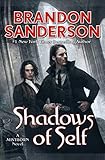
Editors Reads Verdict
Shadows of Self is where the Wax and Wayne series deepens from genre exercise into something more emotionally serious, using its shape-shifting villain to explore questions of identity and self-knowledge while delivering Sanderson's most devastating character moment in the Era 2 books. The political dimensions of allomancy — what happens when magic meets class conflict — become central.
What We Loved
- The kandra villain is one of Sanderson's most conceptually interesting antagonists
- The political class-conflict subplot grounds the fantasy in recognizable social dynamics
- The emotional gut-punch of the ending is Sanderson's most effective in the series
- Marasi's role is significantly expanded and improved from Book One
Minor Drawbacks
- The city's geography and political factions can feel underexplained for new readers
- Some of the investigation sequences are slower than the action-heavy first book
- The resolution requires coincidences that stretch plausibility slightly
Key Takeaways
- → Magic systems with defined rules create the possibility of crimes that are genuine puzzles
- → Class conflict in a world with hereditary magical ability has specific and ugly dynamics
- → Identity questions become most acute when external manipulation of identity is literally possible
- → The most effective emotional beats in series fiction are earned by prior investment in the character
- → A villain who believes in their cause is more dangerous than one who acts from pure malice
| Author | Brandon Sanderson |
|---|---|
| Publisher | Tor Books |
| Pages | 383 |
| Published | October 6, 2015 |
| Language | English |
| Genre | Fantasy, Epic Fantasy, Fiction |
| Difficulty | Intermediate |
| Best For | Readers of The Alloy of Law continuing the series; fans of fantasy mysteries who want political and emotional depth alongside their action. |
How Shadows of Self Compares
Shadows of Self at a glance against 3 similar books readers weigh alongside it.
| Book | Author | Rating | Best for |
|---|---|---|---|
| Shadows of Self (this book) | Brandon Sanderson | ★ 4.4 | Readers of The Alloy of Law continuing the series |
| Six of Crows | Leigh Bardugo | ★ 4.7 | Fantasy readers who enjoy morally complex anti-heroes, ensemble casts, |
| The Alloy of Law | Brandon Sanderson | ★ 4.4 | Readers who completed the original Mistborn trilogy and want more of the world |
| The Bands of Mourning | Brandon Sanderson | ★ 4.5 | Readers of Shadows of Self continuing the series |
The Shape of the Enemy
The second Wax and Wayne novel introduces an antagonist that is conceptually suited to everything the Era 2 books do well. Bleeder is a kandra — one of the shapeshifting creatures from Era 1, now living in secret among the human population — who has gone rogue, capable of assuming any face and determined to destabilize the political order of Elendel. A shapeshifter as a mystery villain is a familiar enough device, but Sanderson uses the kandra’s specific biology and psychology to make Bleeder something genuinely unsettling: a being whose nature is to have no fixed self, driven mad by the experience of wearing too many identities.
The investigation sequences that follow are the series at its most puzzle-box satisfying. Because allomancy has defined capabilities, Wax’s approach to tracking a shapeshifter is a genuine deductive problem with consistent rules, and Sanderson plays fair with the solution.
Class and Magic
The political subplot running beneath the investigation is Shadows of Self’s most ambitious addition to the series. Elendel is a city with a widening gap between the allomantically-gifted nobility and the working class, and Bleeder’s plan exploits this — she is not merely committing crimes but fomenting revolution. The choice to make the villain’s goal class war rather than simple destruction gives the book a social dimension that elevates it above its predecessor.
Sanderson is careful not to make the revolutionary sentiment purely wrong — the workers’ grievances are legitimate, which makes Bleeder’s manipulation of them more morally complex than a straightforward villain scheme.
What the Ending Does
Without specifics, the ending of Shadows of Self is the most emotionally ambitious moment Sanderson had written in the Mistborn universe at its publication. It requires the series’ investment in Wax as a character to land, and it does land — with a force that reframes what kind of story the Wax and Wayne books are actually telling. This is not a lighter companion to Era 1; it is its own serious investigation of loss and identity in a fantasy world.
Our rating: 4.4/5 — The Wax and Wayne series deepens significantly with this second entry, using its shapeshifting villain and political conflict to earn an ending of genuine emotional weight.
Reading Guides
- Brandon Sanderson Cosmere Reading Order: The Complete Guide (2026)
- Brandon Sanderson Books in Order: The Complete Cosmere Reading Guide (2026)
The Kandra in the Cosmere
The decision to make the villain of Shadows of Self a kandra — one of the shapeshifting beings from Era 1 who have been living in secret among humanity — is both a fan service moment and a genuine thematic choice. For readers of the original trilogy, the appearance of a kandra in the industrial city of Elendel raises immediate questions about continuity, about how the beings Vin knew in her time have adapted to a world that has changed enormously.
For readers coming to Era 2 without the original trilogy’s context, Bleeder functions as a conceptually interesting villain even without the historical resonance. A shapeshifter who can wear any face, who believes in their mission deeply enough to pursue it to self-destruction, and whose madness is connected to the specific nature of their kind — this is a strong villain premise independent of Cosmere knowledge.
Class and Allomancy
The social question that Shadows of Self takes seriously — what does hereditary magical ability mean in a class society? — is the most politically mature content in the Wax and Wayne series. Allomancy in Era 1 was uncommon enough to make Mistborn exceptional; in Era 2, allomantic abilities are distributed through the population but clearly correlate with noble lineage. The working class that does not have allomantic powers and the noble class that does have them exist in an economy where magical ability confers significant advantages.
Bleeder’s plan to foment class revolution exploits this genuine inequality. She is not manufacturing a grievance; she is weaponizing a real one. The workers who riot in the novel’s climax are not deceived victims of a manipulator; they are people with legitimate complaints who have been given a push at the wrong moment by someone with destructive intent.
Sanderson is careful about this. He does not use the extremity of Bleeder’s methods to discredit the underlying complaints. This is a more sophisticated political stance than most fantasy takes, and it gives the novel’s moral landscape genuine complexity.
Marasi’s Development
The improvement in Marasi’s role between The Alloy of Law and Shadows of Self is significant. In the first book, she is underdeveloped relative to the male leads — smart and clearly competent, but given less to do and less interiority. In Shadows of Self, her role as a constable expands, her independent judgment is given more weight, and the investigation relies on her contributions in ways that were absent from the first volume.
Her perspective on the political crisis — more analytically systematic than Wax’s, more institutionally minded — provides a useful counterpoint to his frontier-lawman instincts and Wayne’s cheerful chaos.
The Emotional Architecture
The ending of Shadows of Self is the most emotionally devastating moment in the Wax and Wayne series, requiring everything Sanderson built across this volume and the previous one to work. It is not the kind of twist that recontextualizes prior events; it is the kind of ending that fulfills the emotional logic of the story in a way that was never telegraphed but feels inevitable in retrospect.
Sanderson’s willingness to follow the story’s logic to an outcome this painful — in what was initially conceived as a lighter companion series — marks the Wax and Wayne books as something more serious than their genre-blending premise might suggest.
Frequently Asked Questions
What is "Shadows of Self" about?
A shape-shifting kandra is orchestrating political unrest in the city of Elendel, and Wax and Wayne must stop an assassin who can wear any face before the city tears itself apart.
Who should read "Shadows of Self"?
Readers of The Alloy of Law continuing the series; fans of fantasy mysteries who want political and emotional depth alongside their action.
What are the key takeaways from "Shadows of Self"?
Magic systems with defined rules create the possibility of crimes that are genuine puzzles Class conflict in a world with hereditary magical ability has specific and ugly dynamics Identity questions become most acute when external manipulation of identity is literally possible The most effective emotional beats in series fiction are earned by prior investment in the character A villain who believes in their cause is more dangerous than one who acts from pure malice
Is "Shadows of Self" worth reading?
Shadows of Self is where the Wax and Wayne series deepens from genre exercise into something more emotionally serious, using its shape-shifting villain to explore questions of identity and self-knowledge while delivering Sanderson's most devastating character moment in the Era 2 books. The political dimensions of allomancy — what happens when magic meets class conflict — become central.
Ready to Read Shadows of Self?
Check the current price on Amazon.
Check Price on Amazon (paid link)Prices and availability are subject to change. See Amazon for current price.
Review last updated: