Editors Reads Verdict
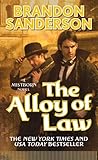
The Alloy of Law is Sanderson at his most playful — a genre-blending Western-mystery-fantasy that transplants Mistborn's magic into a Victorian-era city and loses none of the system's elegance in the translation. Wax and Wayne are an irresistible duo, and the shorter format proves that Sanderson can write tight as well as epic.
What We Loved
- The 300-year time jump shows Sanderson's world evolving organically — industrialization powered by allomancy
- Wax and Wayne's banter is funnier and lighter than anything in Era 1
- The mystery plot fits allomantic magic perfectly — metal-enhanced investigation scenes are inventive
- At 336 pages, the pacing is tight and propulsive compared to Sanderson's usual doorstops
Minor Drawbacks
- Marasi is underdeveloped compared to the two male leads
- The villain's motivation is functional rather than memorable
- Readers unfamiliar with Era 1 may miss the resonance of seeing the world transformed
Key Takeaways
- → A world with a consistent magic system evolves logically when its technology advances
- → Genre-blending — Western, mystery, fantasy — can energize a familiar magic system with new constraints
- → Shorter books can deliver fully satisfying stories without sacrificing world-building depth
- → Humor and lightness are valid modes for serious fantasy universes
- → The consequences of magical power in an industrial economy are more complex than in a feudal one
| Author | Brandon Sanderson |
|---|---|
| Publisher | Tor Books |
| Pages | 336 |
| Published | November 8, 2011 |
| Language | English |
| Genre | Fantasy, Epic Fantasy, Fiction |
| Difficulty | Intermediate |
| Best For | Readers who completed the original Mistborn trilogy and want more of the world; fantasy fans who enjoy genre-blending and lighter adventure alongside their world-building. |
How The Alloy of Law Compares
The Alloy of Law at a glance against 3 similar books readers weigh alongside it.
| Book | Author | Rating | Best for |
|---|---|---|---|
| The Alloy of Law (this book) | Brandon Sanderson | ★ 4.4 | Readers who completed the original Mistborn trilogy and want more of the world |
| Shadows of Self | Brandon Sanderson | ★ 4.4 | Readers of The Alloy of Law continuing the series |
| The Final Empire | Brandon Sanderson | ★ 4.6 | Fantasy readers looking for innovative magic systems and tightly plotted epic |
| The Hero of Ages | Brandon Sanderson | ★ 4.6 | Readers who have completed books one and two |
Three Hundred Years Later
One of the most audacious decisions Brandon Sanderson made with the Mistborn universe was jumping forward three hundred years between trilogies. The Alloy of Law opens in a world that has undergone an industrial revolution — steam-powered trains, electric lights in the wealthy districts, firearms that have fundamentally changed how allomantic powers interact with combat. This is not the ash-covered empire of the first trilogy, and that transformation is the novel’s greatest achievement.
Seeing how the world evolved — how the magical metals have been integrated into industry, how the social structures of the Final Empire gave way to something recognizably Victorian — is a genuine pleasure for readers invested in Sanderson’s world-building philosophy. If allomancy can push and pull on metals, then in an industrial city, the combat possibilities multiply exponentially.
Wax and Wayne
The Era 2 series is built around a duo rather than a protagonist-and-mentor structure. Waxillium Ladrian is a Twinborn — one who has both allomantic and feruchemical abilities — who spent twenty years as a lawman in the Roughs (think: the American frontier) before being recalled to the city to manage his family’s noble house. His partner Wayne is a Twinborn with different abilities and an entirely different personality: cheerful, irreverent, constitutionally unable to take anything seriously except a fight.
Their relationship is the heart of the Wax and Wayne books. Sanderson has a reputation for functional but unspectacular prose; his dialogue, however, is excellent, and Wayne brings out the best of it. The banter between these two is the funniest writing in any Sanderson novel.
The Mystery Frame
The plot involves a series of sophisticated robberies that seem to require allomantic assistance — trains robbed at impossible speeds, hostages taken without a trace. The mystery structure suits the magic system well: allomancy has specific, defined capabilities, which means a clever crime using allomantic powers is a genuine puzzle with a solution the reader can work toward.
This is a shorter, tighter book than anything Sanderson wrote in Era 1, and the compression suits the material. The Alloy of Law demonstrates that the Mistborn world’s depth can support different scales and genres without losing its coherence.
Our rating: 4.4/5 — A genre-blending delight that proves Sanderson’s world-building survives transplantation into new time periods and tonal registers with its magic system more interesting than ever.
Reading Guides
- Brandon Sanderson Cosmere Reading Order: The Complete Guide (2026)
- Brandon Sanderson Books in Order: The Complete Cosmere Reading Guide (2026)
The Genre Blend: Western, Mystery, Fantasy
The decision to write The Alloy of Law at all was partly accident and partly Sanderson’s way of working through the implications of his own world-building. He had been developing the Mistborn universe’s second era for a planned later trilogy, and when a smaller story set in the transitional period started forming, he wrote it as a side project — faster and lighter than his usual doorstop epics.
The Western influence is present in Wax’s backstory: twenty years as a frontier lawman in the Roughs, a region clearly modeled on the American West complete with outlaws, frontier towns, and a general sense that the law only extends as far as the person willing to enforce it. This is explicitly frontier mythology applied to a fantasy world, and Sanderson commits to it without apology. The Roughs are characterized as ungoverned space where self-reliance and quick judgment are survival skills.
The mystery structure then provides the plot engine for what happens when this frontier lawman is dragged back to civilization. Who is orchestrating the train robberies? How are they moving so quickly? The puzzle-box satisfactions of the mystery genre translate naturally to allomancy because the magic system has defined, comprehensible rules — which means an allomantic crime is a problem with a specific solution, not a narrative convenience.
How Industrialization Changes Magic
The technological advancement between the original trilogy and Era 2 is one of Sanderson’s most thoughtful pieces of extended world-building. The Mistborn world underwent its industrial revolution with allomancy as part of the technological base — meaning the specific character of that revolution is different from any historical parallel. Metal rails are everywhere because steel-Pushers need them to travel at speed. The metallurgical industry is structured around both practical use and magical use of metals. The social position of allomancers in an industrial economy is different from their position in a feudal one.
This is Sanderson following the logic of his own creation rather than simply transplanting the Victorian aesthetic he wanted onto an existing world. The result is a secondary world that feels internally generated rather than externally designed.
Steris and the Long Game
Even in her first appearance, Steris Harms is more interesting than she initially appears. Wax’s arranged fiancée is presented as rigidly formal, her emotional range apparently limited to careful contingency planning and social calculation. This is partly comic characterization and partly deliberate concealment — Sanderson is planting seeds for a character arc that will unfold across three more books.
Readers returning to The Alloy of Law after finishing The Lost Metal often report finding Steris’s introductory scenes more moving than they did initially, knowing where the character ends up. This is the sign of retrospective good writing: the early version was always the later version in potential.
The Twinborn System
Wax and Wayne are both Twinborn — individuals who have both an allomantic ability and a feruchemical ability, the two magic systems of the Mistborn world. The specific combination each character has shapes their combat style, their tactics, and their personality in ways that Sanderson makes feel organic rather than mechanical. Wax as a steel-Pusher and iron-Puller who can store weight in metal creates fighting possibilities that are genuinely novel; Wayne as a speed-bubble creator and healer who can also swap things through his bubble makes him tactically useful in ways that surprise.
Frequently Asked Questions
What is "The Alloy of Law" about?
Set 300 years after the events of the original Mistborn trilogy, Waxillium Ladrian is a lawman who returns to the city to find himself caught up in a series of mysterious robberies with allomantic involvement.
Who should read "The Alloy of Law"?
Readers who completed the original Mistborn trilogy and want more of the world; fantasy fans who enjoy genre-blending and lighter adventure alongside their world-building.
What are the key takeaways from "The Alloy of Law"?
A world with a consistent magic system evolves logically when its technology advances Genre-blending — Western, mystery, fantasy — can energize a familiar magic system with new constraints Shorter books can deliver fully satisfying stories without sacrificing world-building depth Humor and lightness are valid modes for serious fantasy universes The consequences of magical power in an industrial economy are more complex than in a feudal one
Is "The Alloy of Law" worth reading?
The Alloy of Law is Sanderson at his most playful — a genre-blending Western-mystery-fantasy that transplants Mistborn's magic into a Victorian-era city and loses none of the system's elegance in the translation. Wax and Wayne are an irresistible duo, and the shorter format proves that Sanderson can write tight as well as epic.
Ready to Read The Alloy of Law?
Check the current price on Amazon.
Check Price on Amazon (paid link)Prices and availability are subject to change. See Amazon for current price.
Review last updated: