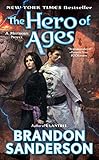
Editors Reads Verdict
The Hero of Ages delivers one of epic fantasy's most satisfying trilogy conclusions, retroactively making every element of the first two books more meaningful while resolving the cosmological mystery with genuine elegance. The emotional beats hit hard, and the final answer to the series' central questions is thematically audacious.
What We Loved
- The retrospective revelations about the first two books are brilliantly constructed
- The emotional stakes are higher than in any previous volume, and Sanderson delivers on them
- The cosmological resolution is theologically ambitious and genuinely surprising
- The villain recontextualization is among the best in epic fantasy
Minor Drawbacks
- The early sections require readers to have the full series freshly in mind
- Some characters introduced in book two have reduced roles
- The scale of the ending may feel overwhelming rather than epic for some readers
Key Takeaways
- → Good and evil may operate at a cosmic scale that individual moral choices fit into without negating
- → The villain's perspective, when fully revealed, can be comprehensible without being correct
- → Sacrifice requires understanding what you are sacrificing for, not just willingness to lose something
- → The world's history is often more complicated than the history the powerful have chosen to record
- → Some problems require accepting fundamental uncertainty rather than achieving complete clarity
| Author | Brandon Sanderson |
|---|---|
| Publisher | Tor Books |
| Pages | 724 |
| Published | October 14, 2008 |
| Language | English |
| Genre | Fantasy, Epic Fantasy, Fiction |
| Difficulty | Intermediate |
| Best For | Readers who have completed books one and two; epic fantasy fans looking for a trilogy conclusion that fully honors its setup; Sanderson fans exploring his early cosmere work. |
How The Hero of Ages Compares
The Hero of Ages at a glance against 3 similar books readers weigh alongside it.
| Book | Author | Rating | Best for |
|---|---|---|---|
| The Hero of Ages (this book) | Brandon Sanderson | ★ 4.6 | Readers who have completed books one and two |
| The Final Empire | Brandon Sanderson | ★ 4.6 | Fantasy readers looking for innovative magic systems and tightly plotted epic |
| The Way of Kings | Brandon Sanderson | ★ 4.7 | Epic fantasy readers ready for a 1,000-page commitment who want the most |
| The Well of Ascension | Brandon Sanderson | ★ 4.4 | Readers who have completed The Final Empire |
The Payoff Three Books in the Making
The highest praise that can be given The Hero of Ages is that it makes you want to immediately reread The Final Empire — not because the first book was unclear, but because the revelations of the third retroactively enrich every detail of the original. Sanderson has been building toward a specific cosmological answer for three books, and the answer is surprising, philosophically serious, and emotionally devastating in ways that the genre rarely achieves.
The novel begins with the world unmistakably ending. The ashfalls that were oppressive background detail in book one are now catastrophic. The mists that have always been mysterious are killing people. The koloss and kandra are acting strangely. Vin and Elend, now married and ruling together, must find the atium caches hidden across the empire while pursuing a truth about the Hero of Ages that keeps revealing new layers.
The Villain Recontextualized
Without spoiling the novel’s central revelation, Sanderson does something few fantasy writers attempt: he rehabilitates the trilogy’s apparent antagonist without excusing them and without reducing the horror of their actions. The explanation for the Lord Ruler — who and what he actually was, what he was trying to accomplish, what he knew that his subjects didn’t — is one of the most emotionally complex villain backstories in epic fantasy.
It doesn’t make the Lord Ruler good. It makes him comprehensible in a way that is more unsettling than simple evil.
An Ending That Earns Its Scale
The final hundred pages of The Hero of Ages operate at a mythological scale that epic fantasy aspires to and rarely reaches. Sanderson’s willingness to follow the logic of his cosmology to its conclusion — rather than softening it for genre comfort — results in an ending that is genuinely tragic and genuinely hopeful simultaneously, a combination that requires both careful structural preparation and real emotional commitment.
The character moments within the climax are matched to the cosmic ones with a craft that shows how far Sanderson had developed between The Final Empire and this conclusion.
Our rating: 4.6/5 — One of epic fantasy’s finest trilogy conclusions: a novel that makes the preceding two volumes more meaningful in retrospect while delivering emotional and cosmological payoffs of genuine ambition.
Reading Guides
- Brandon Sanderson Cosmere Reading Order: The Complete Guide (2026)
- Brandon Sanderson Books in Order: The Complete Cosmere Reading Guide (2026)
The Architecture of a Trilogy Conclusion
What makes The Hero of Ages work structurally is the degree to which its revelations were prepared in the previous two volumes without being telegraphed. Sanderson has spoken about the planning that went into the original Mistborn trilogy — the specific answers he was working toward, the details placed in books one and two that acquire new meaning in book three. Rereaders regularly report the experience of finding planted evidence they missed entirely on first reading, evidence that was always there, visible in retrospect.
This level of long-form structural planning is rare in epic fantasy. Most series develop their worlds and their mysteries organically, meaning revelations often feel invented to explain existing loose ends rather than discovered as the true meaning of carefully prepared groundwork. The Hero of Ages is one of the clearest examples in the genre of the other approach: a climax that was designed before the first book was written, and that fulfills its architecture without visible seams.
The Question of Good and Evil at Cosmic Scale
The theological dimension of the Mistborn trilogy’s conclusion is its most ambitious element. Sanderson — whose Mormon faith is known and acknowledged by both the author and many critics — is not writing allegory, but he is engaging seriously with questions about the nature of divine intention, the possibility of cosmic evil, and what it means for human moral action to exist within a universe shaped by forces whose motivations are beyond human comprehension.
The answer the trilogy arrives at is not a comfortable one. It neither validates a simple divine plan nor dismisses the possibility of cosmic significance. What it does is something harder: it acknowledges that genuine heroism requires acting rightly in the absence of certainty about what the universe is doing with your actions. The characters of The Hero of Ages cannot know what they are part of; they can only know what kind of people they are choosing to be.
Spook and the Minor Characters
One underappreciated aspect of The Hero of Ages is what Sanderson does with the characters who were minor in the previous volumes. Spook, a teenage skaa thief who was mostly comic relief in The Final Empire, receives a complete and emotionally serious arc in the third book that retroactively deepens his earlier presence. The same applies to several other characters who functioned as ensemble texture in books one and two.
This expansion of the minor characters in the final volume is a signal that Sanderson understood from the beginning that his ensemble would need resolution, not just his leads. The result is a novel that feels like a complete accounting of its world rather than simply the resolution of its central plot.
The Kandra and Identity
The kandra — shapeshifting beings who serve as a bridge between the first trilogy’s world and something older — receive their most complete treatment in this volume, and their philosophical implications are the book’s most sustained intellectual content. The questions raised by beings who can become anyone — what identity is, what constitutes genuine selfhood, what obligations shapeshifters have to the people they imitate — are not resolved neatly, and that lack of easy resolution is what makes them interesting.
Frequently Asked Questions
What is "The Hero of Ages" about?
As the world begins to end, Vin, Elend, and their companions race to find the Hero of Ages and uncover the true nature of the powers that have shaped their world from the beginning.
Who should read "The Hero of Ages"?
Readers who have completed books one and two; epic fantasy fans looking for a trilogy conclusion that fully honors its setup; Sanderson fans exploring his early cosmere work.
What are the key takeaways from "The Hero of Ages"?
Good and evil may operate at a cosmic scale that individual moral choices fit into without negating The villain's perspective, when fully revealed, can be comprehensible without being correct Sacrifice requires understanding what you are sacrificing for, not just willingness to lose something The world's history is often more complicated than the history the powerful have chosen to record Some problems require accepting fundamental uncertainty rather than achieving complete clarity
Is "The Hero of Ages" worth reading?
The Hero of Ages delivers one of epic fantasy's most satisfying trilogy conclusions, retroactively making every element of the first two books more meaningful while resolving the cosmological mystery with genuine elegance. The emotional beats hit hard, and the final answer to the series' central questions is thematically audacious.
Ready to Read The Hero of Ages?
Check the current price on Amazon.
Check Price on Amazon (paid link)Prices and availability are subject to change. See Amazon for current price.
Review last updated: