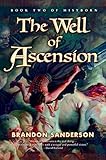
Editors Reads Verdict
The Well of Ascension is a slower and more politically focused volume than its predecessor, exploring the difficult truth that revolution is easier than governance. Some readers find the pacing demanding, but the payoff and its revelations about the Mistborn world's underlying cosmology are extraordinary.
What We Loved
- The political challenges of post-revolutionary governance are explored with real intelligence
- Vin's psychological development continues with consistency from book one
- The cosmological revelations in the final third reframe the entire series
- Elend's arc from idealist to pragmatic leader is one of Sanderson's best character studies
Minor Drawbacks
- Middle-volume pacing issues — the siege sections can feel repetitive
- Some political subplots are more detailed than the narrative strictly requires
- The climax requires close attention to extended cosmological exposition
Key Takeaways
- → Winning a revolution and building a functional society after it are entirely different challenges
- → Prophecy and destiny are interpretive frameworks, not literal blueprints
- → Leadership requires abandoning the idealism that made a leader appealing in order to be effective
- → The history that shapes a world may be more manipulated than anyone alive realizes
- → Love and partnership require both people to grow rather than one person orbiting the other's growth
| Author | Brandon Sanderson |
|---|---|
| Publisher | Tor Books |
| Pages | 816 |
| Published | August 21, 2007 |
| Language | English |
| Genre | Fantasy, Epic Fantasy, Fiction |
| Difficulty | Intermediate |
| Best For | Readers who have completed The Final Empire; Mistborn series fans; readers who appreciate fantasy that engages seriously with political philosophy. |
How The Well of Ascension Compares
The Well of Ascension at a glance against 3 similar books readers weigh alongside it.
| Book | Author | Rating | Best for |
|---|---|---|---|
| The Well of Ascension (this book) | Brandon Sanderson | ★ 4.4 | Readers who have completed The Final Empire |
| The Final Empire | Brandon Sanderson | ★ 4.6 | Fantasy readers looking for innovative magic systems and tightly plotted epic |
| The Hero of Ages | Brandon Sanderson | ★ 4.6 | Readers who have completed books one and two |
| The Way of Kings | Brandon Sanderson | ★ 4.7 | Epic fantasy readers ready for a 1,000-page commitment who want the most |
The Harder Problem: What Comes After Victory
The Well of Ascension begins with the revolution complete and the genuine challenge laid bare: the Lord Ruler is dead, and no one, including his conquerors, knows how to run the world he built. Elend Venture sits on an uncertain throne, Vin guards both him and the city, and three armies arrive to contest what Kelsier’s crew won.
Sanderson is explicit about his thematic interest: this is a novel about the difficulty of governance, about how the skills required to overthrow a tyranny are almost the opposite of those required to build a just society in its place. Elend’s idealism — his conviction that a constitutional monarchy could work, that the assembly would act in good faith — is tested and mostly broken by the political realities of people acting in self-interest while the city starves under siege.
The Political Architecture
The siege sections, which occupy the novel’s lengthy midsection, can test the patience of readers who preferred the heist momentum of The Final Empire. But Sanderson is doing something specific with the slowness: governance, unlike revolution, is not exciting. The assembly debates, the diplomatic maneuvers, the military calculations all have the texture of genuinely difficult institutional problems that resist elegant solutions.
Elend’s arc — from idealist to someone willing to make the hard compromises idealism forbids — is handled with more nuance than the genre typically provides. He doesn’t become cynical; he becomes, painfully, effective.
Vin’s Deepening Questions
Vin’s role shifts in this volume from revolutionary weapon to something more complex — a person trying to understand her own nature, the source of her power, and whether the prophecy she is supposedly fulfilling is actually what it appears to be. The questions she begins to ask about the nature of the Mistborn world’s cosmology are answered in the final third in ways that completely reframe the stakes of the series.
Those revelations are among Sanderson’s finest work and make the investment of 800 pages worthwhile for readers who commit to them.
Our rating: 4.4/5 — A slower, more politically demanding volume than its predecessor that pays off with cosmological revelations and character development that deepens the entire series.
Reading Guides
- Brandon Sanderson Cosmere Reading Order: The Complete Guide (2026)
- Brandon Sanderson Books in Order: The Complete Cosmere Reading Guide (2026)
The Political Philosophy of Post-Revolution
Sanderson has spoken in interviews about the specific historical problem that interested him in The Well of Ascension: what happens in the space between a revolution’s victory and the establishment of a new stable order? It is the most dangerous period for any revolutionary movement, and the most revealing. The ideals that motivated the revolution must now be implemented by people whose skills were built for destruction, not construction.
Elend’s constitutional monarchy is Sanderson’s vehicle for this inquiry. He has designed a government that is, in theory, just — an assembly with real power, protections for the skaa, limits on noble authority. In practice, it is a government that almost no one has any interest in maintaining, because the assembly is composed of people whose self-interest runs in the opposite direction of its stated ideals. Watching Elend learn that designing a just system is orders of magnitude easier than getting people to actually operate it is the novel’s most enduring intellectual content.
The Three-Army Problem
The military situation that opens The Well of Ascension is one of Sanderson’s most effective pieces of scenario design. Three armies encircle Luthadel simultaneously: one led by a nobleman who wants to claim the city for himself, one led by a Mistborn with personal history, one composed of koloss directed by someone whose motivations are unclear. No single army can be fought directly; any accommodation with one antagonizes the others; and the city has no realistic prospect of withstanding a siege indefinitely.
The decision to use this siege as the novel’s backdrop is what makes the political slowness work. The pressure is always there, even in the assembly debates and the diplomatic maneuvers. The question is never whether disaster will arrive but whether Elend and Vin can delay it long enough to find a third option.
Vin’s Cosmological Questions
The novel’s most important development is not political but metaphysical. Vin’s investigation of the mists — their strange behavior, their apparent consciousness, the connection between her powers and their origin — begins in The Well of Ascension the thread that the third volume will resolve. Sanderson is careful to make this feel like Vin’s genuine curiosity rather than an authorial setup device, grounding it in her established character trait of noticing what others overlook.
The final sequence — Vin at the Well of Ascension itself — is where the series’ cosmology first becomes explicitly visible, and the revelation fundamentally changes the stakes of everything that follows. Readers who found the middle slow will find that the ending more than compensates.
Elend’s Arc as Character Study
The transformation Elend undergoes across this novel is the most fully realized character development in the original trilogy. He begins as an idealist intellectual, more comfortable with political theory than political practice, more admired for his principles than effective at applying them. The series of compromises and failures that strip away his initial approach to leadership — and the harder, more effective person who emerges from that process — is handled with more nuance than the genre typically attempts.
Sanderson avoids the cynicism trap: Elend does not become ruthless by losing his values. He becomes effective by understanding how his values must function in a world that does not share them. The distinction is the entire point.
Frequently Asked Questions
What is "The Well of Ascension" about?
With the Lord Ruler dead, Elend Venture struggles to hold together a fragile new government while Vin faces threats from within and without — and begins to question the prophecy that supposedly guides them.
Who should read "The Well of Ascension"?
Readers who have completed The Final Empire; Mistborn series fans; readers who appreciate fantasy that engages seriously with political philosophy.
What are the key takeaways from "The Well of Ascension"?
Winning a revolution and building a functional society after it are entirely different challenges Prophecy and destiny are interpretive frameworks, not literal blueprints Leadership requires abandoning the idealism that made a leader appealing in order to be effective The history that shapes a world may be more manipulated than anyone alive realizes Love and partnership require both people to grow rather than one person orbiting the other's growth
Is "The Well of Ascension" worth reading?
The Well of Ascension is a slower and more politically focused volume than its predecessor, exploring the difficult truth that revolution is easier than governance. Some readers find the pacing demanding, but the payoff and its revelations about the Mistborn world's underlying cosmology are extraordinary.
Ready to Read The Well of Ascension?
Check the current price on Amazon.
Check Price on Amazon (paid link)Prices and availability are subject to change. See Amazon for current price.
Review last updated: