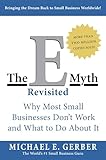
Editors Reads Verdict
Gerber's diagnosis of the entrepreneurial myth — that being good at a technical skill qualifies you to run a business built on that skill — is the most important insight any small business owner can absorb.
What We Loved
- The Technician/Manager/Entrepreneur trichotomy is a genuinely useful diagnostic
- The franchise prototype model provides a concrete path to systematisation
- Written as a business parable — highly readable and engaging
- Widely applicable regardless of industry or business size
Minor Drawbacks
- The narrative framing occasionally slows the pace
- Some prescriptions work better for service businesses than product companies
- The franchise model as the universal answer can feel overstated
Key Takeaways
- → The E-Myth: most small businesses are started by Technicians having an entrepreneurial seizure
- → Every business owner plays three roles: Technician, Manager, and Entrepreneur
- → Work ON your business, not just IN it — build systems that work without you
- → The franchise prototype: document every process as if you're creating a replicable model
- → A business that depends entirely on its owner is not a business — it's a job
| Author | Michael E. Gerber |
|---|---|
| Publisher | HarperCollins |
| Pages | 288 |
| Published | November 1, 1995 |
| Language | English |
| Genre | Business, Entrepreneurship, Small Business |
| Difficulty | Beginner |
| Best For | Small business owners, aspiring entrepreneurs, and anyone who has started or is considering starting a service business. |
How The E-Myth Revisited Compares
The E-Myth Revisited at a glance against 3 similar books readers weigh alongside it.
| Book | Author | Rating | Best for |
|---|---|---|---|
| The E-Myth Revisited (this book) | Michael E. Gerber | ★ 4.4 | Small business owners, aspiring entrepreneurs, and anyone who has started or is |
| Built to Last | Jim Collins | ★ 4.4 | Business leaders, board members, and strategists interested in what |
| The $100 Startup | Chris Guillebeau | ★ 4.3 | Anyone considering leaving traditional employment to build a small, profitable, |
| The Hard Thing About Hard Things | Ben Horowitz | ★ 4.5 | Startup founders, CEOs, and senior managers navigating the unglamorous |
The Honest Truth About Small Business
The mythology of entrepreneurship tells a seductive story: if you’re talented enough at something, you can build a business around that talent. A brilliant baker opens a bakery. A gifted accountant starts a practice. A skilled contractor builds a firm. And then — according to the myth — success follows naturally from skill.
Michael Gerber spent decades consulting with small businesses and watching this story play out very differently. His diagnosis is the heart of The E-Myth: the technical skills that make someone excellent at a craft have almost nothing to do with the skills required to build a successful business based on that craft.
Three Personalities, One Owner
Gerber argues that every small business owner must juggle three fundamentally different personalities. The Technician is the skilled doer — the baker, the accountant, the contractor. The Manager builds systems, manages processes, and maintains order. The Entrepreneur envisions the future and asks “what is possible?”
Most small business owners are primarily Technicians who periodically have what Gerber calls an “entrepreneurial seizure” — the moment of believing they can do what their boss does, only better. They start businesses, discover that managing and visioning are entirely different skills from doing, and end up working longer hours for less reward than they did as employees.
The Franchise Prototype
Gerber’s solution is to build every business as if it might one day become the model for a thousand identical businesses — what he calls the franchise prototype. Not because you intend to franchise, but because this discipline forces you to document every process, build systems that work without specific individuals, and create a business that produces consistent results regardless of who is running it.
This is McDonald’s applied to every small business: Ray Kroc’s genius wasn’t making good hamburgers, it was creating a system for making millions of consistent hamburgers through ordinary people.
A Book That Saves Businesses
The practical implication is profound: stop trying to be the best practitioner in your business and start designing a business that works. Document processes. Create systems. Define standards. Build so that your business can operate without you — because until it can, you don’t have a business, you have a job with extra costs and more stress.
Working On the Business, Not In It
The single phrase most associated with The E-Myth Revisited — “work on your business, not just in it” — has entered the standard vocabulary of small-business advice so thoroughly that many people who have never read the book nonetheless repeat its central lesson. That ubiquity is a measure of how influential Gerber’s framing has been. Before The E-Myth, the dominant story about small-business failure blamed undercapitalization, bad luck, or insufficient hustle. Gerber relocated the problem: most small businesses fail not because the owner lacks skill or effort but because the owner is trapped doing technical work when the business needs systems, delegation, and design. Reframing the owner’s job — from chief doer to chief architect — is the conceptual shift the whole book exists to produce, and it remains genuinely clarifying for anyone caught in the daily grind of a business that cannot run without them.
A Framework You Can Actually Use
What keeps The E-Myth Revisited practical rather than merely inspirational is that Gerber turns his diagnosis into a concrete program. He walks the reader through a “business development process” of innovation, quantification, and orchestration, and he insists that every recurring task be documented into an operations manual so the business can deliver consistent results through ordinary people rather than depending on the heroic effort of the founder. The recurring fable of “Sarah” and her pie shop grounds the abstractions in a relatable story, which is part of why the book reads quickly despite its conceptual ambition. The framework is not flawless — critics note that the franchise-prototype model fits some businesses (repeatable, service-based, scalable) far better than others, and that the systematization Gerber prizes can feel rigid for genuinely craft-driven work. But used as a lens rather than a rulebook, it gives owners a vocabulary and a sequence for escaping the technician’s trap.
Who Should Read It
The E-Myth Revisited is essential for first-time founders, freelancers contemplating turning a skill into a company, and small-business owners who feel they have bought themselves a job rather than built an enterprise. It is less useful for those running large organizations or seeking advanced operational strategy — its value is foundational rather than specialized. Read early, ideally before or during a business’s first year, it can spare the owner years of painful, avoidable lessons. Gerber himself built a coaching company around these ideas, and the book launched an entire E-Myth franchise of titles for specific professions, but the original remains the one to read: clear, persuasive, and quietly transformative in how it makes you see the work.
Final Verdict
Required reading for anyone who owns or is considering starting a small business. The core insight — systems rather than heroic individual effort — is the difference between a job and an enterprise. It is a short, readable book with one big, clarifying idea, and that idea is worth more to most small-business owners than a shelf of more sophisticated management texts. If you take only one lesson from it — to build your business so that it could run without you — you will have absorbed the most valuable thing it has to teach.
Our rating: 4.4/5 — Every small business owner should read this in their first year. Many painful lessons become unnecessary if you absorb Gerber’s framework early.
Frequently Asked Questions
What is "The E-Myth Revisited" about?
Why most small businesses don't work and what to do about it — the classic guide to building a business rather than owning a job.
Who should read "The E-Myth Revisited"?
Small business owners, aspiring entrepreneurs, and anyone who has started or is considering starting a service business.
What are the key takeaways from "The E-Myth Revisited"?
The E-Myth: most small businesses are started by Technicians having an entrepreneurial seizure Every business owner plays three roles: Technician, Manager, and Entrepreneur Work ON your business, not just IN it — build systems that work without you The franchise prototype: document every process as if you're creating a replicable model A business that depends entirely on its owner is not a business — it's a job
Is "The E-Myth Revisited" worth reading?
Gerber's diagnosis of the entrepreneurial myth — that being good at a technical skill qualifies you to run a business built on that skill — is the most important insight any small business owner can absorb.
Ready to Read The E-Myth Revisited?
Check the current price on Amazon.
Check Price on Amazon (paid link)Prices and availability are subject to change. See Amazon for current price.
Review last updated: