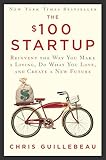
Editors Reads Verdict
Guillebeau's micro-business manifesto is packed with real case studies of people who built profitable businesses on small budgets. Practical, motivating, and deliberately concrete about money.
What We Loved
- Real case studies with actual revenue and cost figures — rare in business books
- The focus on 'good enough' over perfection is liberating and accurate
- Covers the intersection of passion, skills, and market — not just passion
- The one-page business plan template is genuinely useful
Minor Drawbacks
- Some examples feel dated in the post-pandemic creator economy
- The barrier to entry for many featured businesses is higher than acknowledged
- Less useful for people pursuing larger ambitions
Key Takeaways
- → The microbusiness sweet spot: where your skills meet what people will pay for
- → Start before you're ready — imperfect action beats perfect inaction
- → Focus on value creation for others, not just following your passion
- → The one-page business plan forces clarity that longer plans obscure
- → Recurring revenue models create the most sustainable freedom businesses
| Author | Chris Guillebeau |
|---|---|
| Publisher | Crown Business |
| Pages | 304 |
| Published | May 8, 2012 |
| Language | English |
| Genre | Business, Entrepreneurship, Self-Help |
| Difficulty | Beginner |
| Best For | Anyone considering leaving traditional employment to build a small, profitable, location-independent business around their skills and interests. |
How The $100 Startup Compares
The $100 Startup at a glance against 3 similar books readers weigh alongside it.
| Book | Author | Rating | Best for |
|---|---|---|---|
| The $100 Startup (this book) | Chris Guillebeau | ★ 4.3 | Anyone considering leaving traditional employment to build a small, profitable, |
| Built to Last | Jim Collins | ★ 4.4 | Business leaders, board members, and strategists interested in what |
| The E-Myth Revisited | Michael E. Gerber | ★ 4.4 | Small business owners, aspiring entrepreneurs, and anyone who has started or is |
| Ultralearning | Scott Young | ★ 4.4 | Career-changers, autodidacts, and ambitious learners who want to acquire hard |
Freedom Business at Low Cost
Chris Guillebeau’s proposition is democratic: you don’t need venture capital, an MBA, or a revolutionary idea to build a business that gives you financial freedom and meaningful work. You need a skill people will pay for, the willingness to start small, and enough momentum to refine as you go.
The $100 Startup is built on interviews with 1,500 people who had done exactly this, distilled into the most instructive 100 cases. What distinguishes it from most entrepreneurship books is its insistence on specifics — Guillebeau reports actual revenue figures, actual startup costs, actual timelines.
The Convergence Framework
Guillebeau’s central framework identifies the sweet spot where three circles overlap: passion (what you love doing), skills (what you’re good at), and market (what people will pay for). Passion alone is insufficient — countless failed businesses are built on things their founders loved that the market didn’t value. The intersection of all three is where viable micro-businesses live.
The book is particularly useful in its insistence that you convert passion into something useful for others. “I love woodworking” is a hobby. “I build custom furniture for people renovating small apartments” is a business premise.
Case Studies That Ring True
The case studies throughout the book give it credibility most entrepreneurship books lack. You meet a woman who turned her love of travel into a profitable tour guide business with $83 of startup capital. A man who left his corporate career to teach photography workshops and built six figures of annual revenue within two years. The numbers are specific, the timelines are real, and the obstacles are acknowledged.
The most instructive pattern across all cases: the founders launched quickly, sold their first product before they felt ready, and refined based on real feedback rather than hypothetical planning.
The One-Page Business Plan
One of the book’s most useful contributions is a stripped-down business plan template that fits on a single page: what will you sell, who will buy it, what is the price, how will customers find you, and why will they buy from you rather than someone else? This simplicity is not naivety — it forces clarity that most complex business plans obscure behind elaborate projections.
Guillebeau’s Wider Project
The $100 Startup makes more sense once you understand the author behind it. Chris Guillebeau is best known for a personal quest that became a kind of brand: visiting every country in the world — all 193 — before his thirty-fifth birthday, a project he financed and documented through his blog, The Art of Non-Conformity. His writing consistently returns to a single theme, the pursuit of personal freedom and self-directed work outside the assumptions of conventional employment, and The $100 Startup is the most practical and widely read expression of it. Readers familiar with his earlier manifesto-style book of the same name as his blog, or his later The Happiness of Pursuit and Side Hustle, will recognise the through-line: the conviction that ordinary people can engineer unconventional, location-independent lives if they are willing to act rather than wait.
This biographical frame matters because it shapes both the book’s strengths and its blind spots. Guillebeau genuinely lives the philosophy he sells, which lends the case studies a credibility that ghostwritten business books often lack; the people profiled are drawn from the same restless, freedom-seeking community he had spent years cultivating. But it also means the book is implicitly addressed to a particular reader — one with marketable skills, a tolerance for risk, and the kind of flexibility that not everyone’s circumstances allow. The “$100” of the title is partly rhetorical, a deliberate provocation against the belief that you need significant capital, rather than a literal claim that most of these businesses cost only that to start.
Reading It in Today’s Economy
Published in 2012, The $100 Startup arrived early in the wave of interest in self-employment, freelancing, and what would later be called the creator economy, and parts of it now read as prescient. The book anticipated the explosion of one-person businesses built on teaching, consulting, and selling digital products to a niche audience — the model that platforms have since made enormously more accessible. Read today, some of its specific examples and tactics feel dated, predating the maturation of social media marketing, online course platforms, and the subscription tools that have since transformed how micro-businesses reach customers. The underlying principles, however, have aged well: find the overlap between what you can do and what people will pay for, launch before you feel ready, prioritise recurring revenue, and keep the operation small enough to stay free.
A reader coming to the book now is best served by treating it as a framework rather than a tactical manual. The convergence model, the emphasis on solving a real problem for a defined customer, and the bias toward action remain sound; the marketing specifics are worth supplementing with more current sources. Approached that way, the book’s core argument — that meaningful self-employment is within reach of far more people than assume it — is, if anything, more true now than when it was written.
Who Should Read It
The ideal reader of The $100 Startup is someone standing at the edge of a decision: an employee with a skill and a quiet ambition to work for themselves, a freelancer wanting to systematise an existing trade, or anyone drawn to the idea of a modest, profitable business that buys freedom rather than chasing scale. For that reader the book is genuinely energising, and its insistence on real numbers and quick launches is a useful antidote to analysis paralysis. It is less suited to those with venture-scale ambitions, who will find its horizons deliberately small, or to readers wanting deep operational detail on any single business type. Read as an on-ramp — a confidence-builder paired with a concrete first framework — it remains one of the most approachable books available for the would-be small-scale entrepreneur, and a natural companion to more specialised guides on whatever niche the reader ultimately chooses.
Final Verdict
The $100 Startup is an accessible, honest, and motivating guide for people considering small-scale entrepreneurship. It won’t help you build the next unicorn — but it might help you build something you actually want.
Our rating: 4.3/5 — One of the most honest and practical books about starting a small business. The case studies alone make it worth reading.
Frequently Asked Questions
What is "The $100 Startup" about?
How to launch a freedom business — earning a good living from something you love — with minimal startup capital.
Who should read "The $100 Startup"?
Anyone considering leaving traditional employment to build a small, profitable, location-independent business around their skills and interests.
What are the key takeaways from "The $100 Startup"?
The microbusiness sweet spot: where your skills meet what people will pay for Start before you're ready — imperfect action beats perfect inaction Focus on value creation for others, not just following your passion The one-page business plan forces clarity that longer plans obscure Recurring revenue models create the most sustainable freedom businesses
Is "The $100 Startup" worth reading?
Guillebeau's micro-business manifesto is packed with real case studies of people who built profitable businesses on small budgets. Practical, motivating, and deliberately concrete about money.
Ready to Read The $100 Startup?
Check the current price on Amazon.
Check Price on Amazon (paid link)Prices and availability are subject to change. See Amazon for current price.
Review last updated: