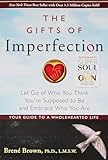
Editors Reads Verdict
The book that preceded Daring Greatly and established Brown's framework for wholehearted living — shorter, more personal, and more directly organized as a practical guide, it rewards readers who want the framework in its most accessible form.
What We Loved
- The ten guideposts structure gives the book immediate practical organization
- Shorter than Daring Greatly — easier to complete and return to
- The Guidepost format makes the book ideal for journaling and reflection
- Brown's warm, personal voice makes the research feel like conversation
Minor Drawbacks
- Less research-heavy than Daring Greatly — readers who want the academic underpinning should go there
- Some guideposts are more developed than others
- The vocabulary of 'wholehearted living' feels more idealized than practical for some readers
Key Takeaways
- → Authenticity is not a state to achieve but a daily practice of choosing truth over performance
- → Perfectionism is not about high standards — it is about avoiding judgment and shame
- → Gratitude and joy are not natural states but practices that require cultivation
- → Rest and play are not indulgences — they are necessary for wholehearted living
- → Letting go of comparison is one of the most liberating and most difficult practices
| Author | Brené Brown |
|---|---|
| Publisher | Hazelden Publishing |
| Pages | 160 |
| Published | August 27, 2010 |
| Language | English |
| Genre | Self-Help, Psychology, Personal Development |
| Difficulty | Beginner |
| Best For | Readers who want a practical, accessible framework for releasing perfectionism and cultivating more authentic, joyful living. |
How The Gifts of Imperfection Compares
The Gifts of Imperfection at a glance against 3 similar books readers weigh alongside it.
| Book | Author | Rating | Best for |
|---|---|---|---|
| The Gifts of Imperfection (this book) | Brené Brown | ★ 4.3 | Readers who want a practical, accessible framework for releasing perfectionism |
| Daring Greatly | Brené Brown | ★ 4.3 | Readers interested in the psychology of shame and vulnerability, particularly |
| Man's Search for Meaning | Viktor E. Frankl | ★ 4.8 | Anyone confronting meaninglessness, loss, suffering, or existential questions |
| The Untethered Soul | Michael A. Singer | ★ 4.5 | Readers seeking a practical spiritual framework for working with their own mind |
The Foundation Before the Breakthrough
The Gifts of Imperfection was published in 2010, two years before Daring Greatly, and represents Brown’s first major popular synthesis of her shame and vulnerability research. Where Daring Greatly builds a comprehensive framework, The Gifts of Imperfection is more intimate — organized around ten specific guideposts for what Brown calls “wholehearted living.”
The term might sound aspirational to the point of vagueness, but Brown’s specific definition is practical: wholehearted living is life engaged from a place of worthiness rather than from a place of perpetually trying to earn worthiness. The distinction matters enormously in practice. People who believe they are already worthy of love and belonging behave differently from people who believe they must prove it.
The Ten Guideposts
The book’s organizing structure — ten guideposts that cultivate wholehearted living and ten corresponding things to let go of — gives it a practical focus that makes it easier to implement than more comprehensive frameworks. Each guidepost pairs a positive practice (cultivating authenticity, cultivating gratitude, cultivating meaningful work) with the thing that most commonly obstructs it (letting go of what people think, letting go of scarcity and fear, letting go of self-doubt).
Perfectionism vs. High Standards
Brown’s distinction between perfectionism and high standards is one of the book’s most practically useful contributions. Perfectionism is not the same as wanting to do well — it is the belief that if you achieve perfection, you will be safe from judgment, criticism, and shame. It is a defensive posture rather than a productive one, and it consistently interferes with the risk-taking that genuine achievement requires.
This distinction resonates powerfully with readers who have always described themselves as “perfectionists” in job interviews as if it were a virtue rather than recognizing it as a strategy for avoiding vulnerability.
The Complement to Daring Greatly
Readers often report reading The Gifts of Imperfection after Daring Greatly, finding the earlier book’s shorter, more practically organized format useful as a companion to the later book’s more comprehensive argument. Together they constitute Brown’s most complete articulation of her core framework.
Our rating: 4.3/5 — The most accessible and practically organized of Brown’s books, ideal for readers who want the wholehearted living framework in its most implementable form.
Cultivating and Letting Go
The structural elegance of The Gifts of Imperfection lies in its pairing: each of the ten guideposts couples something to cultivate with something to release, so that the practice is never purely additive. To cultivate authenticity, one lets go of what other people think; to cultivate self-compassion, one releases perfectionism; to cultivate a resilient spirit, one lets go of numbing and powerlessness; to cultivate calm and stillness, one releases anxiety as a lifestyle; to cultivate meaningful work, one lets go of self-doubt and the “supposed to.” This double movement reflects Brown’s underlying conviction that wholehearted living is not a matter of acquiring more virtues but of removing the defences that block the worthiness already present. The guideposts that readers most often single out — cultivating play and rest against a culture of exhaustion-as-status, and cultivating creativity against the lie that one is “not the creative type” — are notable for treating apparently soft practices as structural requirements of a sustainable life rather than indulgences.
Why the Shorter Book Endures
Published two years before Daring Greatly and running to a fraction of its length, The Gifts of Imperfection has remained in print and in heavy recommendation circulation partly because of its scale. It is short enough to be read in an evening and structured clearly enough to be used as a workbook, returned to one guidepost at a time. Brown’s voice here is at its most personal and least systematised — she is working out the framework rather than defending it — which some readers find warmer and more inviting than the more argued later books. The risk of the format is that the language of “wholehearted living” can tip toward the aspirational and abstract, and that the lighter research apparatus leaves certain claims resting on Brown’s authority rather than on visible evidence. For most readers, though, the trade is worth it: the book functions as the most direct on-ramp to Brown’s entire body of work, and as a self-contained practice for anyone whose central obstacle is the conviction that they must earn the right to belong.
Perfectionism as Self-Protection
The single idea readers most often carry away from The Gifts of Imperfection is Brown’s reframing of perfectionism. In ordinary usage the word is almost a humble-brag, the flaw one volunteers in a job interview because it sounds like a virtue. Brown dismantles this. Perfectionism, in her account, has nothing to do with striving for excellence; it is a defensive strategy, the belief that if one can only do everything flawlessly, one will be shielded from judgement, blame, and shame. Because that shield is impossible to maintain, perfectionism reliably produces the opposite of what it promises — paralysis, procrastination, and the avoidance of exactly the risks that meaningful work and connection require. Separating the healthy pursuit of high standards from the self-protective armour of perfectionism is one of the book’s most practically liberating moves, and it is characteristic of Brown’s method: take a familiar word, show that it conceals a defence against vulnerability, and offer a more honest practice in its place.
Reading Guides
Frequently Asked Questions
What is "The Gifts of Imperfection" about?
Brené Brown's guide to wholehearted living — letting go of who we think we should be and embracing who we actually are, with ten guideposts for cultivating authenticity, gratitude, and joy.
Who should read "The Gifts of Imperfection"?
Readers who want a practical, accessible framework for releasing perfectionism and cultivating more authentic, joyful living.
What are the key takeaways from "The Gifts of Imperfection"?
Authenticity is not a state to achieve but a daily practice of choosing truth over performance Perfectionism is not about high standards — it is about avoiding judgment and shame Gratitude and joy are not natural states but practices that require cultivation Rest and play are not indulgences — they are necessary for wholehearted living Letting go of comparison is one of the most liberating and most difficult practices
Is "The Gifts of Imperfection" worth reading?
The book that preceded Daring Greatly and established Brown's framework for wholehearted living — shorter, more personal, and more directly organized as a practical guide, it rewards readers who want the framework in its most accessible form.
Ready to Read The Gifts of Imperfection?
Check the current price on Amazon.
Check Price on Amazon (paid link)Prices and availability are subject to change. See Amazon for current price.
Review last updated: