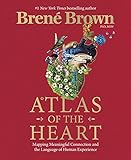
Editors Reads Verdict
Atlas of the Heart is Brown's most structurally ambitious book — a genuine reference work that catalogs the nuances between emotions we often flatten into a single word. The research is robust, the writing is warm, and the practical implications for communication and connection are significant for anyone who's ever said 'fine' when they meant something far more specific.
What We Loved
- The emotional vocabulary it provides is genuinely useful in daily life and relationships
- Brown's research is careful and the distinctions she draws between similar emotions are illuminating
- The writing is characteristically warm and accessible without being superficial
- The visual design of the book enhances its function as a reference rather than a cover-to-cover read
Minor Drawbacks
- Some readers will find the sheer number of emotions overwhelming rather than clarifying
- The format works better as a reference than as a linear reading experience
- Readers already familiar with Brown's prior work will find significant conceptual overlap
Key Takeaways
- → Naming emotions precisely is not weakness — it is the foundation of self-awareness and connection
- → The difference between shame and guilt, envy and jealousy, or grief and sadness matters enormously
- → Most people operate with a vocabulary of three to five emotions when dozens are available
- → Emotional granularity — the ability to distinguish subtle feelings — correlates with resilience
- → Language shapes experience: learning new emotion words changes what you feel and how you respond
| Author | Brené Brown |
|---|---|
| Publisher | Random House |
| Pages | 336 |
| Published | November 30, 2021 |
| Language | English |
| Genre | Psychology, Self-Help, Nonfiction |
| Difficulty | Beginner |
| Best For | Anyone seeking to deepen their emotional vocabulary, improve communication in relationships, or understand the research behind emotional experience. |
How Atlas of the Heart Compares
Atlas of the Heart at a glance against 3 similar books readers weigh alongside it.
| Book | Author | Rating | Best for |
|---|---|---|---|
| Atlas of the Heart (this book) | Brené Brown | ★ 4.4 | Anyone seeking to deepen their emotional vocabulary, improve communication in |
| Emotional Agility | Susan David | ★ 4.3 | Anyone who struggles with difficult emotions, tends to suppress or ruminate, or |
| Maybe You Should Talk to Someone | Lori Gottlieb | ★ 4.6 | Anyone curious about how therapy actually works, considering starting therapy, |
| Set Boundaries, Find Peace | Nedra Glover Tawwab | ★ 4.5 | Anyone who struggles to say no, feels chronically overwhelmed by others' needs, |
Mapping the Interior
Brené Brown has spent decades studying vulnerability, shame, and courage. In Atlas of the Heart, she turns that research toward a more foundational question: do we have the words for what we actually feel? Her answer, backed by twenty years of data, is mostly no — and the consequences of that deficit are significant.
The book catalogs 87 emotions and experiences, from the familiar (joy, sadness, anger) to the precise (foreboding joy, bittersweetness, schadenfreude). For each, Brown offers a research-backed definition, distinguishes it from neighboring emotions, and explains why the distinction matters. It is part glossary, part psychology text, and part invitation to take your inner life more seriously.
Why Vocabulary Matters
The core argument is both simple and counterintuitive: most people move through their emotional lives with a vocabulary of perhaps three to five words (happy, sad, angry, anxious, fine), when the actual landscape is far richer. This matters because emotional granularity — the ability to make fine-grained distinctions between what you’re feeling — is strongly associated with better mental health, more effective coping strategies, and more productive communication.
Brown makes the case vividly: the difference between shame (I am bad) and guilt (I did something bad) is not semantic. People who can identify shame are far more likely to take constructive action. People stuck in undifferentiated shame tend toward self-destruction. The precision of language changes the experience itself.
The Book as Reference Work
Atlas of the Heart works differently from Brown’s prior books. Daring Greatly or Braving the Wilderness are cover-to-cover arguments. This one is structured more like a field guide — best used when you encounter an emotion you can’t quite name, when a conversation goes sideways in ways you can’t explain, or when you want to help a child articulate what they’re feeling. The visual design reinforces this: the book is beautiful and laid out to facilitate dipping in rather than linear reading.
That design choice does mean the book is slower to read straight through, and some readers will find the sheer volume of entries — 87 is a lot of territory — difficult to absorb. The structure invites returning to the book rather than reading it once and putting it down.
Brown at Her Best
Atlas of the Heart represents Brown doing what she does most distinctively: taking research that lives in academic journals and translating it into language that is accessible, warm, and practically useful. The distinctions she draws are real, not invented. The examples are well-chosen. And the underlying argument — that emotional literacy is a skill that can be learned and that changes lives — is both true and underrepresented in popular culture.
Our rating: 4.4/5 — An essential reference for anyone serious about understanding the full range of human experience, and one of Brown’s most practically useful books.
The Eighty-Seven and the Logic of Grouping
Rather than presenting its eighty-seven emotions and experiences as a flat list, Atlas of the Heart organises them into thirteen clusters defined by the situations that provoke them — the feelings that arrive when things are uncertain or too much, when we compare ourselves to others, when we are hurt, when things don’t go as planned, when we search for connection. This situational architecture is one of the book’s quieter contributions: it implies that emotions are best understood not as free-floating internal weather but as responses to recognisable circumstances, which is part of why naming them accurately is possible at all. Within each cluster Brown does her most characteristic work, drawing distinctions that ordinary usage collapses — stress from overwhelm, envy from jealousy, the specific tightness of “foreboding joy” (the dress rehearsal for tragedy that interrupts a happy moment) from anxiety in general, and the bittersweet from simple nostalgia.
Granularity as a Practice, Not a Trick
The research concept doing the heaviest lifting beneath the book is emotional granularity — the documented finding that people who can describe their feelings in finer-grained terms tend to regulate them more effectively, recover from distress more quickly, and communicate their needs more precisely. Brown’s wager is that vocabulary is trainable and that the training has real consequences: that learning the word for what you feel changes, slightly, what you can do about it. The book’s format honours this argument by inviting return rather than completion — it is built to be opened at the moment of need, when a conversation has gone wrong in a way you cannot name or a child is flooded by a feeling they have no word for. The cost of that design is that read straight through it can feel less like an argument than an inventory, and readers steeped in Brown’s earlier work will meet familiar material on shame, vulnerability, and connection along the way. As a reference for the inner life, however, it is unusually practical, and its central claim — that language does not merely label experience but shapes it — is both well supported and quietly radical.
How to Actually Use It
Because Atlas of the Heart is a reference rather than an argument, it rewards a different kind of reading than Brown’s other books. Read straight through, the procession of eighty-seven entries can blur, and the conceptual overlap with her earlier work on shame and vulnerability becomes more visible. Used as designed — opened at the moment of need — it becomes something more valuable: a tool for the instant when you cannot name what you feel, when a conversation has curdled in a way you cannot articulate, or when someone you love is overwhelmed and you want to help them find the word. The companion HBO Max series extended this function to a wider audience, but the book remains the fuller resource, with the research citations and the careful distinctions intact. For readers willing to treat it as a field guide to the inner life rather than a book to be finished, it is among the most practically useful things Brown has produced, and its governing claim — that more precise language yields more precise, and more manageable, emotional experience — is both well evidenced and genuinely useful in daily life.
Reading Guides
Frequently Asked Questions
What is "Atlas of the Heart" about?
Brené Brown maps 87 human emotions and experiences, providing a language for the full complexity of what we feel and why naming emotions accurately changes our lives.
Who should read "Atlas of the Heart"?
Anyone seeking to deepen their emotional vocabulary, improve communication in relationships, or understand the research behind emotional experience.
What are the key takeaways from "Atlas of the Heart"?
Naming emotions precisely is not weakness — it is the foundation of self-awareness and connection The difference between shame and guilt, envy and jealousy, or grief and sadness matters enormously Most people operate with a vocabulary of three to five emotions when dozens are available Emotional granularity — the ability to distinguish subtle feelings — correlates with resilience Language shapes experience: learning new emotion words changes what you feel and how you respond
Is "Atlas of the Heart" worth reading?
Atlas of the Heart is Brown's most structurally ambitious book — a genuine reference work that catalogs the nuances between emotions we often flatten into a single word. The research is robust, the writing is warm, and the practical implications for communication and connection are significant for anyone who's ever said 'fine' when they meant something far more specific.
Ready to Read Atlas of the Heart?
Check the current price on Amazon.
Check Price on Amazon (paid link)Prices and availability are subject to change. See Amazon for current price.
Review last updated: