Editors Reads Verdict
The Obelisk Gate deepens the Broken Earth trilogy's world-building while escalating both its emotional stakes and its political analysis. Jemisin expands the narrative to include her daughter's perspective, and the two parallel storylines develop a tension — between knowledge and ignorance, between despair and hope — that the trilogy's final volume must resolve.
What We Loved
- The expansion of Nassun's perspective adds emotional complexity and structural balance
- The obelisk network is among the most original and well-integrated magic systems in contemporary fantasy
- Jemisin's worldbuilding continues to deepen without losing narrative momentum
- The novel's treatment of parental love under impossible conditions is genuinely moving
Minor Drawbacks
- As a middle volume, the novel resists standalone resolution — readers must have read the first book
- Some secondary characters in the comm setting are underdeveloped
- The revelations about the Stillness's history are denser than the first volume and require active engagement
Key Takeaways
- → Parental love and parental damage are not opposites — they can coexist in the same relationship
- → Power without understanding is as dangerous as oppression — knowledge of what we wield matters
- → Survival communities reproduce the hierarchies they escaped unless they actively resist doing so
- → The mechanisms of historical injustice run deeper than any individual's ability to opt out
| Author | N.K. Jemisin |
|---|---|
| Publisher | Orbit |
| Pages | 433 |
| Published | August 16, 2016 |
| Language | English |
| Genre | Fantasy, Science Fantasy, Fiction |
| Difficulty | Intermediate |
| Best For | Readers who have completed The Fifth Season and want to continue one of fantasy's most acclaimed trilogies; those interested in how sequels deepen rather than dilute their predecessors. |
How The Obelisk Gate Compares
The Obelisk Gate at a glance against 3 similar books readers weigh alongside it.
| Book | Author | Rating | Best for |
|---|---|---|---|
| The Obelisk Gate (this book) | N.K. Jemisin | ★ 4.4 | Readers who have completed The Fifth Season and want to continue one of |
| Parable of the Sower | Octavia Butler | ★ 4.4 | Science fiction readers interested in climate fiction and societal collapse, |
| The Fifth Season | N.K. Jemisin | ★ 4.4 | Fantasy readers seeking formally innovative work |
| The Left Hand of Darkness | Ursula K. Le Guin | ★ 4.4 | Science fiction readers interested in Le Guin's literary science fiction and |
Two Women, Two Trajectories
The Obelisk Gate picks up where The Fifth Season ended — the world in the grip of an extinction-level Fifth Season, triggered deliberately by the rogue orogene Alabaster at the novel’s opening. Essun has found refuge in the underground comm of Castrima, a geode community powered by obelisk energy, and is learning from a dying Alabaster how to access and control the network of floating crystals that encircle the globe.
Meanwhile, her daughter Nassun — whose existence the first novel told us about but whose perspective it withheld — has her own narrative. She has been taken by her father to the settlement of Found Moon, where a Guardian named Schaffa, broken and changed by the events of the first book, is working with a group of child orogenes. Nassun, who watched her father kill her brother and who has reason to distrust the adults who claim to protect her, is developing power that exceeds Essun’s — and a set of conclusions about the world that diverge sharply from her mother’s.
The Obelisk Network
The first novel introduced the obelisks as background phenomena — enormous crystals of unknown origin floating above the Stillness, apparently inert, occasionally dangerous. The Obelisk Gate reveals that they are a network, that they were built for a specific purpose, and that Alabaster’s deliberate triggering of the Fifth Season was itself an attempt to activate that purpose. The magic system of orogeny — the geological power that defines the trilogy’s oppressed class — turns out to be connected to a technology so old that its origins have been completely forgotten.
Jemisin’s integration of the obelisk revelation into the political structure of the world is characteristic of her method: the technology and the oppression are not separate elements but aspects of a single system. The orogenes were enslaved not merely because they were feared but because they were needed for something their enslavers did not fully understand.
Mother and Daughter, Converging
The structural achievement of The Obelisk Gate is its development of Nassun as a character whose perspective is internally coherent and emotionally sympathetic even as it moves toward conclusions that readers — and Essun — will find devastating. Nassun loves her mother and has been formed by that love; she also knows things about what her mother did, and carries wounds that Essun does not know exist. Their convergence in The Stone Sky is the trilogy’s emotional endpoint, and Jemisin earns it by giving each of them a fully realized interiority in this middle volume.
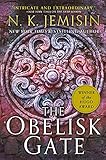
The novel won the Hugo Award for Best Novel in 2017, making Jemisin the first author to win consecutive Hugos — a record she would extend with the trilogy’s conclusion.
An Unprecedented Achievement
It is impossible to discuss The Obelisk Gate without noting its place in genre history. N.K. Jemisin’s Broken Earth trilogy won the Hugo Award for Best Novel three years running — The Fifth Season in 2016, The Obelisk Gate in 2017, and The Stone Sky in 2018 — making Jemisin the first author ever to win the Hugo for every volume of a trilogy, and the first Black author to win the award at all. That recognition reflected something genuinely new: a secondary-world fantasy that used its invented apocalypse and its enslaved orogene class as a searching allegory for systemic oppression, environmental catastrophe, and the rage of the dispossessed, written with literary control rarely seen in epic fantasy. The Obelisk Gate sustains that ambition through the notoriously difficult middle stretch of a trilogy, deepening rather than merely prolonging the story.
How to Read the Trilogy
A crucial caveat for new readers: The Obelisk Gate is emphatically not a starting point. It opens essentially mid-scene, assuming full knowledge of The Fifth Season and its central revelations — including the structural trick of that first novel that gives the trilogy its emotional foundation. Readers must begin with The Fifth Season, and ideally read straight through to The Stone Sky, since the three books function as a single continuous narrative rather than discrete installments. Approached that way, The Obelisk Gate is a powerful bridge: it widens the mystery of the obelisks and the planet’s ancient history while drawing the mother-daughter relationship between Essun and Nassun toward its devastating convergence. For readers who were gripped by The Fifth Season and want the trilogy’s stakes and world to expand without any loss of emotional or political precision, it delivers completely — and it confirms the Broken Earth as one of the defining works of twenty-first-century fantasy.
One of the quieter pleasures of The Obelisk Gate is how Jemisin uses it to recalibrate the trilogy’s emotional center. The Fifth Season was, structurally, a feat of misdirection; this middle volume settles into a steadier, more intimate mode, alternating between Essun’s reluctant apprenticeship in a hidden underground community and her daughter Nassun’s parallel education far away. By giving Nassun her own sustained point of view, Jemisin transforms what could have been a simple quest for reunion into a genuine tragedy of misunderstanding, in which mother and daughter are being shaped toward irreconcilable conclusions about a broken world. It is a bold choice for a middle book — to invest so heavily in a character whose worldview will ultimately collide with the protagonist’s — and it pays off completely in The Stone Sky. For readers who appreciate fantasy that takes character and theme as seriously as worldbuilding, The Obelisk Gate is a model of how to deepen a series rather than merely extend it.
Our rating: 4.4/5 — A masterful middle volume that expands the Broken Earth trilogy’s world and stakes without losing the emotional and political precision that made the first book extraordinary.
Frequently Asked Questions
What is "The Obelisk Gate" about?
Essun searches for her daughter while learning to control the obelisks — floating crystals that could either save or destroy the world — in the second Hugo Award-winning volume of the Broken Earth trilogy.
Who should read "The Obelisk Gate"?
Readers who have completed The Fifth Season and want to continue one of fantasy's most acclaimed trilogies; those interested in how sequels deepen rather than dilute their predecessors.
What are the key takeaways from "The Obelisk Gate"?
Parental love and parental damage are not opposites — they can coexist in the same relationship Power without understanding is as dangerous as oppression — knowledge of what we wield matters Survival communities reproduce the hierarchies they escaped unless they actively resist doing so The mechanisms of historical injustice run deeper than any individual's ability to opt out
Is "The Obelisk Gate" worth reading?
The Obelisk Gate deepens the Broken Earth trilogy's world-building while escalating both its emotional stakes and its political analysis. Jemisin expands the narrative to include her daughter's perspective, and the two parallel storylines develop a tension — between knowledge and ignorance, between despair and hope — that the trilogy's final volume must resolve.
Ready to Read The Obelisk Gate?
Check the current price on Amazon.
Check Price on Amazon (paid link)Prices and availability are subject to change. See Amazon for current price.
Review last updated: