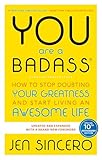
Editors Reads Verdict
Sincero's informal, irreverent voice makes this one of the most readable self-help books available, and her core message about self-limiting beliefs is genuinely useful. The spirituality is light and the practicality is considerable.
What We Loved
- Sincero's voice is consistently entertaining and genuinely funny
- Short chapters make it digestible in small increments
- The practical exercises are actionable rather than abstract
- Resonates particularly with readers who have found other self-help too earnest
Minor Drawbacks
- Some universal prescriptions may not apply to readers in genuinely constrained circumstances
- The spiritual elements are vague — not rigorous enough for believers or skeptics
- Some advice is more cheerleading than coaching
Key Takeaways
- → Self-limiting beliefs are learned, not innate — they can be unlearned
- → Comfort zones are where dreams go to die
- → Most people are far more capable than their current behavior suggests
- → Taking imperfect action beats waiting for perfect conditions indefinitely
- → Your story about why you cannot do something is usually more fictional than factual
| Author | Jen Sincero |
|---|---|
| Publisher | Running Press |
| Pages | 256 |
| Published | April 23, 2013 |
| Language | English |
| Genre | Self-Help, Personal Development |
| Difficulty | Beginner |
| Best For | Self-help readers who want practical encouragement without heavy psychology or spirituality. |
How You Are a Badass Compares
You Are a Badass at a glance against 3 similar books readers weigh alongside it.
| Book | Author | Rating | Best for |
|---|---|---|---|
| You Are a Badass (this book) | Jen Sincero | ★ 4.1 | Self-help readers who want practical encouragement without heavy psychology or |
| Daring Greatly | Brené Brown | ★ 4.3 | Readers interested in the psychology of shame and vulnerability, particularly |
| The Subtle Art of Not Giving a F*ck | Mark Manson | ★ 4.4 | Anyone exhausted by relentless optimism culture who wants a blunter, more |
| Untamed | Glennon Doyle | ★ 4.3 | Women questioning the expectations imposed on them by family, religion, or |
The Self-Help Book That Swears
“You Are a Badass” works for one simple reason: Jen Sincero is talking to you like a smart, blunt friend rather than a therapist or a guru. She curses. She makes fun of herself. She is specific about her own years of mediocrity before she figured out how to change. The informality is the delivery mechanism for a message that is, underneath the irreverence, genuine and practically useful.
Self-Limiting Beliefs
The book’s core argument is about the stories we tell ourselves about what we are capable of. These stories — I’m not smart enough, not talented enough, not lucky enough, not the kind of person who does X — were written by other people and absorbed before we were old enough to evaluate them. They feel like facts. They are not facts. They are beliefs, and beliefs can be examined, challenged, and replaced. The bulk of the book is about how to do this work.
The Exercises
Sincero provides concrete exercises throughout — journaling prompts, affirmations, specific action challenges — that are more practically oriented than the vague “change your mindset” advice that characterizes weaker self-help books. The exercises are calibrated to produce small wins that build momentum, which is consistent with what the behavioral psychology literature actually says about habit formation.
The Big Snooze and the Subconscious Blueprint
A useful organising idea in the book is Sincero’s claim that much of our lives runs on a subconscious “blueprint” assembled in childhood, long before we could evaluate the information going in. We absorb our parents’ anxieties about money, our culture’s verdicts about who we are allowed to become, and a thousand offhand messages that calcify into “facts” about our limits. Sincero personifies the part of us that clings to this safe, small self as the “Big Snooze” — the inner voice of fear and habit that keeps us comfortable and stuck. The work of the book is to drag these inherited stories into the light, recognise them as choices rather than truths, and consciously replace them. She layers practical tools onto this — gratitude practice, a light form of meditation, and above all a bias toward action, captured in her insistence that you should “jump, and the net will appear” rather than wait for fear to disappear first. The short, punchy chapters are built to be read in small bursts and to send you off the page and into a concrete next step, which is part of why the book feels less like reading and more like being coached.
The Spiritual Element
Sincero includes a spiritual dimension — a “Source Energy” or universal force that responds to alignment and intention — that occupies the middle ground between Rhonda Byrne’s Law of Attraction and secular positive psychology. It is unlikely to satisfy committed atheists or committed believers, but it works as a framework for readers who want something beyond pure self-reliance without committing to a specific tradition. Sincero extends this to money in particular, urging readers to stop “vilifying” wealth and instead see it as an energy exchange — a theme she later expanded into the follow-up You Are a Badass at Making Money.
The Backstory and the Phenomenon
Part of the book’s appeal is that Sincero is not writing from a mountaintop. Her central anecdote is that she was a broke, directionless freelance writer in her forties, living in a converted garage, before she applied the principles she preaches and turned her life around. That lived, self-deprecating credibility is the engine of the whole book, and it clearly resonated: You Are a Badass became a number-one New York Times bestseller, spent more than four years on the list, and has sold well over three million copies — numbers that put it among the defining self-help titles of the 2010s.
The Criticisms Worth Taking Seriously
The book has real detractors, and their objections are worth weighing. The most substantial is that its “mindset as magic” premise — that what you think, you manifest — shades into Law of Attraction territory and risks becoming a kind of prosperity gospel, one that quietly blames people for their own misfortune. Critics point out that “think your way to success” oversimplifies the structural barriers of poverty, discrimination, and circumstance, and that the advice often assumes a baseline of middle-class security. More seriously, several reviewers have flagged the book’s treatment of mental health: its breezy “just decide to be happy” tone can misrepresent clinical depression and anxiety as mere self-pity, which can be alienating or even harmful to readers facing genuine illness. And some find little here that is original, noting that Sincero synthesises ideas long circulating in the self-help and New Thought traditions rather than adding new ones.
Verdict
You Are a Badass is best understood for what it is: a high-energy pep talk rather than a rigorous program. Taken in that spirit — as a funny, motivating kick toward examining the self-limiting stories you tell yourself and taking imperfect action anyway — it genuinely helps a lot of readers, and its core message about challenging inherited beliefs is sound. Taken as a literal blueprint for guaranteed success through positive thinking, it overpromises and underdelivers, and it is poorly suited to anyone navigating serious mental-health or material constraints. Read it for the encouragement, keep your skepticism about the metaphysics, and pair it with more substantive work.
Our rating: 4.1/5 — One of the most readable and genuinely entertaining self-help books available, with practical substance behind the breezy voice — best enjoyed as a pep talk, not a manifesto.
Frequently Asked Questions
What is "You Are a Badass" about?
Self-made success coach Jen Sincero delivers a no-nonsense, profanity-laced guide to identifying the self-limiting beliefs that keep you broke, bored, and unhappy, and replacing them with confidence and action.
Who should read "You Are a Badass"?
Self-help readers who want practical encouragement without heavy psychology or spirituality.
What are the key takeaways from "You Are a Badass"?
Self-limiting beliefs are learned, not innate — they can be unlearned Comfort zones are where dreams go to die Most people are far more capable than their current behavior suggests Taking imperfect action beats waiting for perfect conditions indefinitely Your story about why you cannot do something is usually more fictional than factual
Is "You Are a Badass" worth reading?
Sincero's informal, irreverent voice makes this one of the most readable self-help books available, and her core message about self-limiting beliefs is genuinely useful. The spirituality is light and the practicality is considerable.
Ready to Read You Are a Badass?
Check the current price on Amazon.
Check Price on Amazon (paid link)Prices and availability are subject to change. See Amazon for current price.
Review last updated: