Carl Sagan was an American astronomer, science communicator, and author whose work made the cosmos accessible and compelling to millions of readers and viewers worldwide.
Carl Sagan spent his career at Cornell as an astronomer and planetary scientist while simultaneously becoming the most effective popular science communicator of the twentieth century. His television series Cosmos reached hundreds of millions of viewers worldwide and his books sold in the tens of millions. He was not merely a popularizer; he was a working scientist who contributed meaningfully to research on planetary atmospheres, the search for extraterrestrial intelligence, and the nuclear winter hypothesis.
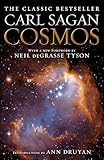
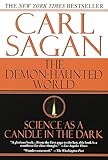
Cosmos, the book companion to the series, is his most beloved work: a sweeping account of the universe’s history and humanity’s place within it, written with a combination of scientific rigor, genuine wonder, and a persistent moral argument about the value of rational inquiry. The Pale Blue Dot photograph — Earth as a mote of dust in a sunbeam — and Sagan’s accompanying meditation on human humility and responsibility remain among the most affecting passages in science writing. The Demon-Haunted World, published near the end of his life, is his sustained defense of scientific thinking and skepticism against pseudoscience and irrationalism — a book that reads, in retrospect, as a kind of warning.
Sagan’s writing can occasionally tip into the lyrical to a degree that some readers find overwrought. His optimism about human potential was sometimes at odds with his pessimism about human behavior, and that tension is not always fully resolved. But his essential gifts — the ability to convey scale, time, and complexity without losing the reader, and to make scientific thinking seem not just useful but beautiful — are unmatched in the history of popular science writing.
The Scientist Behind the Communicator
It is easy, given the scale of his fame, to forget that Sagan was a serious working scientist whose research credentials underpinned his authority as a public figure. He made early and influential contributions to planetary science, including the recognition that the surface of Venus is extraordinarily hot owing to a runaway greenhouse effect, work that carried obvious and prescient implications for understanding climate on Earth. He studied the atmospheres and surfaces of the planets, the chemistry that might give rise to life, and the seasonal changes on Mars. He played a central role in NASA’s robotic exploration of the solar system, from the Mariner and Viking missions to the Voyager probes, and he conceived the famous golden records carried aboard the Voyagers — phonograph discs encoding sounds and images of Earth, intended as a message to any intelligent life that might one day intercept them. He was also a founder of the modern search for extraterrestrial intelligence, lending scientific respectability to the question of whether we are alone, and a leading voice in the research on nuclear winter that warned of the catastrophic climatic consequences of nuclear war. This grounding in real research is what separated him from mere popularizers.
A Crusader for Reason and Skepticism
As his career advanced, Sagan increasingly took up the cause of scientific literacy and rational thinking as a public good, and nowhere is this clearer than in The Demon-Haunted World: Science as a Candle in the Dark (1995). The book is at once a celebration of the scientific method and a warning against the credulity, superstition, and pseudoscience he feared were gaining ground in a society increasingly dependent on technologies its citizens did not understand. Its famous “baloney detection kit” — a toolkit of skeptical habits for distinguishing sound reasoning from nonsense — has become a touchstone for science educators and critical thinkers. Sagan worried, with what now looks like considerable foresight, about a future in which scientific and technological power was concentrated in the hands of a few while the general public lost the capacity to evaluate claims, ask hard questions, or recognise when they were being deceived. His defence of skepticism was never cold; he paired it with genuine wonder, insisting that the real universe revealed by science is more astonishing than any myth, and that doubt and awe could and should coexist.
A Lasting Legacy in Science and Culture
Sagan’s influence has proven remarkably durable, both within science communication and in the wider culture. Cosmos, the television series he created and presented, remains one of the most watched science programmes ever made, and its revival decades later, hosted by the astrophysicist Neil deGrasse Tyson, testified to the enduring power of the template Sagan established. He demonstrated that a scientist could speak to a mass audience without condescension or oversimplification, and he inspired countless people to pursue careers in science and to look at the night sky with informed wonder. His novel Contact (1985), later adapted into a major film, dramatized his lifelong preoccupations: the search for extraterrestrial intelligence, the tension and possible reconciliation between science and religion, and the human longing for cosmic significance. The “Pale Blue Dot” passage — his meditation on a photograph of Earth taken by Voyager from the edge of the solar system, in which our entire world is reduced to a single pixel — has become perhaps the most quoted piece of science writing of its era, a humbling argument for humility, stewardship, and our shared responsibility for the only home we have ever known.
Where to Begin with Sagan
New readers are usually best served by Cosmos, the book that accompanies his landmark television series and captures the full sweep of his vision, from the origin of the universe to the future of humanity, written with the wonder and clarity that made him famous. Those more concerned with the defence of reason in an age of misinformation should turn to The Demon-Haunted World, his most urgent and arguably most relevant book, whose “baloney detection kit” has become an enduring tool for critical thinkers. Pale Blue Dot, the sequel to Cosmos, extends his cosmic perspective toward questions of space exploration and human destiny and contains the passage for which he is most quoted. Readers who prefer fiction can experience his preoccupations dramatized in the novel Contact. Whichever the starting point, Sagan rewards the reader with the same rare gift: the sense that understanding the real universe is not a diminishment of wonder but its deepest source.
Reading Guides