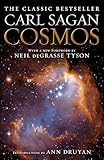
Editors Reads Verdict
Perhaps the finest work of science communication ever produced — Sagan's ability to make the cosmic personal and the personal cosmic, across thirteen chapters that span from ancient Alexandria to the search for extraterrestrial life, remains unmatched.
What We Loved
- Sagan's prose achieves a kind of secular poetry about the universe
- The breadth of coverage — astronomy, history, biology, philosophy — is staggering
- Makes the universe feel both immense and personally relevant
- The science holds up remarkably well four decades after publication
Minor Drawbacks
- Some chapters on space exploration are inevitably dated
- The Cold War context of some sections feels of its moment
- The scope can feel overwhelming in places
Key Takeaways
- → We are made of star stuff — every atom in our bodies was forged in a stellar furnace
- → The history of science is the history of human courage against the unknown
- → The universe is large enough that our significance must be earned, not assumed
- → Scientific thinking is a skill that must be taught and maintained against our natural tendencies
- → The cosmos rewards curiosity with gifts of perspective unavailable any other way
| Author | Carl Sagan |
|---|---|
| Publisher | Random House |
| Pages | 365 |
| Published | October 12, 1980 |
| Language | English |
| Genre | Science, Non-Fiction |
| Difficulty | Beginner |
| Best For | Anyone curious about the universe; science enthusiasts at any level; philosophy readers. |
How Cosmos Compares
Cosmos at a glance against 3 similar books readers weigh alongside it.
| Book | Author | Rating | Best for |
|---|---|---|---|
| Cosmos (this book) | Carl Sagan | ★ 4.7 | Anyone curious about the universe |
| A Brief History of Time | Stephen Hawking | ★ 4.5 | General readers curious about the universe, cosmology, and the nature of space |
| Astrophysics for People in a Hurry | Neil deGrasse Tyson | ★ 4.5 | Curious non-scientists who want a concise, reliable, and enjoyable introduction |
| The Demon-Haunted World | Carl Sagan | ★ 4.6 | Anyone who wants to think more clearly |
The Pale Blue Dot
Carl Sagan’s “Cosmos” began as a thirteen-episode PBS television series in 1980 and its companion book became one of the bestselling science books in history. Together, they introduced a generation to the universe — not as an abstract subject for specialists but as the context in which every human life occurs, vast beyond imagination and intimate beyond expression. Sagan’s opening sentence — “The cosmos is all that is or ever was or ever will be” — sets the register for everything that follows: immense in scope, personal in feeling.
Science and History as One Story
Sagan’s greatest structural achievement is treating the history of science as a single continuous story rather than a collection of isolated discoveries. He begins in ancient Alexandria — with the Library, with Eratosthenes measuring the Earth’s circumference with a stick and his intelligence — and traces a thread forward through Kepler, Newton, Darwin, and Einstein. The point is not to catalogue these people but to show how the courage to think differently about the universe is the one continuous thread in human intellectual history.
We Are Star Stuff
The phrase “we are star stuff” — appearing in various forms throughout the book — is Sagan’s attempt to communicate a scientific fact with the emotional weight it deserves. The carbon, nitrogen, and oxygen in our bodies were synthesized in stellar furnaces and scattered across the galaxy when those stars exploded. We are literally made of the universe. Sagan understood that this fact, properly communicated, could change how people understand their relationship to existence — not diminishing humans but expanding them.
The Search for Intelligence
The final chapters, on the search for extraterrestrial intelligence, reflect Sagan’s own research and his profound hope that we are not alone. He argues that the universe, given its scale, almost certainly contains other intelligent life — and that making contact with it would be one of the most significant events in human history. He walks readers through the Drake equation, the radio searches, and the golden records he helped send aboard the Voyager probes, framing the search not as idle speculation but as one of the noblest expressions of human curiosity. This hope is inseparable from his concern about Earth: the pale blue dot is precious partly because of its fragility.
A Television Landmark
Cosmos cannot be separated from the phenomenon that birthed it. The book was co-developed with Cosmos: A Personal Voyage, the thirteen-part 1980 PBS series Sagan wrote with Ann Druyan and Steven Soter, which became a genuine watershed in popular science. Broadcast in more than sixty countries and eventually seen by over 500 million people, it won Emmys and a Peabody and made Sagan — with his turtlenecks, his “billions and billions,” and his evident wonder — the most recognizable scientist on Earth. The book, riding the show’s popularity, spent some seventy weeks on the New York Times bestseller list and became the best-selling science book ever published at the time, single-handedly expanding the commercial space for serious science writing. Its legacy was renewed for a new generation in 2014, when Neil deGrasse Tyson and Druyan produced an acclaimed sequel series, Cosmos: A Spacetime Odyssey.
Science as a Candle
Beneath the astronomy, Cosmos is animated by a deeper argument about how to think. Sagan is forever insisting that the scientific method — the disciplined balance of open-minded wonder and rigorous skepticism — is humanity’s finest tool, and a fragile cultural achievement that must be actively defended against superstition, dogma, and our own cognitive shortcuts. He returns again and again to the ancient Library of Alexandria and the murder of the scholar Hypatia as a warning of what is lost when curiosity is crushed by intolerance. This thread — science as a candle in the dark, and the suppression of free inquiry as a recurring human tragedy — would become the explicit subject of his later, equally essential book The Demon-Haunted World. It is what lifts Cosmos above a tour of facts into a moral vision.
A Few Marks of Its Age
For all its staying power, the book inevitably carries traces of 1980. The sections on space exploration reflect the missions and ambitions of their moment, some now superseded; the looming dread of nuclear annihilation that shadows the final chapters is very much a product of the Cold War; and a handful of cosmological details have been refined by four decades of subsequent discovery. None of this meaningfully diminishes the book — the core science holds up remarkably well, and the dated passages have acquired their own historical interest. Sagan’s wonder, and his warnings about stewardship of our small world, read as more urgent now, not less.
Verdict
Cosmos remains, more than forty years on, perhaps the finest work of science communication ever produced. Sagan’s singular gift was to make the cosmic personal and the personal cosmic — to convey both the staggering scale of the universe and the intimate fact that we are made of its dust, “star stuff” contemplating the stars. Lyrical, humane, intellectually generous, and quietly profound, it is the book that has turned more people toward science, and toward awe, than almost any other. For anyone curious about the universe and their place in it, it is essential reading — and arguably the single best gateway ever written into a life of scientific wonder.
Our rating: 4.7/5 — The greatest work of science communication ever produced, a book that changes how you see the universe and your place in it.
Reading Guides
Frequently Asked Questions
What is "Cosmos" about?
Carl Sagan's companion to his landmark PBS series explores the history of science, the nature of the universe, and humanity's place in the cosmos with breathtaking scope and lyrical prose.
Who should read "Cosmos"?
Anyone curious about the universe; science enthusiasts at any level; philosophy readers.
What are the key takeaways from "Cosmos"?
We are made of star stuff — every atom in our bodies was forged in a stellar furnace The history of science is the history of human courage against the unknown The universe is large enough that our significance must be earned, not assumed Scientific thinking is a skill that must be taught and maintained against our natural tendencies The cosmos rewards curiosity with gifts of perspective unavailable any other way
Is "Cosmos" worth reading?
Perhaps the finest work of science communication ever produced — Sagan's ability to make the cosmic personal and the personal cosmic, across thirteen chapters that span from ancient Alexandria to the search for extraterrestrial life, remains unmatched.
Ready to Read Cosmos?
Check the current price on Amazon.
Check Price on Amazon (paid link)Prices and availability are subject to change. See Amazon for current price.
Review last updated: