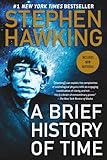
Editors Reads Verdict
The book that made theoretical cosmology accessible to millions of readers. Hawking's ability to convey the universe's strangeness without a single equation is a towering intellectual achievement.
What We Loved
- Explains profoundly complex physics without equations — a feat of scientific communication
- Covers the full arc from Big Bang to black holes with genuine intellectual depth
- Hawking's wit and humanity shine throughout
- Transformed public understanding of theoretical physics
Minor Drawbacks
- Some sections are challenging even without equations
- The cosmological chapter structure has been partially superseded by subsequent discoveries
- Updated editions don't fully incorporate post-1988 physics
Key Takeaways
- → Space and time are not fixed backgrounds but dynamic, curved geometries
- → Black holes have temperature and emit radiation (Hawking radiation)
- → The Big Bang was a beginning of time itself, not an explosion into pre-existing space
- → The universe is comprehensible through mathematics even when it defies intuition
- → Our existence is the product of extremely precise physical constants — the anthropic puzzle
| Author | Stephen Hawking |
|---|---|
| Publisher | Bantam Books |
| Pages | 212 |
| Published | April 1, 1988 |
| Language | English |
| Genre | Science, Physics, Popular Science |
| Difficulty | Intermediate |
| Best For | General readers curious about the universe, cosmology, and the nature of space and time, with no prior physics background required. |
How A Brief History of Time Compares
A Brief History of Time at a glance against 3 similar books readers weigh alongside it.
| Book | Author | Rating | Best for |
|---|---|---|---|
| A Brief History of Time (this book) | Stephen Hawking | ★ 4.5 | General readers curious about the universe, cosmology, and the nature of space |
| A Short History of Nearly Everything | Bill Bryson | ★ 4.6 | Anyone who has ever felt they missed out on science in school and wants to |
| Astrophysics for People in a Hurry | Neil deGrasse Tyson | ★ 4.5 | Curious non-scientists who want a concise, reliable, and enjoyable introduction |
| The Order of Time | Carlo Rovelli | ★ 4.4 | Curious readers who want to understand what physics actually says about the |
The Book That Opened the Cosmos
When Stephen Hawking’s literary agent told him that every equation in a popular science book would halve the sales, Hawking decided to write A Brief History of Time with only one equation: E=mc². The result was a book that spent a record 237 weeks on the British Sunday Times bestseller list and sold over ten million copies worldwide — making it, by some calculations, one of the best-selling books of the twentieth century.
The paradox is that A Brief History of Time is notoriously difficult to finish. Its concepts — the curvature of spacetime, the thermodynamics of black holes, quantum uncertainty, the beginning and possible end of the universe — are genuinely challenging even in Hawking’s lucid rendering. But the ambition is magnificent: an attempt to communicate the actual content of modern theoretical physics to anyone willing to give it their sustained attention.
Space, Time, and Curved Geometry
Einstein’s general relativity — the framework Hawking built his career on — revealed that space and time are not a fixed stage on which events occur but a dynamic, curved geometry shaped by matter and energy. Mass warps spacetime; what we experience as gravity is the curvature of spacetime around massive objects. This is counterintuitive to the point of being surreal, but Hawking renders it with examples that make the strangeness almost tangible.
Black Holes and Hawking Radiation
The book’s most significant scientific contribution — the one that has Hawking’s name permanently attached to it — is the prediction that black holes are not entirely black. Quantum effects near the event horizon should cause black holes to slowly emit radiation (now called Hawking radiation), which means they eventually evaporate. This theoretical discovery at the intersection of quantum mechanics and general relativity was among the most significant in physics in the second half of the twentieth century.
The Beginning of Time
Perhaps the most philosophically charged section concerns the Big Bang — not merely as an explosion but as the beginning of time itself. Before the Big Bang, there was no “before” in any meaningful sense: time began with the universe. This is a concept Hawking handles with characteristic precision, carefully distinguishing between philosophical and scientific questions about what preceded the beginning.
The Arrow of Time
One of the book’s most thought-provoking chapters tackles a question most of us never think to ask: why does time have a direction? Why do we remember the past but not the future, and why do broken cups never reassemble themselves? Hawking distinguishes several “arrows of time” — the thermodynamic arrow (entropy, or disorder, always increasing), the psychological arrow (the direction in which we feel time passing), and the cosmological arrow (the universe expanding) — and explores why they appear to point the same way. It is a beautiful example of his method: taking a phenomenon so familiar it seems beneath notice and revealing the deep physics that governs it.
The Quest for a Theory of Everything
Running through the whole book is the dream that has animated modern physics: a single, unified theory reconciling general relativity, which governs the very large, with quantum mechanics, which governs the very small. Hawking surveys the building blocks of matter and the four fundamental forces, and explains why a complete “theory of everything” — capable of describing the universe in one consistent framework — remains the field’s holy grail. He is candid about how far we are from grasping it, and characteristically bold in speculating about what its discovery might mean for our understanding of, in his famous closing phrase, “the mind of God.”
The Man Behind the Book
It is impossible to separate the achievement from its author. Hawking wrote A Brief History of Time while living with motor neurone disease (ALS), which had progressively paralysed him and, by the time of writing, left him able to communicate only through a speech-generating computer. That a mind so physically constrained could roam so freely across the cosmos — and could render its furthest reaches comprehensible to ordinary readers — gives the book an almost mythic dimension. His dry wit and evident delight in the universe’s strangeness humanise material that could easily have been forbidding, and turned Hawking himself into the most recognisable scientist of his age.
Criticisms and Legacy
The book is not flawless. It is, by the frank admission of many who buy it, more often purchased than finished — some passages remain genuinely demanding even stripped of equations — and the science of cosmology has moved on since 1988, with discoveries like dark energy and the accelerating expansion of the universe arriving after publication. Hawking himself later produced The Universe in a Nutshell and a Briefer History of Time to update and clarify. Yet none of this dims the original’s stature: included on Time’s list of the best nonfiction books of the past century and a sales phenomenon with more than 25 million copies sold, it permanently changed the public’s relationship with theoretical physics.
Final Verdict
A Brief History of Time remains the gold standard of popular cosmology writing — ambitious, intellectually serious, and written by the person who contributed most to the field it describes.
To read it is to accept an invitation from one of history’s great minds to contemplate the largest questions there are — where the universe came from, where it is going, and whether it will ever be fully understood — and to come away convinced that these questions belong not only to specialists but to everyone willing to think.
Our rating: 4.5/5 — One of the great achievements in scientific communication. Worth the effort, even where the going gets hard.
Reading Guides
Frequently Asked Questions
What is "A Brief History of Time" about?
Stephen Hawking's landmark exploration of cosmology, from the Big Bang to black holes, written for readers with no background in physics.
Who should read "A Brief History of Time"?
General readers curious about the universe, cosmology, and the nature of space and time, with no prior physics background required.
What are the key takeaways from "A Brief History of Time"?
Space and time are not fixed backgrounds but dynamic, curved geometries Black holes have temperature and emit radiation (Hawking radiation) The Big Bang was a beginning of time itself, not an explosion into pre-existing space The universe is comprehensible through mathematics even when it defies intuition Our existence is the product of extremely precise physical constants — the anthropic puzzle
Is "A Brief History of Time" worth reading?
The book that made theoretical cosmology accessible to millions of readers. Hawking's ability to convey the universe's strangeness without a single equation is a towering intellectual achievement.
Ready to Read A Brief History of Time?
Check the current price on Amazon.
Check Price on Amazon (paid link)Prices and availability are subject to change. See Amazon for current price.
Review last updated: