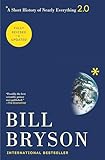
Editors Reads Verdict
The most enjoyable popular science book ever written. Bryson's talent for making complex science accessible and human makes 560 pages feel too short. A masterpiece of scientific communication.
What We Loved
- Makes the history of science as entertaining as any novel
- Covers physics, chemistry, geology, biology, and cosmology in one volume
- Bryson's focus on the scientists as people gives science a human face
- Won the Aventis Prize and the Descartes Prize — scientifically as well as literarily acclaimed
Minor Drawbacks
- Breadth comes at the cost of depth — each area gets a survey rather than thorough treatment
- Some scientific details have been updated or corrected since publication
- The book's ambition means no single topic gets the treatment it might deserve
Key Takeaways
- → The universe is immeasurably old and vast — our existence on Earth is improbably fortunate
- → Science advances through personalities, rivalries, and serendipity as much as through method
- → Life is extraordinarily resilient and improbable simultaneously
- → Most of what we know about the natural world was discovered surprisingly recently
- → The history of science is full of forgotten genius and accidental discovery
| Author | Bill Bryson |
|---|---|
| Publisher | Broadway Books |
| Pages | 560 |
| Published | September 9, 2003 |
| Language | English |
| Genre | Science, History, Popular Science |
| Difficulty | Beginner |
| Best For | Anyone who has ever felt they missed out on science in school and wants to understand the natural world from the Big Bang to the present day. |
How A Short History of Nearly Everything Compares
A Short History of Nearly Everything at a glance against 3 similar books readers weigh alongside it.
| Book | Author | Rating | Best for |
|---|---|---|---|
| A Short History of Nearly Everything (this book) | Bill Bryson | ★ 4.6 | Anyone who has ever felt they missed out on science in school and wants to |
| A Brief History of Time | Stephen Hawking | ★ 4.5 | General readers curious about the universe, cosmology, and the nature of space |
| Astrophysics for People in a Hurry | Neil deGrasse Tyson | ★ 4.5 | Curious non-scientists who want a concise, reliable, and enjoyable introduction |
| The Selfish Gene | Richard Dawkins | ★ 4.5 | Anyone with intellectual curiosity about evolution, genetics, and the nature of |
The Science Book You Actually Finish
Bill Bryson’s A Short History of Nearly Everything began as a personal quest. Bryson, a travel writer with no scientific background, read a geology textbook on a transatlantic flight and realised that he knew nothing — genuinely nothing — about the natural world he had been living in for decades. He spent three years interviewing scientists and reading extensively to produce what became the definitive popular science survey.
The result is the most readable, entertaining, and comprehensively informative science book for general audiences ever published. It won the Aventis Prize for science writing and the Descartes Prize for science communication. More importantly, it sits on the bedside table of millions of readers who have tried and given up on popular science before and found themselves unable to put this one down.
Science as Human Drama
The secret to the book’s success is Bryson’s focus on the scientists as much as the science. He wants to know not just what we know but how we came to know it — and the stories of discovery are invariably more dramatic, stranger, and funnier than any textbook account suggests.
Charles Lyell, the geologist whose work on deep time revolutionised Victorian thinking, was largely excluded from the great geological discovery of plate tectonics because he died before the evidence became conclusive. Albert Einstein submitted his dissertation to the University of Bern, which rejected it as “irrelevant and fanciful.” Alfred Wegener’s continental drift theory was ridiculed for decades before being vindicated by the very geologists who had mocked it.
The Scale of Things
Bryson has an extraordinary gift for conveying the scales at which nature operates — from the subatomic to the cosmological — in ways that illuminate rather than overwhelm. His descriptions of just how vast the universe is, just how old the Earth is, just how much life has existed and perished before us, are among the most effective in popular science writing.
The famous passage about how many individual organisms inhabit a single teaspoon of soil — more than all the humans who have ever lived — is the kind of detail that permanently changes how you look at the ground beneath your feet.
Geology, Biology, and the Precariousness of Life
The book spends considerable time on mass extinctions — the five great events that nearly ended complex life on Earth — and their implications for the stability of the conditions that make human existence possible. Bryson treats this not as doomsday material but as a profound reminder of life’s improbability and resilience.
How One Book Came to Cover Everything
The scope of A Short History of Nearly Everything is its defining feature and its defining risk. Bryson set out to write a single accessible volume covering cosmology, physics, chemistry, geology, palaeontology, and biology — the entire story of how the universe and life came to be — and the obvious objection is that no such book can do justice to any one field. Bryson’s answer is to lean into breadth as a virtue rather than apologise for it. The book is not a textbook substitute; it is a guided survey whose purpose is to restore a sense of how astonishing the ordinary facts of existence actually are, and to send curious readers onward into the specialist literature better equipped to appreciate it.
The Recency of Knowledge
One of the book’s quietly radical themes is how recently most of what we know was discovered, and how much remains genuinely uncertain. Bryson keeps returning to the fact that confident-sounding numbers — the age of the Earth, the mass of the planet, the number of species — were arrived at through improvisation, rivalry, and luck, and that many remain estimates. This is the opposite of the textbook posture of settled authority, and it is part of why the book has aged gracefully even as specific figures have been updated. Bryson was always more interested in the process of knowing than in the momentary state of knowledge, which means the corrections that time has imposed feel like extensions of his argument rather than refutations of it. That the book won both the Aventis Prize for science writing and the Descartes Prize for science communication suggests the scientific community recognised this too.
The Scientists, Not Just the Science
The reason the book reads like narrative rather than reference is Bryson’s relentless interest in the people. He wants to know not only what we know but who figured it out, and the stories of discovery turn out to be stranger, funnier, and more human than any textbook lets on — the rivalries, the missed credit, the accidents, the decades-long stretches in which a correct idea was ridiculed before being vindicated. Continental drift dismissed for a generation; the dimensions of the Earth wrestled from improbable eighteenth-century expeditions; whole fields advanced by amateurs and obsessives working at the edge of respectability. By keeping the scientists in frame as fallible, vain, lucky, and occasionally heroic individuals, Bryson gives the abstractions a human face and turns the history of knowledge into something close to comedy and tragedy combined. It is this, more than any single fact, that explains why so many readers who had given up on science finished the book and wanted more.
Final Verdict
A Short History of Nearly Everything is the ideal first port of call for anyone who wants to understand the natural world. It makes no demands on prior knowledge, takes nothing for granted, and is genuinely delightful throughout.
Our rating: 4.6/5 — The most enjoyable and broadly informative science book available. Essential reading for the curious.
Reading Guides
Frequently Asked Questions
What is "A Short History of Nearly Everything" about?
Bill Bryson's quest to understand everything that has ever happened, from the Big Bang to the rise of civilisation — written with his characteristic wit and warmth.
Who should read "A Short History of Nearly Everything"?
Anyone who has ever felt they missed out on science in school and wants to understand the natural world from the Big Bang to the present day.
What are the key takeaways from "A Short History of Nearly Everything"?
The universe is immeasurably old and vast — our existence on Earth is improbably fortunate Science advances through personalities, rivalries, and serendipity as much as through method Life is extraordinarily resilient and improbable simultaneously Most of what we know about the natural world was discovered surprisingly recently The history of science is full of forgotten genius and accidental discovery
Is "A Short History of Nearly Everything" worth reading?
The most enjoyable popular science book ever written. Bryson's talent for making complex science accessible and human makes 560 pages feel too short. A masterpiece of scientific communication.
Ready to Read A Short History of Nearly Everything?
Check the current price on Amazon.
Check Price on Amazon (paid link)Prices and availability are subject to change. See Amazon for current price.
Review last updated: