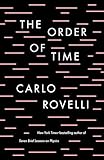
Editors Reads Verdict
Rovelli writes physics like a philosopher and poetry like a scientist. *The Order of Time* is the most intellectually and aesthetically satisfying popular physics book of recent years — a rare combination of rigour and beauty.
What We Loved
- Combines rigorous physics with literary and philosophical sensibility
- The explanation of why time appears to flow in one direction is among the clearest available
- Short, dense, and rewards slow reading — unlike most popular science
- Rovelli's wonder at the strangeness of physics is contagious
Minor Drawbacks
- Some readers find the literary sections intrusive in a physics book
- The later chapters on thermal time and quantum gravity are challenging
- The philosophical implications are more raised than resolved
Key Takeaways
- → Time does not pass at the same rate everywhere — it slows near mass and at speed
- → The direction of time (past to future) is explained by entropy increasing in one direction
- → At the quantum level of spacetime, the concept of 'now' becomes meaningless
- → The present moment is not universal — simultaneity is relative, not absolute
- → Our experience of time as flowing may be a feature of our minds rather than of physical reality
| Author | Carlo Rovelli |
|---|---|
| Publisher | Riverhead Books |
| Pages | 256 |
| Published | May 8, 2018 |
| Language | English |
| Genre | Science, Physics, Philosophy |
| Difficulty | Intermediate |
| Best For | Curious readers who want to understand what physics actually says about the nature of time, written at the intersection of science, philosophy, and literature. |
How The Order of Time Compares
The Order of Time at a glance against 3 similar books readers weigh alongside it.
| Book | Author | Rating | Best for |
|---|---|---|---|
| The Order of Time (this book) | Carlo Rovelli | ★ 4.4 | Curious readers who want to understand what physics actually says about the |
| A Brief History of Time | Stephen Hawking | ★ 4.5 | General readers curious about the universe, cosmology, and the nature of space |
| A Short History of Nearly Everything | Bill Bryson | ★ 4.6 | Anyone who has ever felt they missed out on science in school and wants to |
| Astrophysics for People in a Hurry | Neil deGrasse Tyson | ★ 4.5 | Curious non-scientists who want a concise, reliable, and enjoyable introduction |
Physics Written as Literature
Carlo Rovelli is a theoretical physicist at the University of Marseille who has also written extensively about science and philosophy. The Order of Time is his most personal and literary work — a meditation on time that moves from the physics of relativity and thermodynamics to quantum gravity to the phenomenology of human experience, with quotations from Lucretius, Aristotle, and Proust woven throughout.
The book is short but demanding. Rovelli assumes you will think carefully about what you read, not just absorb it. In exchange, he offers one of the most intellectually and aesthetically satisfying popular physics books available.
What Time Is Not
Rovelli begins by systematically dismantling our naive understanding of time. Time does not pass at the same rate everywhere — it passes more slowly near mass (the famous gravitational time dilation of general relativity) and at high velocity. The “present” — the simultaneous instant that we naively assume stretches across the universe — has no physical reality; simultaneity is relative, not absolute. The “flow” of time from past to future may be a feature of our thermodynamic position in the universe rather than a fundamental property of reality.
Each of these claims is supported by well-established physics, yet each is profoundly disorienting to common sense.
The Arrow of Time
If the fundamental equations of physics are time-symmetric — they work equally well in both temporal directions — why does time appear to flow in only one direction? Rovelli’s answer draws on thermodynamics: the second law of thermodynamics (entropy increases over time) gives time its directionality not because of anything fundamental in the laws of physics but because the past happened to start in a state of extremely low entropy.
This asymmetry in boundary conditions — the strangeness of the beginning — is what creates the experienced difference between past and future.
Time in Quantum Gravity
The book’s most challenging final section explores what happens to time in Rovelli’s own field, loop quantum gravity: a candidate theory of quantum gravity that does not include time as a fundamental variable. At the Planck scale, spacetime itself breaks down into a discrete, granular structure in which the concept of “when” becomes meaningless.
The Disappearance of “Now”
Among the book’s most vertiginous arguments is Rovelli’s dismantling of the universal present — the intuitive conviction that there exists a single “now” extending across the whole of reality, an instant we all share regardless of distance. Relativity, he explains, dissolves this entirely: because simultaneity depends on the observer’s motion and position, there is no fact of the matter about what is happening “right now” on a distant planet, only a fuzzy zone of events that are neither definitely past nor definitely future relative to us. The cosmos has no shared present moment ticking forward in unison; what we experience as the universal now is a parochial artifact of living among slow speeds and short distances. Rovelli renders this loss not as a dry technical correction but as a genuine reorientation of one’s place in reality, and it is characteristic of the book that he treats the demolition of a cherished intuition as an occasion for wonder rather than alarm. The present is local, partial, and observer-dependent — a discovery as strange as anything in fiction.
Time as a Human Perspective
Having spent the first half of the book stripping time of one feature after another — its universality, its uniform rate, its objective flow — Rovelli turns, in the book’s most moving movement, to rebuild time as a phenomenon of perspective, memory, and emotion. The directional, flowing time we experience, he argues, emerges from our particular vantage as creatures embedded in a thermodynamic gradient, equipped with memory of the past and anticipation of the future, blurring the underlying microphysics into the felt passage of moments. Far from concluding that time is therefore an illusion to be dismissed, Rovelli insists that this human time is where meaning, identity, grief, and love actually live. He weaves in Proust and his own reflections on mortality, suggesting that our emotional relationship to time — our suffering over its passing, our longing for what is gone — is not a confusion to be corrected by physics but the very substance of being a conscious self. The science and the humanism converge: time’s loss of fundamentality makes the human experience of it more precious, not less.
Lyricism as a Mode of Explanation
What sets The Order of Time apart from the crowded shelf of popular physics is that Rovelli treats prose style as integral to understanding rather than mere decoration, and the book’s brevity and beauty are deliberate pedagogical choices. He writes in short, contemplative chapters, returns repeatedly to the ancient poet Lucretius and to fragments of philosophy, and allows silence and metaphor to do work that equations alone could not. This approach has a cost: readers seeking rigorous derivation or a careful survey of competing theories will find the treatment impressionistic, and loop quantum gravity is presented as Rovelli’s own contested research program rather than settled consensus. But the gain is a book that conveys not just the content of modern physics but its felt strangeness, its capacity to move and disturb. Rovelli’s wager is that the reader who is made to feel the dissolution of time will understand it more deeply than the reader merely told about it, and for most the wager pays off. It is physics written as literature, demanding to be reread.
Final Verdict
The Order of Time is a small masterpiece. It challenges everything you think you know about the most fundamental feature of your experience, and it does so with unusual beauty.
Our rating: 4.4/5 — One of the most intellectually and aesthetically rewarding popular physics books available. Read slowly.
Frequently Asked Questions
What is "The Order of Time" about?
A theoretical physicist's meditation on the nature of time — what it is, why it flows in one direction, and what physics reveals about its deepest structure.
Who should read "The Order of Time"?
Curious readers who want to understand what physics actually says about the nature of time, written at the intersection of science, philosophy, and literature.
What are the key takeaways from "The Order of Time"?
Time does not pass at the same rate everywhere — it slows near mass and at speed The direction of time (past to future) is explained by entropy increasing in one direction At the quantum level of spacetime, the concept of 'now' becomes meaningless The present moment is not universal — simultaneity is relative, not absolute Our experience of time as flowing may be a feature of our minds rather than of physical reality
Is "The Order of Time" worth reading?
Rovelli writes physics like a philosopher and poetry like a scientist. *The Order of Time* is the most intellectually and aesthetically satisfying popular physics book of recent years — a rare combination of rigour and beauty.
Ready to Read The Order of Time?
Check the current price on Amazon.
Check Price on Amazon (paid link)Prices and availability are subject to change. See Amazon for current price.
Review last updated: