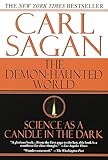
Editors Reads Verdict
Sagan's most explicitly political book is also his most urgent, a defense of scientific skepticism that has only grown more necessary in the decades since its publication. The 'baloney detection kit' chapter alone is worth the price of the book.
What We Loved
- The baloney detection kit is the best practical guide to critical thinking ever written
- Sagan manages to be both deeply skeptical and deeply compassionate
- The chapter on witch trials as a lens on modern pseudoscience is brilliant
- Prophetic — the concerns he raises in 1995 are more urgent now
Minor Drawbacks
- Some of the specific pseudosciences discussed are dated
- The tone occasionally condescends to the credulous
- At 457 pages, somewhat repetitive in the later chapters
Key Takeaways
- → A claim is only as good as the evidence supporting it
- → The same cognitive tendencies that make us creative also make us credulous
- → Democracy requires a scientifically literate citizenry — without it, demagogues win
- → Skepticism is not cynicism — it is the foundation of wonder
- → The tools of science are the best defense against those who would exploit our fears
| Author | Carl Sagan |
|---|---|
| Publisher | Ballantine Books |
| Pages | 457 |
| Published | March 7, 1995 |
| Language | English |
| Genre | Science, Philosophy |
| Difficulty | Beginner |
| Best For | Anyone who wants to think more clearly; science enthusiasts; those concerned about misinformation. |
How The Demon-Haunted World Compares
The Demon-Haunted World at a glance against 3 similar books readers weigh alongside it.
| Book | Author | Rating | Best for |
|---|---|---|---|
| The Demon-Haunted World (this book) | Carl Sagan | ★ 4.6 | Anyone who wants to think more clearly |
| Cosmos | Carl Sagan | ★ 4.7 | Anyone curious about the universe |
| Enlightenment Now | Steven Pinker | ★ 4.4 | Anyone who wants a data-based counterweight to civilisational pessimism and a |
| Thinking, Fast and Slow | Daniel Kahneman | ★ 4.6 | Investors, doctors, lawyers, managers, policymakers, and any curious person who |
The Dragon in the Garage
Sagan opens “The Demon-Haunted World” with one of his most quoted thought experiments: suppose someone tells you there is a fire-breathing dragon living in their garage. You ask to see it. The dragon is invisible. You propose spreading flour on the garage floor to catch its footprints. The dragon floats. Every test you propose, the person has an explanation for why it won’t work. What is the difference, Sagan asks, between an invisible dragon that leaves no trace and no dragon at all?
The Baloney Detection Kit
The book’s most practically useful section is the “baloney detection kit” — a list of cognitive tools for evaluating claims. Independent confirmation of facts. Encourage debate rather than suppressing it. Check for hidden assumptions. Quantify wherever possible. Check whether the simplest explanation fits the evidence. Ask whether the claim would, if true, change the world in testable ways. These tools, applied consistently, are the foundation of scientific thinking — and Sagan argues they are skills that need to be explicitly taught rather than assumed.
The Cost of Credulity
Sagan moves from the abstract to the specific in case studies that range from alien abductions to recovered memory therapy to the burning of witches in early modern Europe. His argument throughout is that the same cognitive vulnerabilities — our desire for pattern, our susceptibility to authority, our deep hunger for agency in a universe that feels indifferent — make us susceptible to charlatans in every era. The weapons against these vulnerabilities are the same in every case: evidence, testing, honest admission of uncertainty.
A Warning for the Future
Writing in 1995, Sagan ends with a chapter that has become prophetic: a description of what American democracy would look like if scientific literacy continued to decline, if entertainment replaced education, if demagogues learned to exploit the population’s distrust of experts. The specific phenomena he describes — the collapse of critical thinking, the rise of conspiracy theories, the weaponization of anti-intellectualism — read as contemporary reportage.
Science as a Candle in the Dark
The book’s subtitle — Science as a Candle in the Dark — captures its deepest argument: that science is not primarily a body of facts but a way of thinking, a method for distinguishing what is true from what we merely wish were true. Sagan, writing with his wife and longtime collaborator Ann Druyan, is at pains to present this method as humanity’s hard-won, fragile protection against the darkness of superstition and self-deception. The candle is small and easily snuffed out, he warns, and the demons of the title are not literal but the products of our own credulous minds — the comforting illusions and exploitable fears that flourish whenever the light of evidence is allowed to gutter. It is a stirring, almost devotional vision of science as a moral and civic enterprise rather than a sterile technical one.
Skepticism and Wonder, Together
What lifts the book above mere debunking is Sagan’s insistence that skepticism and wonder are not opposites but partners. He has no patience for the cynic who rejects everything, nor for the credulous who accept anything; the scientific temperament he champions holds both an openness to new ideas and a rigorous demand for evidence in a productive tension. Crucially, he is never contemptuous of the people drawn to pseudoscience — he understands the genuine human hungers (for meaning, for agency, for connection) that astrology and alien abductions and faith healing exploit, and he writes about them with real compassion. Science, in Sagan’s telling, does not diminish wonder by explaining the world; it deepens it, replacing cheap mysteries with the far grander true ones. This warmth is what makes the book persuasive rather than merely scolding, even if his tone occasionally tips toward condescension.
More Necessary Than Ever
It is hard to read The Demon-Haunted World three decades on without a chill of recognition. Sagan diagnosed, with uncanny precision, the information environment we now inhabit: a culture awash in misinformation, where conspiracy theories spread faster than corrections, where distrust of expertise is weaponized for profit and power, and where the patient work of evidence-based reasoning is drowned out by noise. His “baloney detection kit” was conceived as a defense against psychics and faith healers, but it applies with even greater force to the algorithmic firehose of the internet age. The book’s specific examples — recovered-memory therapy, alien abduction, certain debunked therapies — have inevitably dated, and at 457 pages it grows somewhat repetitive in its later stretches. But its central tools and its central warning have only gained urgency, which is precisely why it has become a touchstone for a new generation of skeptics.
The Verdict
The Demon-Haunted World is the finest popular defense of scientific thinking ever written, and Carl Sagan’s most urgent and politically charged book. Its dated examples and occasional repetitiveness are trivial against its enduring gifts: the unforgettable dragon-in-the-garage parable, the indispensable baloney detection kit, and a vision of science as a humane, wonder-preserving discipline that protects democracy itself. In an era of viral misinformation and eroding trust in evidence, it reads less like a 1995 artifact than like a field manual for the present. Everyone who wants to think clearly — which is to say everyone — should read it. It is, fittingly, the book Sagan completed near the end of his life, and it stands as his enduring gift: a candle pressed into the reader’s hand against the dark.
Our rating: 4.6/5 — The most important defense of scientific thinking ever written for a general audience, more urgently needed today than when it was published.
Reading Guides
Frequently Asked Questions
What is "The Demon-Haunted World" about?
Carl Sagan's passionate defense of scientific thinking and critical reasoning, arguing that the tools of skepticism are the only reliable protection against superstition, pseudoscience, and those who would exploit human credulity.
Who should read "The Demon-Haunted World"?
Anyone who wants to think more clearly; science enthusiasts; those concerned about misinformation.
What are the key takeaways from "The Demon-Haunted World"?
A claim is only as good as the evidence supporting it The same cognitive tendencies that make us creative also make us credulous Democracy requires a scientifically literate citizenry — without it, demagogues win Skepticism is not cynicism — it is the foundation of wonder The tools of science are the best defense against those who would exploit our fears
Is "The Demon-Haunted World" worth reading?
Sagan's most explicitly political book is also his most urgent, a defense of scientific skepticism that has only grown more necessary in the decades since its publication. The 'baloney detection kit' chapter alone is worth the price of the book.
Ready to Read The Demon-Haunted World?
Check the current price on Amazon.
Check Price on Amazon (paid link)Prices and availability are subject to change. See Amazon for current price.
Review last updated: