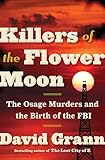
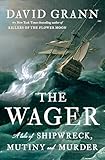
David Grann is an American staff writer at The New Yorker who crafts meticulous, propulsive narrative nonfiction — including Killers of the Flower Moon and The Wager — with the precision of a novelist.
David Grann has been a staff writer at The New Yorker since 2003 and is among the finest narrative nonfiction writers working today. His books draw from deep archival research and in-person reporting to reconstruct events that read — without distortion — with the momentum of literary thrillers. Killers of the Flower Moon, published in 2017, tells the story of the Osage Nation in 1920s Oklahoma, whose members were being systematically murdered for their oil wealth. It is an extraordinary piece of historical reconstruction — meticulous in its research, devastating in its implications, and the starting point for one of the foundational investigations of the early FBI. Martin Scorsese’s 2023 adaptation brought the story to an even wider audience.
The Lost City of Z follows Grann’s research into the disappearance of British explorer Percy Fawcett in the Amazon in 1925 and becomes as much about Grann himself — and the peculiar compulsion that drives people to follow obsessions into dangerous territory — as about Fawcett. The Wager, published in 2023, reconstructs a catastrophic eighteenth-century shipwreck and the conflicting accounts of survival that followed, and is a meditation on truth, narrative, and the power of official stories over actual events.
Grann’s weakness, if he has one, is that his narratives occasionally build expectations his resolutions cannot fully satisfy — the truth, after all, is messier than fiction. But his ability to find the right story, master its material, and convey its stakes to readers who knew nothing about the subject before picking up the book puts him in a small class of American narrative nonfiction writers.
The Method Behind the Momentum
What separates Grann from the broader field of popular historians is a working method that fuses exhaustive archival labour with old-fashioned shoe-leather reporting, and a structural discipline borrowed from the best fiction. He immerses himself in primary sources — court records, diaries, ships’ logs, FBI files, newspaper morgues — for years, then travels to the places where his stories unfolded, whether the Osage country of Oklahoma or a desolate island off Patagonia, to ground the research in physical reality. The result reads with the propulsion of a thriller while remaining scrupulously factual, every dramatic turn anchored in documented evidence rather than invention. Grann is also a master of structure, withholding and revealing information with a novelist’s sense of pacing, building suspense around questions of who did what and why even when the broad outcome is a matter of historical record. He frequently writes himself into the later stages of his books as an investigator following a cold trail, a device that lets the reader experience the unraveling of a mystery rather than simply receiving its solution. This marriage of rigour and craft is what allows him to make century-old events feel urgent and alive.
Recurring Obsessions
Across his body of work, certain preoccupations recur with the consistency of an authorial signature. Grann is drawn to obsession itself — to the explorers, detectives, and monomaniacs who pursue a fixed idea past the point of reason, and his earlier collection The Devil and Sherlock Holmes gathers magazine pieces about exactly such driven figures. He is fascinated by the gap between official narratives and buried truths, by how power constructs the stories a society agrees to believe, a theme that animates The Wager with its competing accounts of mutiny and survival and Killers of the Flower Moon with its exposure of a conspiracy that the institutions of the day preferred to ignore. He returns again and again to the costs of empire, racism, and greed, letting the human particulars carry the moral weight rather than editorializing. And he is endlessly interested in the act of investigation — the patient, often frustrating work of reconstructing what really happened — which is perhaps why his books so often double as meditations on the difficulty of ever knowing the full truth.
Influence and Standing
Grann has become one of the most commercially successful and critically admired nonfiction writers of his generation, a rare figure who satisfies both general readers and demanding critics while drawing the attention of Hollywood’s most serious filmmakers. The adaptation of Killers of the Flower Moon by Martin Scorsese, like earlier screen versions of his work, reflects how cinematic his storytelling instincts are, and how thoroughly his books have entered the cultural mainstream. His influence on contemporary narrative nonfiction is considerable; he has helped demonstrate that meticulously sourced history, told with the techniques of literature, can command a mass audience without sacrificing accuracy or depth. He stands in a lineage of New Yorker writers who treat reporting as an art form, and he has raised the bar for what readers expect from popular history and true crime alike. For anyone seeking nonfiction that informs and grips in equal measure, Grann is among the most reliable names working today, a writer whose every book is an event.
Where to Start with Grann
Newcomers have three excellent entry points, and the right one depends on taste. Readers drawn to true crime and American history should begin with Killers of the Flower Moon, his most acclaimed and devastating book, which reconstructs the Osage murders and the birth of the FBI with novelistic force. Those who prefer adventure and obsession will be gripped by The Lost City of Z, the story of a doomed Amazon explorer that doubles as a meditation on the compulsion to chase a fixed idea past all reason. Readers interested in survival, mutiny, and the contested nature of truth should pick up The Wager, his propulsive account of an eighteenth-century shipwreck and the competing stories the survivors told. His earlier collection The Devil and Sherlock Holmes gathers shorter magazine pieces and offers a fine sampler of his range. Whichever the starting point, the qualities are constant: meticulous research, relentless momentum, and stories that linger long after the final page.
Reading Guides