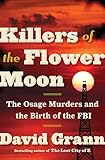
Editors Reads Verdict
Grann's masterpiece of narrative nonfiction transforms a shameful and poorly-known chapter of American history into a gripping true-crime narrative — the structural twist in the final section recontextualizes everything that came before with devastating effect.
What We Loved
- Grann's structural revelation in the final section is one of nonfiction's great coups
- The Osage Nation's perspective is centered rather than relegated to background
- Historical research is exhaustive and invisibly worn
- The moral horror of the events never becomes exploitative
Minor Drawbacks
- The early sections require patience before the full conspiracy scope becomes apparent
- Some readers find the FBI-founding subplot distracting from the Osage story
- The narrative necessarily leaves many deaths unresolved
Key Takeaways
- → Systematic crimes require systematic investigation — individual actors alone cannot explain structural evil
- → The guardianship system imposed on Native Americans was exploitation by legal design
- → The FBI's founding mythology obscures the inadequacy of the initial response to Osage murders
- → Greed operating inside intimate relationships is the most invisible form of evil
- → History deliberately erased must be actively recovered
| Author | David Grann |
|---|---|
| Publisher | Doubleday |
| Pages | 338 |
| Published | April 18, 2017 |
| Language | English |
| Genre | True Crime, History, Narrative Nonfiction |
| Difficulty | Intermediate |
| Best For | History and true crime readers, anyone interested in Native American history and the systemic nature of American racial violence, and fans of narrative nonfiction. |
How Killers of the Flower Moon Compares
Killers of the Flower Moon at a glance against 3 similar books readers weigh alongside it.
| Book | Author | Rating | Best for |
|---|---|---|---|
| Killers of the Flower Moon (this book) | David Grann | ★ 4.5 | History and true crime readers, anyone interested in Native American history |
| Hidden Figures | Margot Lee Shetterly | ★ 4.5 | Readers interested in American history, the Space Race, Black women's history, |
| The Immortal Life of Henrietta Lacks | Rebecca Skloot | ★ 4.6 | Readers interested in medical history, bioethics, race and medicine in America, |
| The Lost City of Z | David Grann | ★ 4.3 | Adventure and exploration history readers, archaeology enthusiasts, and fans of |
The Reign of Terror
In the early 1920s, the Osage Nation were the wealthiest people per capita in the world. Oil had been discovered beneath the land they had been assigned in Indian Territory — land the US government chose precisely because it appeared worthless — and the headrights to that oil made individual Osage citizens extraordinarily wealthy. Then they began to die.
The killings that David Grann documents in Killers of the Flower Moon were not random. They were systematic — part of a conspiracy to murder Osage headright holders and marry or inherit their way into their oil wealth. Grann’s genius is revealing the full scope of that conspiracy only gradually, saving the most horrifying revelation for the book’s final section.
How Deep the Conspiracy Ran
The Osage murders were known in their time — some called it the “Reign of Terror.” What was not fully known was how deep the conspiracy ran, how many white citizens of Osage County were involved, and how thoroughly the local law enforcement and justice system had been compromised by men who benefited from the killings.
J. Edgar Hoover dispatched a young Bureau of Investigation to Osage County partly to solve the case and partly to build his nascent agency’s credibility and authority. Tom White, the Texas Ranger who led the investigation, is the book’s procedural hero. But Grann is careful to note the limits of what the official investigation pursued.
The Structural Revelation
The book’s final section — in which Grann reveals that the full conspiracy was far larger than White’s investigation pursued — is one of narrative nonfiction’s great moments. The cases that were solved and prosecuted were real. But they were also, Grann demonstrates, a fraction of the total deaths, and the perpetrators who were convicted were not the entire network.
That revelation does what the best nonfiction coups do: it recontextualizes everything that came before and forces the reader to reckon with the incompleteness of official history.
A Scorsese Film’s Source Material
Martin Scorsese’s 2023 adaptation brought the Osage murders to an enormous global audience. The film is remarkable. The book remains essential — Grann’s structural choices and his centering of Osage voices produce a different moral experience than cinema can achieve.
Three Acts, Three Perspectives
The architecture of Killers of the Flower Moon is its quiet genius, and it is worth understanding how deliberately Grann built it. The book unfolds in three “chronicles”: the first centered on Mollie Burkhart, an Osage woman watching her family die one by one; the second on Tom White and the fledgling federal investigation; and the third on Grann himself, decades later, reopening the case. This structure is not merely organizational but moral. By beginning with the Osage perspective rather than the lawmen’s, Grann resists the temptation to make the story a heroic detective narrative and keeps the victims at its center. By ending with his own investigation, he implicates the reader in the work of historical recovery and reveals how much the official account left buried. The three-part movement transforms what could have been a straightforward true-crime procedural into something deeper: a meditation on whose stories get told and whose get erased.
A Crime Bigger Than Its Convictions
The most devastating turn in the book comes in its final chronicle, when Grann’s own research reveals that the conspiracy was far larger than the famous federal case ever established. The convictions secured by Tom White’s investigation — the prosecution of William Hale and his associates — accounted for only a fraction of the Osage deaths. Grann uncovers evidence of many more murders, committed by many more white citizens of Osage County, that were never investigated, never prosecuted, and in most cases never even recognized as murders. This revelation recontextualizes everything that precedes it, exposing the celebrated FBI triumph as a partial and self-serving account that allowed a vast atrocity to be remembered as a contained one. It is one of the great gut-punches in modern nonfiction, and it forces the reader to confront how thoroughly official history can launder collective guilt.
The Birth of the FBI and the Limits of Justice
Woven through the Osage tragedy is the origin story of American federal law enforcement, as J. Edgar Hoover seized on the case to build the credibility of his nascent Bureau of Investigation. Grann is clear-eyed about the irony: the investigation that helped legitimize the FBI was also an instrument that, for all its successes, fundamentally failed the Osage by treating a handful of convictions as a closed case. Tom White, the former Texas Ranger who led the field work, emerges as a genuinely admirable figure, but Grann situates his efforts within an institutional logic more interested in headlines and agency-building than in justice for an Indigenous nation. This dual focus — the founding myth of the FBI set against the unfinished reckoning it papered over — gives the book a sharp analytical edge beneath its narrative momentum, complicating any comfortable story of federal heroism.
Recovering an Erased History
What finally distinguishes Killers of the Flower Moon is its insistence on remembering what was designed to be forgotten. The systematic murder of Osage people for their oil wealth was one of the most sustained racial atrocities of the twentieth century, and it had been largely written out of American memory. Grann’s achievement is not only to reconstruct the crimes but to restore the humanity of their victims, centering Mollie Burkhart and her family rather than the perpetrators or the lawmen. Published in 2017 to enormous acclaim and adapted by Martin Scorsese into a major 2023 film, the book has done significant cultural work in returning the Osage murders to public consciousness. Grann’s structural choices and his centering of Indigenous experience produce a moral reckoning that the film, for all its power, approaches differently — and the book remains the essential account.
Our rating: 4.5/5 — A masterwork of narrative nonfiction that recovers a deliberately obscured atrocity with thriller pacing and a structural revelation that hits like a gut punch.
Reading Guides
Frequently Asked Questions
What is "Killers of the Flower Moon" about?
In 1920s Oklahoma, members of the Osage Nation were being systematically murdered for their oil wealth in a conspiracy that eventually drew in J. Edgar Hoover's nascent FBI.
Who should read "Killers of the Flower Moon"?
History and true crime readers, anyone interested in Native American history and the systemic nature of American racial violence, and fans of narrative nonfiction.
What are the key takeaways from "Killers of the Flower Moon"?
Systematic crimes require systematic investigation — individual actors alone cannot explain structural evil The guardianship system imposed on Native Americans was exploitation by legal design The FBI's founding mythology obscures the inadequacy of the initial response to Osage murders Greed operating inside intimate relationships is the most invisible form of evil History deliberately erased must be actively recovered
Is "Killers of the Flower Moon" worth reading?
Grann's masterpiece of narrative nonfiction transforms a shameful and poorly-known chapter of American history into a gripping true-crime narrative — the structural twist in the final section recontextualizes everything that came before with devastating effect.
Ready to Read Killers of the Flower Moon?
Check the current price on Amazon.
Check Price on Amazon (paid link)Prices and availability are subject to change. See Amazon for current price.
Review last updated: