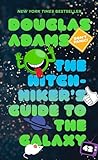
Douglas Adams was a British author and humorist whose The Hitchhiker's Guide to the Galaxy remains one of the most beloved works of comic science fiction ever written.
Douglas Adams began his career writing for British radio and television — including Doctor Who — before adapting and expanding his radio serial The Hitchhiker’s Guide to the Galaxy into a novel in 1979. The book follows Arthur Dent, an ordinary Englishman who survives the demolition of Earth (to make way for a hyperspace bypass) and travels the universe with his alien friend Ford Prefect, consulting the eponymous electronic guide along the way. The novel is simultaneously a satire of science fiction conventions, a philosophical comedy about the absurdity of existence, and one of the funniest books written in the English language.
Adams’s humor operates on multiple levels: the wordplay and the timing are precise, the philosophical jokes (the answer to life, the universe, and everything is 42; the question is never quite established) are genuinely thought-provoking, and the satirical targets — bureaucracy, consumer culture, the self-importance of intelligent beings — are hit with accuracy and affection. The Guide format, which gives Adams a voice to offer digressive asides on anything in the universe, is a structural masterstroke that allows his imagination to range freely. The book spawned four sequels of diminishing energy, plus a final posthumous completion, but the original novel stands entirely alone.
Adams notoriously struggled with deadlines and left his career somewhat incomplete — he died of a heart attack in 2001 at fifty-one. But The Hitchhiker’s Guide to the Galaxy is a rare thing: a book whose comedy has lasted for nearly fifty years without dating, because its targets are permanent features of human existence.
A Master of Comic Science Fiction
Douglas Adams was one of the most beloved and influential comic writers of the twentieth century, the creator of The Hitchhiker’s Guide to the Galaxy, a work that became a cultural phenomenon and a touchstone of comic science fiction. Renowned for his brilliant wit, his absurdist imagination, and his ability to combine hilarious comedy with genuine intelligence and surprising philosophical depth, Adams created fiction of enduring appeal and influence. His distinctive blend of science fiction, satire, and surreal humor has delighted millions of readers, and he remains one of the most quoted and cherished authors in the genre, his work having transcended science fiction to become a beloved part of popular culture.
The Hitchhiker’s Guide to the Galaxy
Adams’s masterpiece, The Hitchhiker’s Guide to the Galaxy, began as a radio comedy and grew into a series of novels that became a global phenomenon. Following the hapless Arthur Dent as he is swept across the galaxy after the destruction of Earth, the series combines absurdist humor, brilliant invention, and sharp satire of science fiction conventions and human folly. Its memorable characters, ideas, and jokes, from the answer to life, the universe, and everything being simply “42,” to the importance of always carrying a towel, have become part of popular culture, and the series remains the cornerstone of Adams’s enduring fame.
Absurdist Imagination
A defining feature of Adams’s work is his wildly absurdist, inventive imagination. His fiction overflows with brilliant, surreal concepts, improbable scenarios, and ingenious comic inventions that turn the conventions of science fiction on their head. From improbability drives to depressed robots to bureaucratic aliens, his imaginative creations are both hilarious and strangely insightful, and his ability to generate endless absurd yet logical ideas is central to his appeal. This boundless, playful imagination, combined with his comic timing, made his work uniquely delightful and influential, inspiring countless writers and comedians who followed.
Wit and Wordplay
Adams was a master of wit and wordplay, and his prose sparkles with clever, quotable lines, brilliant comic timing, and ingenious turns of phrase. His humor ranges from the silly to the sophisticated, often combining absurdity with sharp observation and a distinctive, droll voice. His writing is endlessly quotable, and his best lines have entered the common stock of comic reference. This verbal brilliance, his gift for the perfectly constructed joke and the memorable phrase, is central to the pleasure of his work and a key reason it has remained so beloved and so widely cited over the decades.
Comedy With Depth
Beneath the hilarity, Adams’s work carries genuine intelligence and surprising philosophical depth. His comedy often engages with real questions about existence, meaning, technology, and the absurdity of the universe and human life, using humor to explore ideas that more solemn writers approach with gravity. His satirical eye took in bureaucracy, technology, religion, and human folly, and his work reflects a sharp, skeptical, and thoughtful mind. This combination of genuine comedy with real intellectual substance distinguishes his work and gives it a lasting resonance beyond its considerable entertainment value.
A Lasting Influence
Adams’s influence on comic science fiction and on popular culture is immense. His distinctive blend of humor and science fiction inspired countless writers and shaped the genre’s comic tradition, and his ideas, characters, and phrases have permeated popular culture far beyond his readership. Beyond Hitchhiker’s, he created the comic detective Dirk Gently and championed causes including environmental conservation and technology. His relatively small body of work, cut short by his early death, has had an outsized and enduring impact, and his unique comic vision continues to delight new generations of readers.
Why Douglas Adams Endures
Douglas Adams’s influence on comic science fiction and popular culture is profound, and his work remains beloved for its wit, imagination, and surprising depth. For newcomers, The Hitchhiker’s Guide to the Galaxy is the essential starting point and the gateway to its sequels, while Dirk Gently’s Holistic Detective Agency offers his comic detective fiction. For readers seeking hilarious, brilliantly inventive, and surprisingly thoughtful comic science fiction that has delighted millions and shaped popular culture, Douglas Adams is an essential and irreplaceable author, one of the great comic imaginations of his time.
Reading Guides